 Add to Chrome
 Add to Firefox
 Add to Edge
Fix Representation (Optimally) Before Fairness: Finite-Sample Shrinkage Population Correction and the True Price of Fairness Under Subpopulation Shift
Feb 05, 2026
Machine learning practitioners frequently observe tension between predictive accuracy and group fairness constraints -- yet sometimes fairness interventions appear to improve accuracy. We show that both phenomena can be artifacts of training data that misrepresents subgroup proportions. Under subpopulation shift (stable within-group distributions, shifted group proportions), we establish: (i) full importance-weighted correction is asymptotically unbiased but finite-sample suboptimal; (ii) the optimal finite-sample correction is a shrinkage reweighting that interpolates between target and training mixtures; (iii) apparent "fairness helps accuracy" can arise from comparing fairness methods to an improperly-weighted baseline. We provide an actionable evaluation protocol: fix representation (optimally) before fairness -- compare fairness interventions against a shrinkage-corrected baseline to isolate the true, irreducible price of fairness. Experiments on synthetic and real-world benchmarks (Adult, COMPAS) validate our theoretical predictions and demonstrate that this protocol eliminates spurious tradeoffs, revealing the genuine fairness-utility frontier.

Fairness Under Group-Conditional Prior Probability Shift: Invariance, Drift, and Target-Aware Post-Processing
Feb 05, 2026Machine learning systems are often trained and evaluated for fairness on historical data, yet deployed in environments where conditions have shifted. A particularly common form of shift occurs when the prevalence of positive outcomes changes differently across demographic groups--for example, when disease rates rise faster in one population than another, or when economic conditions affect loan default rates unequally. We study group-conditional prior probability shift (GPPS), where the label prevalence $P(Y=1\mid A=a)$ may change between training and deployment while the feature-generation process $P(X\mid Y,A)$ remains stable. Our analysis yields three main contributions. First, we prove a fundamental dichotomy: fairness criteria based on error rates (equalized odds) are structurally invariant under GPPS, while acceptance-rate criteria (demographic parity) can drift--and we prove this drift is unavoidable for non-trivial classifiers (shift-robust impossibility). Second, we show that target-domain risk and fairness metrics are identifiable without target labels: the invariance of ROC quantities under GPPS enables consistent estimation from source labels and unlabeled target data alone, with finite-sample guarantees. Third, we propose TAP-GPPS, a label-free post-processing algorithm that estimates prevalences from unlabeled data, corrects posteriors, and selects thresholds to satisfy demographic parity in the target domain. Experiments validate our theoretical predictions and demonstrate that TAP-GPPS achieves target fairness with minimal utility loss.
Projected Boosting with Fairness Constraints: Quantifying the Cost of Fair Training Distributions
Feb 05, 2026Boosting algorithms enjoy strong theoretical guarantees: when weak learners maintain positive edge, AdaBoost achieves geometric decrease of exponential loss. We study how to incorporate group fairness constraints into boosting while preserving analyzable training dynamics. Our approach, FairBoost, projects the ensemble-induced exponential-weights distribution onto a convex set of distributions satisfying fairness constraints (as a reweighting surrogate), then trains weak learners on this fair distribution. The key theoretical insight is that projecting the training distribution reduces the effective edge of weak learners by a quantity controlled by the KL-divergence of the projection. We prove an exponential-loss bound where the convergence rate depends on weak learner edge minus a "fairness cost" term $δ_t = \sqrt{\mathrm{KL}(w^t \| q^t)/2}$. This directly quantifies the accuracy-fairness tradeoff in boosting dynamics. Experiments on standard benchmarks validate the theoretical predictions and demonstrate competitive fairness-accuracy tradeoffs with stable training curves.
DAG DECORation: Continuous Optimization for Structure Learning under Hidden Confounding
Oct 02, 2025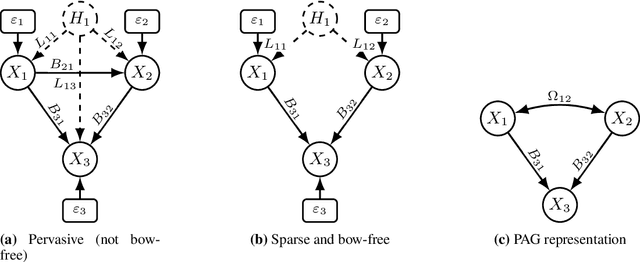
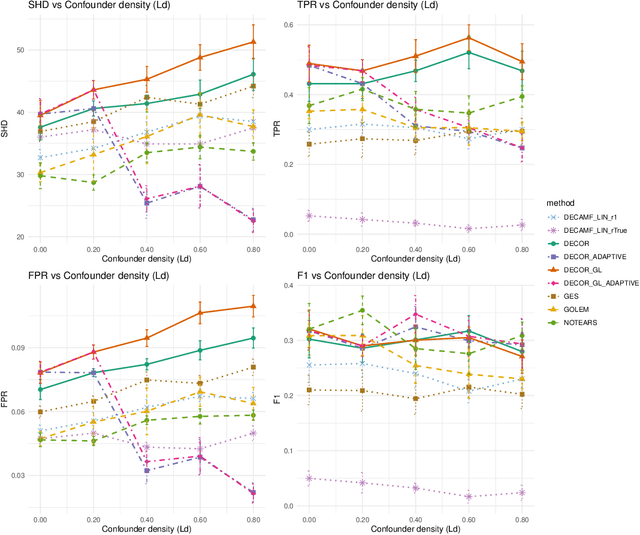
We study structure learning for linear Gaussian SEMs in the presence of latent confounding. Existing continuous methods excel when errors are independent, while deconfounding-first pipelines rely on pervasive factor structure or nonlinearity. We propose \textsc{DECOR}, a single likelihood-based and fully differentiable estimator that jointly learns a DAG and a correlated noise model. Our theory gives simple sufficient conditions for global parameter identifiability: if the mixed graph is bow free and the noise covariance has a uniform eigenvalue margin, then the map from $(\B,\OmegaMat)$ to the observational covariance is injective, so both the directed structure and the noise are uniquely determined. The estimator alternates a smooth-acyclic graph update with a convex noise update and can include a light bow complementarity penalty or a post hoc reconciliation step. On synthetic benchmarks that vary confounding density, graph density, latent rank, and dimension with $n<p$, \textsc{DECOR} matches or outperforms strong baselines and is especially robust when confounding is non-pervasive, while remaining competitive under pervasiveness.
Conversation Games and a Strategic View of the Turing Test
Jan 30, 2025Although many game-theoretic models replicate real interactions that often rely on natural language, explicit study of games where language is central to strategic interaction remains limited. This paper introduces the \emph{conversation game}, a multi-stage, extensive-form game based on linguistic strategic interaction. We focus on a subset of the games, called verdict games. In a verdict game, two players alternate to contribute to a conversation, which is evaluated at each stage by a non-strategic judge who may render a conclusive binary verdict, or a decision to continue the dialogue. The game ends once a limit is reached or a verdict is given. We show many familiar processes, such as interrogation or a court process fall under this category. We also, show that the Turing test is an instance of verdict game, and discuss the significance of a strategic view of the Turing test in the age of advanced AI deception. We show the practical relevance of the proposed concepts by simulation experiments, and show that a strategic agent outperforms a naive agent by a high margin.
Using Large Language Models for OntoClean-based Ontology Refinement
Mar 23, 2024This paper explores the integration of Large Language Models (LLMs) such as GPT-3.5 and GPT-4 into the ontology refinement process, specifically focusing on the OntoClean methodology. OntoClean, critical for assessing the metaphysical quality of ontologies, involves a two-step process of assigning meta-properties to classes and verifying a set of constraints. Manually conducting the first step proves difficult in practice, due to the need for philosophical expertise and lack of consensus among ontologists. By employing LLMs with two prompting strategies, the study demonstrates that high accuracy in the labelling process can be achieved. The findings suggest the potential for LLMs to enhance ontology refinement, proposing the development of plugin software for ontology tools to facilitate this integration.