 Add to Chrome
 Add to Firefox
 Add to Edge
Zero-shot large vision-language model prompting for automated bone identification in paleoradiology x-ray archives
Feb 03, 2026
Paleoradiology, the use of modern imaging technologies to study archaeological and anthropological remains, offers new windows on millennial scale patterns of human health. Unfortunately, the radiographs collected during field campaigns are heterogeneous: bones are disarticulated, positioning is ad hoc, and laterality markers are often absent. Additionally, factors such as age at death, age of bone, sex, and imaging equipment introduce high variability. Thus, content navigation, such as identifying a subset of images with a specific projection view, can be time consuming and difficult, making efficient triaging a bottleneck for expert analysis. We report a zero shot prompting strategy that leverages a state of the art Large Vision Language Model (LVLM) to automatically identify the main bone, projection view, and laterality in such images. Our pipeline converts raw DICOM files to bone windowed PNGs, submits them to the LVLM with a carefully engineered prompt, and receives structured JSON outputs, which are extracted and formatted onto a spreadsheet in preparation for validation. On a random sample of 100 images reviewed by an expert board certified paleoradiologist, the system achieved 92% main bone accuracy, 80% projection view accuracy, and 100% laterality accuracy, with low or medium confidence flags for ambiguous cases. These results suggest that LVLMs can substantially accelerate code word development for large paleoradiology datasets, allowing for efficient content navigation in future anthropology workflows.

Brain age identification from diffusion MRI synergistically predicts neurodegenerative disease
Oct 29, 2024
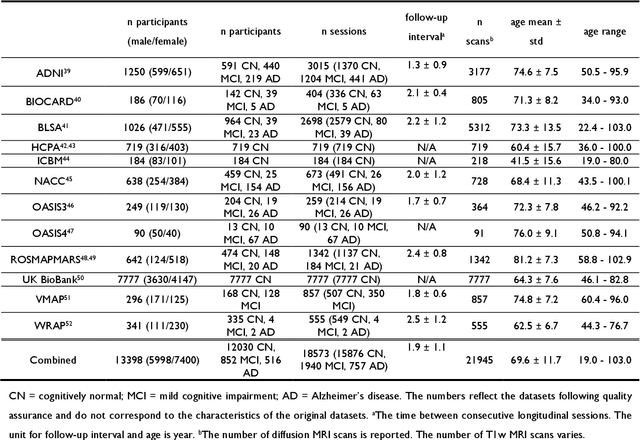

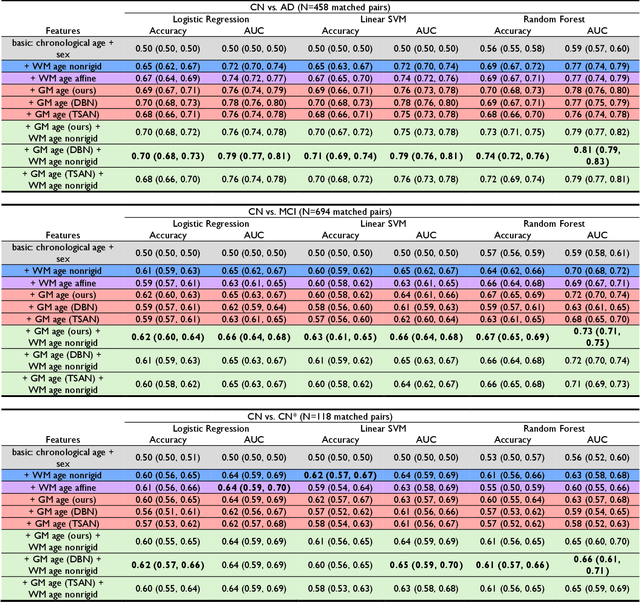
Estimated brain age from magnetic resonance image (MRI) and its deviation from chronological age can provide early insights into potential neurodegenerative diseases, supporting early detection and implementation of prevention strategies. Diffusion MRI (dMRI), a widely used modality for brain age estimation, presents an opportunity to build an earlier biomarker for neurodegenerative disease prediction because it captures subtle microstructural changes that precede more perceptible macrostructural changes. However, the coexistence of macro- and micro-structural information in dMRI raises the question of whether current dMRI-based brain age estimation models are leveraging the intended microstructural information or if they inadvertently rely on the macrostructural information. To develop a microstructure-specific brain age, we propose a method for brain age identification from dMRI that minimizes the model's use of macrostructural information by non-rigidly registering all images to a standard template. Imaging data from 13,398 participants across 12 datasets were used for the training and evaluation. We compare our brain age models, trained with and without macrostructural information minimized, with an architecturally similar T1-weighted (T1w) MRI-based brain age model and two state-of-the-art T1w MRI-based brain age models that primarily use macrostructural information. We observe difference between our dMRI-based brain age and T1w MRI-based brain age across stages of neurodegeneration, with dMRI-based brain age being older than T1w MRI-based brain age in participants transitioning from cognitively normal (CN) to mild cognitive impairment (MCI), but younger in participants already diagnosed with Alzheimer's disease (AD). Approximately 4 years before MCI diagnosis, dMRI-based brain age yields better performance than T1w MRI-based brain ages in predicting transition from CN to MCI.
Predicting Age from White Matter Diffusivity with Residual Learning
Nov 06, 2023Imaging findings inconsistent with those expected at specific chronological age ranges may serve as early indicators of neurological disorders and increased mortality risk. Estimation of chronological age, and deviations from expected results, from structural MRI data has become an important task for developing biomarkers that are sensitive to such deviations. Complementary to structural analysis, diffusion tensor imaging (DTI) has proven effective in identifying age-related microstructural changes within the brain white matter, thereby presenting itself as a promising additional modality for brain age prediction. Although early studies have sought to harness DTI's advantages for age estimation, there is no evidence that the success of this prediction is owed to the unique microstructural and diffusivity features that DTI provides, rather than the macrostructural features that are also available in DTI data. Therefore, we seek to develop white-matter-specific age estimation to capture deviations from normal white matter aging. Specifically, we deliberately disregard the macrostructural information when predicting age from DTI scalar images, using two distinct methods. The first method relies on extracting only microstructural features from regions of interest. The second applies 3D residual neural networks (ResNets) to learn features directly from the images, which are non-linearly registered and warped to a template to minimize macrostructural variations. When tested on unseen data, the first method yields mean absolute error (MAE) of 6.11 years for cognitively normal participants and MAE of 6.62 years for cognitively impaired participants, while the second method achieves MAE of 4.69 years for cognitively normal participants and MAE of 4.96 years for cognitively impaired participants. We find that the ResNet model captures subtler, non-macrostructural features for brain age prediction.