 Add to Chrome
 Add to Firefox
 Add to Edge
The role of System 1 and System 2 semantic memory structure in human and LLM biases
Apr 14, 2026
Implicit biases in both humans and large language models (LLMs) pose significant societal risks. Dual process theories propose that biases arise primarily from associative System 1 thinking, while deliberative System 2 thinking mitigates bias, but the cognitive mechanisms that give rise to this phenomenon remain poorly understood. To better understand what underlies this duality in humans, and possibly in LLMs, we model System 1 and System 2 thinking as semantic memory networks with distinct structures, built from comparable datasets generated by both humans and LLMs. We then investigate how these distinct semantic memory structures relate to implicit gender bias using network-based evaluation metrics. We find that semantic memory structures are irreducible only in humans, suggesting that LLMs lack certain types of human-like conceptual knowledge. Moreover, semantic memory structure relates consistently to implicit bias only in humans, with lower levels of bias in System~2 structures. These findings suggest that certain types of conceptual knowledge contribute to bias regulation in humans, but not in LLMs, highlighting fundamental differences between human and machine cognition.

The "LLM World of Words" English free association norms generated by large language models
Dec 02, 2024Free associations have been extensively used in cognitive psychology and linguistics for studying how conceptual knowledge is organized. Recently, the potential of applying a similar approach for investigating the knowledge encoded in LLMs has emerged, specifically as a method for investigating LLM biases. However, the absence of large-scale LLM-generated free association norms that are comparable with human-generated norms is an obstacle to this new research direction. To address this limitation, we create a new dataset of LLM-generated free association norms modeled after the "Small World of Words" (SWOW) human-generated norms consisting of approximately 12,000 cue words. We prompt three LLMs, namely Mistral, Llama3, and Haiku, with the same cues as those in the SWOW norms to generate three novel comparable datasets, the "LLM World of Words" (LWOW). Using both SWOW and LWOW norms, we construct cognitive network models of semantic memory that represent the conceptual knowledge possessed by humans and LLMs. We demonstrate how these datasets can be used for investigating implicit biases in humans and LLMs, such as the harmful gender stereotypes that are prevalent both in society and LLM outputs.
Y Social: an LLM-powered Social Media Digital Twin
Aug 01, 2024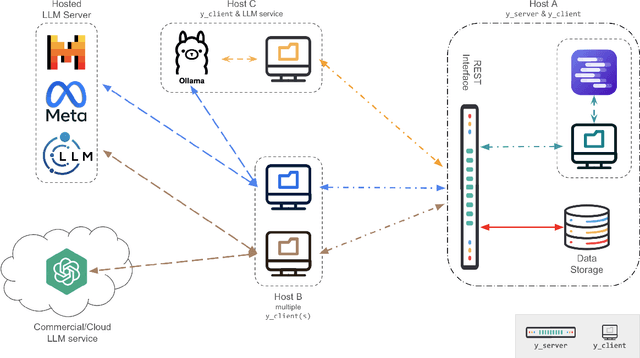
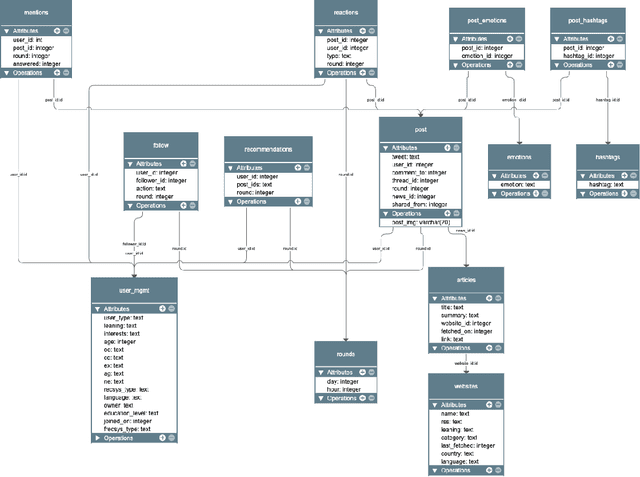
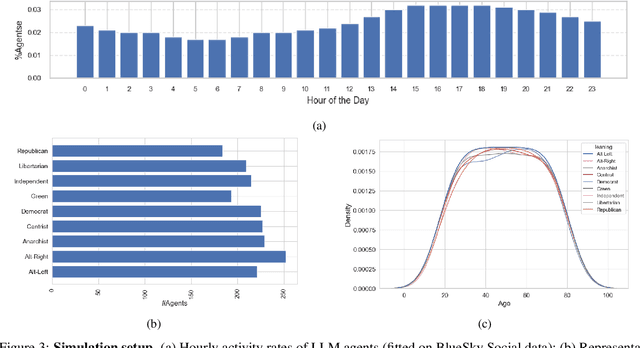
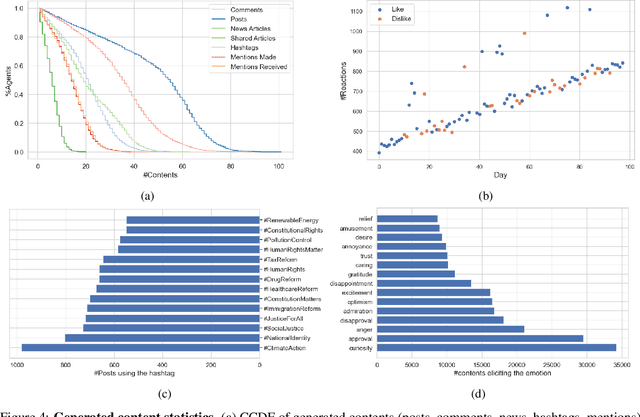
In this paper we introduce Y, a new-generation digital twin designed to replicate an online social media platform. Digital twins are virtual replicas of physical systems that allow for advanced analyses and experimentation. In the case of social media, a digital twin such as Y provides a powerful tool for researchers to simulate and understand complex online interactions. {\tt Y} leverages state-of-the-art Large Language Models (LLMs) to replicate sophisticated agent behaviors, enabling accurate simulations of user interactions, content dissemination, and network dynamics. By integrating these aspects, Y offers valuable insights into user engagement, information spread, and the impact of platform policies. Moreover, the integration of LLMs allows Y to generate nuanced textual content and predict user responses, facilitating the study of emergent phenomena in online environments. To better characterize the proposed digital twin, in this paper we describe the rationale behind its implementation, provide examples of the analyses that can be performed on the data it enables to be generated, and discuss its relevance for multidisciplinary research.
From Perils to Possibilities: Understanding how Human (and AI) Biases affect Online Fora
Mar 21, 2024Social media platforms are online fora where users engage in discussions, share content, and build connections. This review explores the dynamics of social interactions, user-generated contents, and biases within the context of social media analysis (analyzing works that use the tools offered by complex network analysis and natural language processing) through the lens of three key points of view: online debates, online support, and human-AI interactions. On the one hand, we delineate the phenomenon of online debates, where polarization, misinformation, and echo chamber formation often proliferate, driven by algorithmic biases and extreme mechanisms of homophily. On the other hand, we explore the emergence of online support groups through users' self-disclosure and social support mechanisms. Online debates and support mechanisms present a duality of both perils and possibilities within social media; perils of segregated communities and polarized debates, and possibilities of empathy narratives and self-help groups. This dichotomy also extends to a third perspective: users' reliance on AI-generated content, such as the ones produced by Large Language Models, which can manifest both human biases hidden in training sets and non-human biases that emerge from their artificial neural architectures. Analyzing interdisciplinary approaches, we aim to deepen the understanding of the complex interplay between social interactions, user-generated content, and biases within the realm of social media ecosystems.