 Add to Chrome
 Add to Firefox
 Add to Edge
Efficient Logic Gate Networks for Video Copy Detection
Apr 23, 2026
Video copy detection requires robust similarity estimation under diverse visual distortions while operating at very large scale. Although deep neural networks achieve strong performance, their computational cost and descriptor size limit practical deployment in high-throughput systems. In this work, we propose a video copy detection framework based on differentiable Logic Gate Networks (LGNs), which replace conventional floating-point feature extractors with compact, logic-based representations. Our approach combines aggressive frame miniaturization, binary preprocessing, and a trainable LGN embedding model that learns both logical operations and interconnections. After training, the model can be discretized into a purely Boolean circuit, enabling extremely fast and memory-efficient inference. We systematically evaluate different similarity strategies, binarization schemes, and LGN architectures across multiple dataset folds and difficulty levels. Experimental results demonstrate that LGN-based models achieve competitive or superior accuracy and ranking performance compared to prior models, while producing descriptors several orders of magnitude smaller and delivering inference speeds exceeding 11k samples per second. These findings indicate that logic-based models offer a promising alternative for scalable and resource-efficient video copy detection.

LILogic Net: Compact Logic Gate Networks with Learnable Connectivity for Efficient Hardware Deployment
Nov 15, 2025Efficient deployment of machine learning models ultimately requires taking hardware constraints into account. The binary logic gate is the fundamental building block of all digital chips. Designing models that operate directly on these units enables energy-efficient computation. Recent work has demonstrated the feasibility of training randomly connected networks of binary logic gates (such as OR and NAND) using gradient-based methods. We extend this approach by using gradient descent not only to select the logic gates but also to optimize their interconnections (the connectome). Optimizing the connections allows us to substantially reduce the number of logic gates required to fit a particular dataset. Our implementation is efficient both at training and inference: for instance, our LILogicNet model with only 8,000 gates can be trained on MNIST in under 5 minutes and achieves 98.45% test accuracy, matching the performance of state-of-the-art models that require at least two orders of magnitude more gates. Moreover, for our largest architecture with 256,000 gates, LILogicNet achieves 60.98% test accuracy on CIFAR-10 exceeding the performance of prior logic-gate-based models with a comparable gate budget. At inference time, the fully binarized model operates with minimal compute overhead, making it exceptionally efficient and well suited for deployment on low-power digital hardware.
Counteracting temporal attacks in Video Copy Detection
Jan 19, 2025

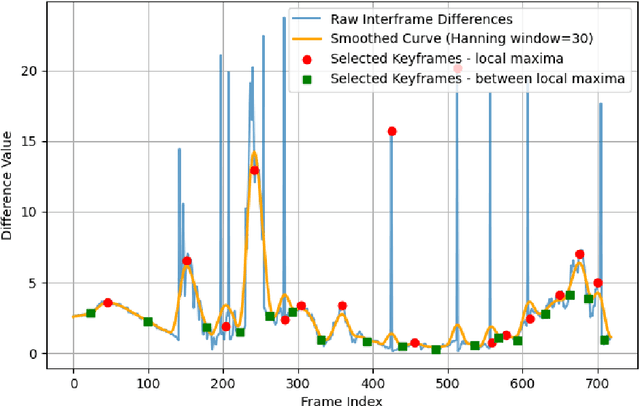

Video Copy Detection (VCD) plays a crucial role in copyright protection and content verification by identifying duplicates and near-duplicates in large-scale video databases. The META AI Challenge on video copy detection provided a benchmark for evaluating state-of-the-art methods, with the Dual-level detection approach emerging as a winning solution. This method integrates Video Editing Detection and Frame Scene Detection to handle adversarial transformations and large datasets efficiently. However, our analysis reveals significant limitations in the VED component, particularly in its ability to handle exact copies. Moreover, Dual-level detection shows vulnerability to temporal attacks. To address it, we propose an improved frame selection strategy based on local maxima of interframe differences, which enhances robustness against adversarial temporal modifications while significantly reducing computational overhead. Our method achieves an increase of 1.4 to 5.8 times in efficiency over the standard 1 FPS approach. Compared to Dual-level detection method, our approach maintains comparable micro-average precision ($\mu$AP) while also demonstrating improved robustness against temporal attacks. Given 56\% reduced representation size and the inference time of more than 2 times faster, our approach is more suitable to real-world resource restriction.