 Add to Chrome
 Add to Firefox
 Add to Edge
Discovery of Decision Synchronization Patterns from Event Logs
Mar 20, 2026
Synchronizing decisions between running cases in business processes facilitates fair and efficient use of resources, helps prioritize the most valuable cases, and prevents unnecessary waiting. Consequently, decision synchronization patterns are regularly built into processes, in the form of mechanisms that temporarily delay one case to favor another. These decision mechanisms therefore consider properties of multiple cases at once, rather than just the properties of a single case; an aspect that is rarely addressed by current process discovery techniques. To address this gap, this paper proposes an approach for discovering decision synchronization patterns inspired by supply chain processes. These decision synchronization patterns take the form of specific process constructs combined with a constraint that determines which particular case to execute. We describe, formalize and demonstrate how the constraint for four such patterns can be discovered. We evaluate our approach in two artificial scenarios. First, with four separate process models each containing a single decision synchronization pattern, i.e., we demonstrate that our approach can discover every type of pattern when only this one type is present. Second, we consider a process model containing all four decision synchronization patterns to show generalizability of the approach to more complex problems. For both scenarios, we could reliably retrieve the expected patterns.

Model-Driven Engineering for Artificial Intelligence -- A Systematic Literature Review
Jul 10, 2023Objective: This study aims to investigate the existing body of knowledge in the field of Model-Driven Engineering MDE in support of AI (MDE4AI) to sharpen future research further and define the current state of the art. Method: We conducted a Systemic Literature Review (SLR), collecting papers from five major databases resulting in 703 candidate studies, eventually retaining 15 primary studies. Each primary study will be evaluated and discussed with respect to the adoption of (1) MDE principles and practices and (2) the phases of AI development support aligned with the stages of the CRISP-DM methodology. Results: The study's findings show that the pillar concepts of MDE (metamodel, concrete syntax and model transformation), are leveraged to define domain-specific languages (DSL) explicitly addressing AI concerns. Different MDE technologies are used, leveraging different language workbenches. The most prominent AI-related concerns are training and modeling of the AI algorithm, while minor emphasis is given to the time-consuming preparation of the data sets. Early project phases that support interdisciplinary communication of requirements, such as the CRISP-DM \textit{Business Understanding} phase, are rarely reflected. Conclusion: The study found that the use of MDE for AI is still in its early stages, and there is no single tool or method that is widely used. Additionally, current approaches tend to focus on specific stages of development rather than providing support for the entire development process. As a result, the study suggests several research directions to further improve the use of MDE for AI and to guide future research in this area.
Predictive Compliance Monitoring in Process-Aware Information Systems: State of the Art, Functionalities, Research Directions
May 10, 2022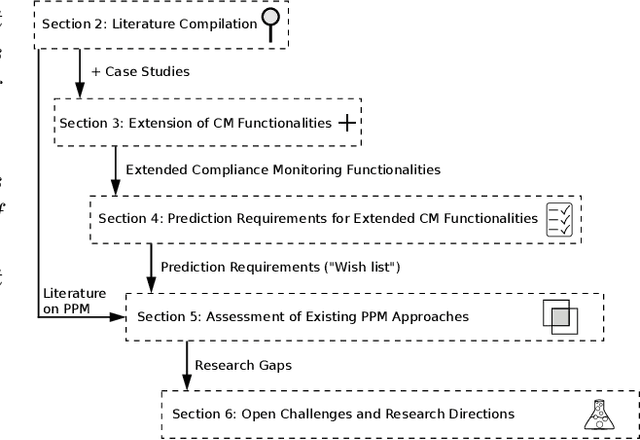
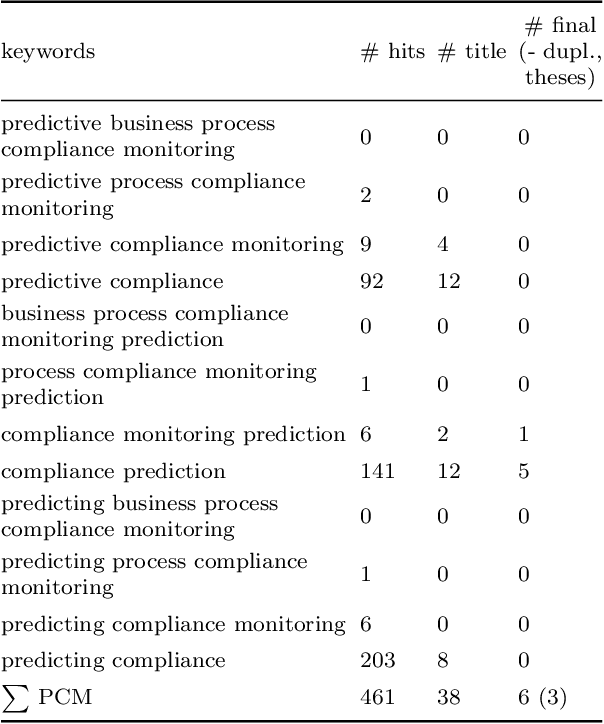
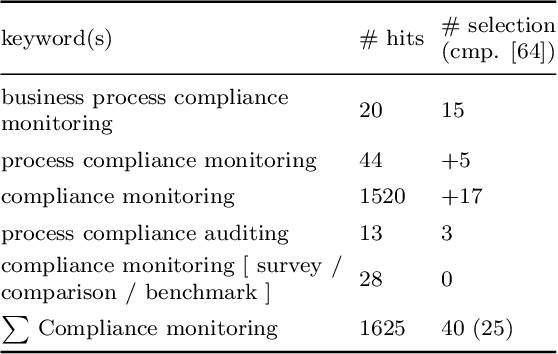
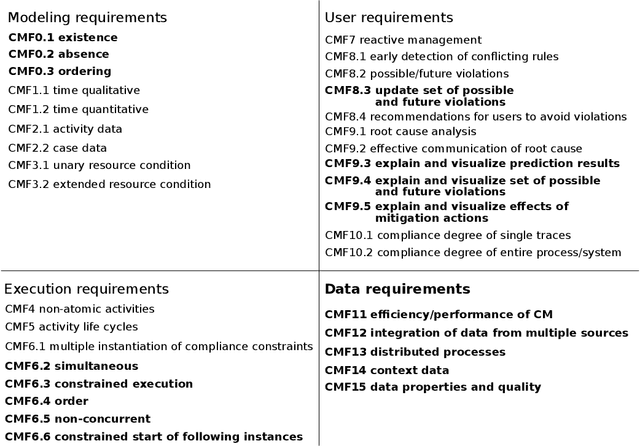
Business process compliance is a key area of business process management and aims at ensuring that processes obey to compliance constraints such as regulatory constraints or business rules imposed on them. Process compliance can be checked during process design time based on verification of process models and at runtime based on monitoring the compliance states of running process instances. For existing compliance monitoring approaches it remains unclear whether and how compliance violations can be predicted, although predictions are crucial in order to prepare and take countermeasures in time. This work, hence, analyzes existing literature from compliance and SLA monitoring as well as predictive process monitoring and provides an updated framework of compliance monitoring functionalities. For each compliance monitoring functionality we elicit prediction requirements and analyze their coverage by existing approaches. Based on this analysis, open challenges and research directions for predictive compliance and process monitoring are elaborated.
Untangling the GDPR Using ConRelMiner
Nov 08, 2018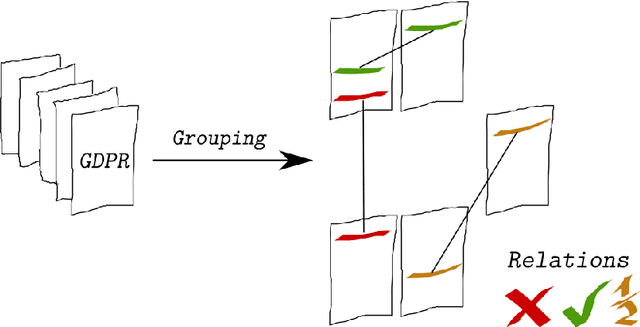
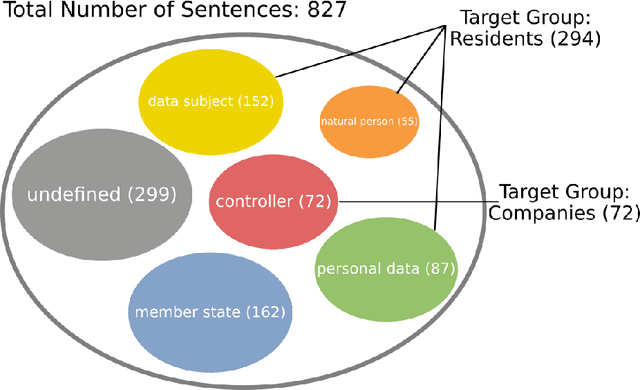
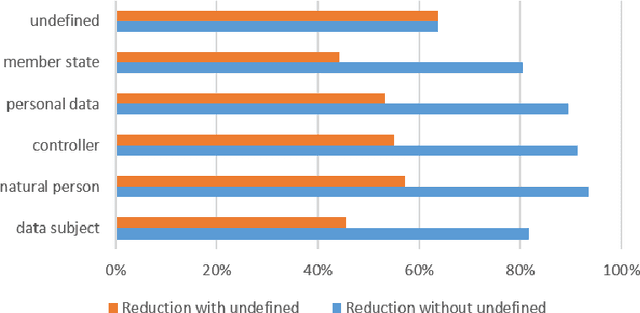
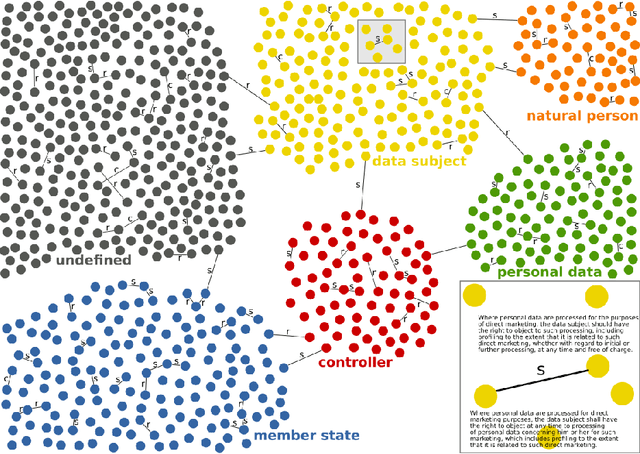
The General Data Protection Regulation (GDPR) poses enormous challenges on companies and organizations with respect to understanding, implementing, and maintaining the contained constraints. We report on how the ConRelMiner method can be used for untangling the GDPR. For this, the GDPR is filtered and grouped along the roles mentioned by the GDPR and the reduction of sentences to be read by analysts is shown. Moreover, the output of the ConRelMiner - a cluster graph with relations between the sentences - is displayed and interpreted. Overall the goal is to illustrate how the effort for implementing the GDPR can be reduced and a structured and meaningful representation of the relevant GDPR sentences can be found.