 Add to Chrome
 Add to Firefox
 Add to Edge
From Knowledge to Action: Outcomes of the 2025 Large Language Model (LLM) Hackathon for Applications in Materials Science and Chemistry
May 04, 2026
Large language models (LLMs) are rapidly changing how researchers in materials science and chemistry discover, organize, and act on scientific knowledge. This paper analyzes a broad set of community-developed LLM applications in an effort to identify emerging patterns in how these systems can be used across the scientific research lifecycle. We organize the projects into two complementary categories: Knowledge Infrastructure, systems that structure, retrieve, synthesize, and validate scientific information; and Action Systems, systems that execute, coordinate, or automate scientific work across computational and experimental environments. The submissions reveal a shift from single-purpose LLM tools toward integrated, multi-agent workflows that combine retrieval, reasoning, tool use, and domain-specific validation. Prominent themes include retrieval-augmented generation as grounding infrastructure, persistent structured knowledge representations, multimodal and multilingual scientific inputs, and early progress toward laboratory-integrated closed-loop systems. Together, these results suggest that LLMs are evolving from general-purpose assistants into composable infrastructure for scientific reasoning and action. This work provides a community snapshot of that transition and a practical taxonomy for understanding emerging LLM-enabled workflows in materials science and chemistry.

A Granular Framework for Construction Material Price Forecasting: Econometric and Machine-Learning Approaches
Dec 10, 2025The persistent volatility of construction material prices poses significant risks to cost estimation, budgeting, and project delivery, underscoring the urgent need for granular and scalable forecasting methods. This study develops a forecasting framework that leverages the Construction Specifications Institute (CSI) MasterFormat as the target data structure, enabling predictions at the six-digit section level and supporting detailed cost projections across a wide spectrum of building materials. To enhance predictive accuracy, the framework integrates explanatory variables such as raw material prices, commodity indexes, and macroeconomic indicators. Four time-series models, Long Short-Term Memory (LSTM), Autoregressive Integrated Moving Average (ARIMA), Vector Error Correction Model (VECM), and Chronos-Bolt, were evaluated under both baseline configurations (using CSI data only) and extended versions with explanatory variables. Results demonstrate that incorporating explanatory variables significantly improves predictive performance across all models. Among the tested approaches, the LSTM model consistently achieved the highest accuracy, with RMSE values as low as 1.390 and MAPE values of 0.957, representing improvements of up to 59\% over the traditional statistical time-series model, ARIMA. Validation across multiple CSI divisions confirmed the framework's scalability, while Division 06 (Wood, Plastics, and Composites) is presented in detail as a demonstration case. This research offers a robust methodology that enables owners and contractors to improve budgeting practices and achieve more reliable cost estimation at the Definitive level.
Statistical learning method for predicting density-matrix based electron dynamics
Jul 31, 2021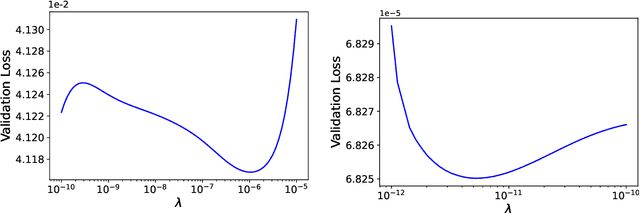

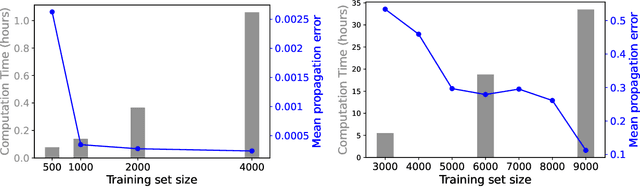
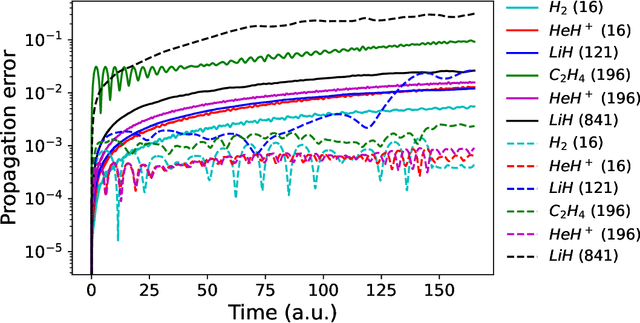
We develop a statistical method to learn a molecular Hamiltonian matrix from a time-series of electron density matrices. We extend our previous method to larger molecular systems by incorporating physical properties to reduce dimensionality, while also exploiting regularization techniques like ridge regression for addressing multicollinearity. With the learned Hamiltonian we can solve the Time-Dependent Hartree-Fock (TDHF) equation to propagate the electron density in time, and predict its dynamics for field-free and field-on scenarios. We observe close quantitative agreement between the predicted dynamics and ground truth for both field-off trajectories similar to the training data, and field-on trajectories outside of the training data.
Machine Learning a Molecular Hamiltonian for Predicting Electron Dynamics
Aug 31, 2020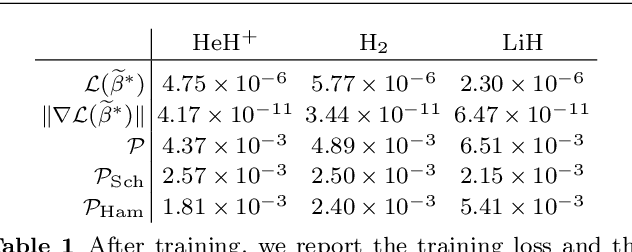
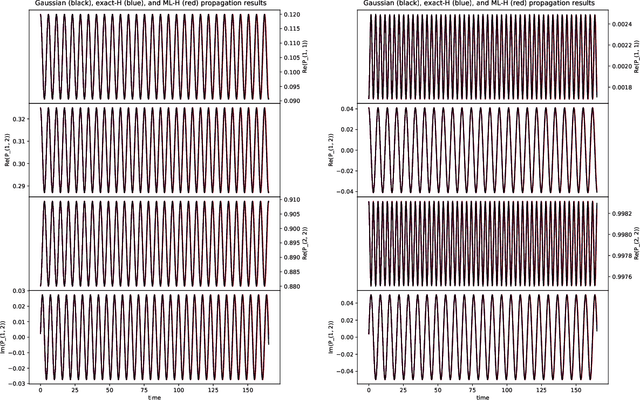
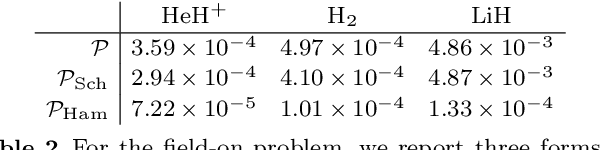
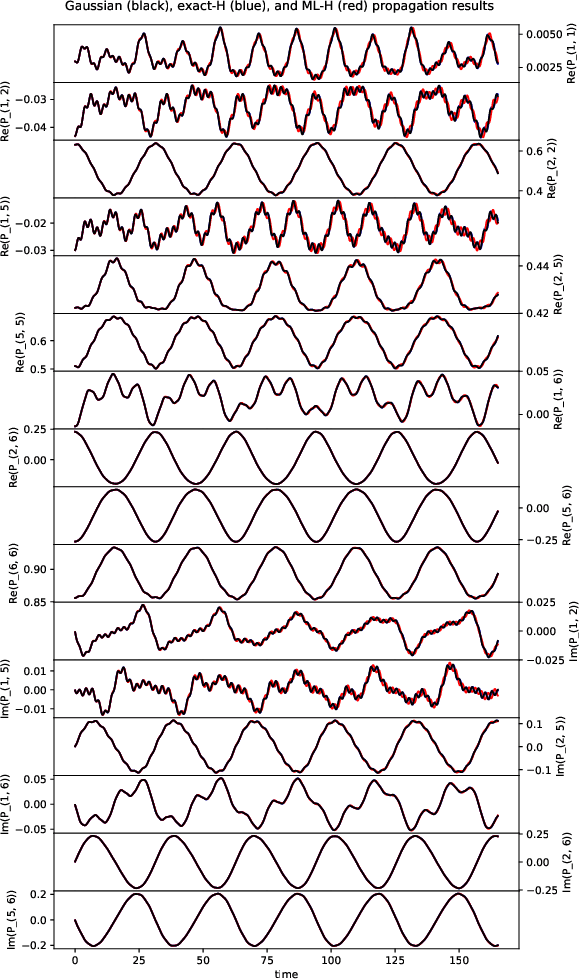
We develop a computational method to learn a molecular Hamiltonian matrix from matrix-valued time series of the electron density. As we demonstrate for three small molecules, the resulting Hamiltonians can be used for electron density evolution, producing highly accurate results even when propagating 1000 time steps beyond the training data. As a more rigorous test, we use the learned Hamiltonians to simulate electron dynamics in the presence of an applied electric field, extrapolating to a problem that is beyond the field-free training data. We find that the resulting electron dynamics predicted by our learned Hamiltonian are in close quantitative agreement with the ground truth. Our method relies on combining a reduced-dimensional, linear statistical model of the Hamiltonian with a time-discretization of the quantum Liouville equation within time-dependent Hartree Fock theory. We train the model using a least-squares solver, avoiding numerous, CPU-intensive optimization steps. For both field-free and field-on problems, we quantify training and propagation errors, highlighting areas for future development.