 Add to Chrome
 Add to Firefox
 Add to Edge
DISCODE: Distribution-Aware Score Decoder for Robust Automatic Evaluation of Image Captioning
Dec 16, 2025
Large vision-language models (LVLMs) have shown impressive performance across a broad range of multimodal tasks. However, robust image caption evaluation using LVLMs remains challenging, particularly under domain-shift scenarios. To address this issue, we introduce the Distribution-Aware Score Decoder (DISCODE), a novel finetuning-free method that generates robust evaluation scores better aligned with human judgments across diverse domains. The core idea behind DISCODE lies in its test-time adaptive evaluation approach, which introduces the Adaptive Test-Time (ATT) loss, leveraging a Gaussian prior distribution to improve robustness in evaluation score estimation. This loss is efficiently minimized at test time using an analytical solution that we derive. Furthermore, we introduce the Multi-domain Caption Evaluation (MCEval) benchmark, a new image captioning evaluation benchmark covering six distinct domains, designed to assess the robustness of evaluation metrics. In our experiments, we demonstrate that DISCODE achieves state-of-the-art performance as a reference-free evaluation metric across MCEval and four representative existing benchmarks.

Multi-Point Positional Insertion Tuning for Small Object Detection
Dec 24, 2024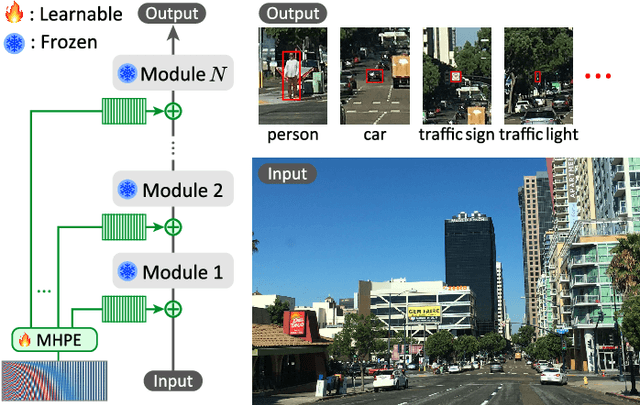

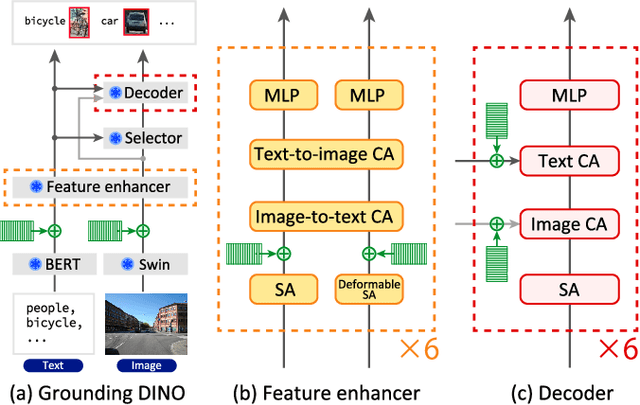

Small object detection aims to localize and classify small objects within images. With recent advances in large-scale vision-language pretraining, finetuning pretrained object detection models has emerged as a promising approach. However, finetuning large models is computationally and memory expensive. To address this issue, this paper introduces multi-point positional insertion (MPI) tuning, a parameter-efficient finetuning (PEFT) method for small object detection. Specifically, MPI incorporates multiple positional embeddings into a frozen pretrained model, enabling the efficient detection of small objects by providing precise positional information to latent features. Through experiments, we demonstrated the effectiveness of the proposed method on the SODA-D dataset. MPI performed comparably to conventional PEFT methods, including CoOp and VPT, while significantly reducing the number of parameters that need to be tuned.