 Add to Chrome
 Add to Firefox
 Add to Edge
Natural Language Interfaces for Spatial and Temporal Databases: A Comprehensive Overview of Methods, Taxonomy, and Future Directions
Mar 24, 2026
The task of building a natural language interface to a database, known as NLIDB, has recently gained significant attention from both the database and Natural Language Processing (NLP) communities. With the proliferation of geospatial datasets driven by the rapid emergence of location-aware sensors, geospatial databases play a vital role in supporting geospatial applications. However, querying geospatial and temporal databases differs substantially from querying traditional relational databases due to the presence of geospatial topological operators and temporal operators. To bridge the gap between geospatial query languages and non-expert users, the geospatial research community has increasingly focused on developing NLIDBs for geospatial databases. Yet, existing research remains fragmented across systems, datasets, and methodological choices, making it difficult to clearly understand the landscape of existing methods, their strengths and weaknesses, and opportunities for future research. Existing surveys on NLIDBs focus on general-purpose database systems and do not treat geospatial and temporal databases as primary focus for analysis. To address this gap, this paper presents a comprehensive survey of studies on NLIDBs for geospatial and temporal databases. Specifically, we provide a detailed overview of datasets, evaluation metrics, and the taxonomy of the methods for geospatial and temporal NLIDBs, as well as a comparative analysis of the existing methods. Our survey reveals recurring trends in existing methods, substantial variation in datasets and evaluation practices, and several open challenges that continue to hinder progress in this area. Based on these findings, we identify promising directions for future research to advance natural language interfaces to geospatial and temporal databases.

Evaluating Deep Learning in SystemML using Layer-wise Adaptive Rate Scaling(LARS) Optimizer
Feb 05, 2021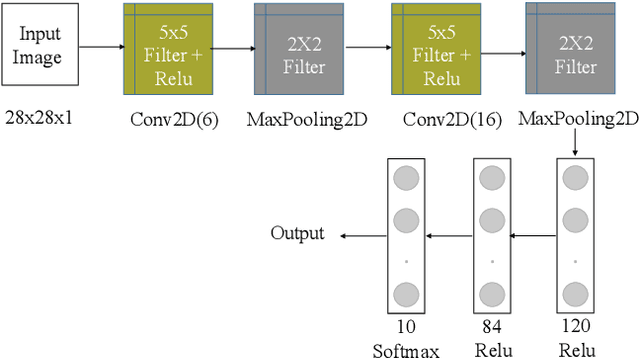
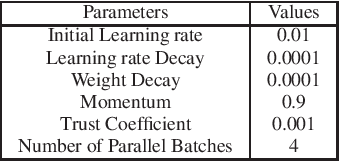
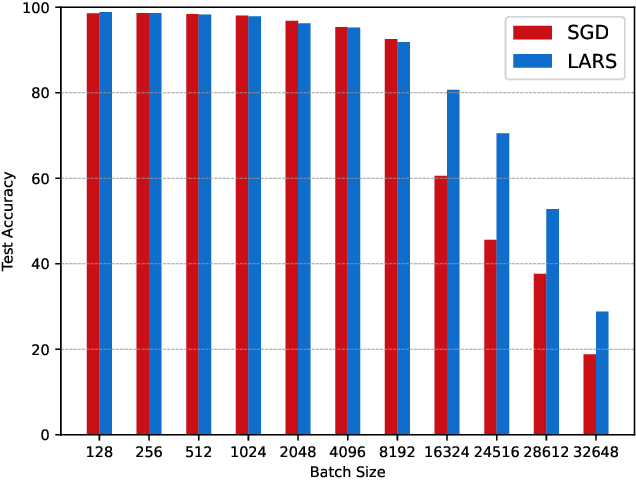
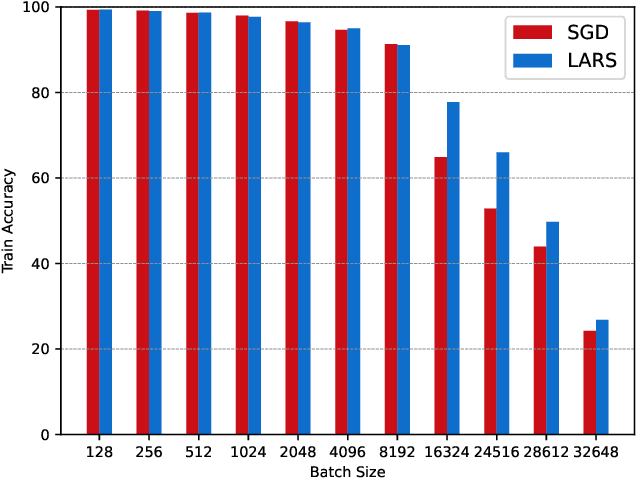
Increasing the batch size of a deep learning model is a challenging task. Although it might help in utilizing full available system memory during training phase of a model, it results in significant loss of test accuracy most often. LARS solved this issue by introducing an adaptive learning rate for each layer of a deep learning model. However, there are doubts on how popular distributed machine learning systems such as SystemML or MLlib will perform with this optimizer. In this work, we apply LARS optimizer to a deep learning model implemented using SystemML.We perform experiments with various batch sizes and compare the performance of LARS optimizer with \textit{Stochastic Gradient Descent}. Our experimental results show that LARS optimizer performs significantly better than Stochastic Gradient Descent for large batch sizes even with the distributed machine learning framework, SystemML.