 Add to Chrome
 Add to Firefox
 Add to Edge
Physics-informed simulation framework for realistic sonar image generation and statistical validation
May 19, 2026
Synthetic sonar datasets offer a scalable alternative to costly real-world acquisition, yet their utility remains limited by the absence of rigorous quantitative validation. We present ACOUSIM (ACOustic SIMulation and Validation Platform), a physics-informed framework that evaluates the statistical alignment between synthetic and real sonar imagery without relying on generative models. A Gazebo-based environment generates sonar-like images by explicitly controlling seabed texture, illumination-driven shadowing, platform altitude, and noise. Realism is quantified against two public sonar datasets, SeabedObjects-KLSG-II and Sonar Common Target Detection (SCTD), using global intensity and local texture (LBP) distributions assessed via Kullback-Leibler divergence, Jensen-Shannon divergence, and Earth Mover's Distance. Results show strong texture alignment (KL < 0.07) across all classes, with plane-class intensity alignment outperforming ship-class due to shadow geometry complexity. ACOUSIM establishes a reproducible, distribution-level baseline for sim-to-real sonar evaluation and directly supports reliable dataset validation for underwater image analysis.

S3Simulator: A benchmarking Side Scan Sonar Simulator dataset for Underwater Image Analysis
Aug 23, 2024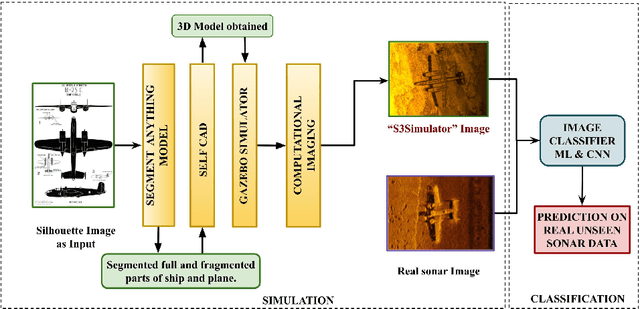
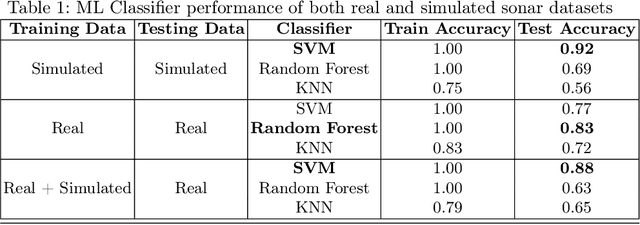
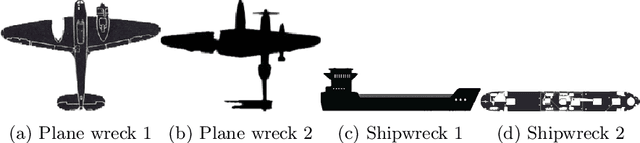
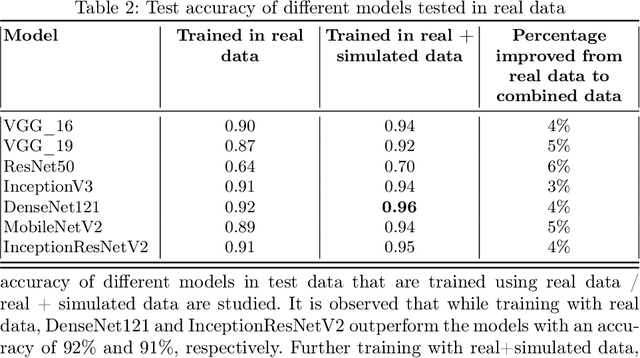
Acoustic sonar imaging systems are widely used for underwater surveillance in both civilian and military sectors. However, acquiring high-quality sonar datasets for training Artificial Intelligence (AI) models confronts challenges such as limited data availability, financial constraints, and data confidentiality. To overcome these challenges, we propose a novel benchmark dataset of Simulated Side-Scan Sonar images, which we term as 'S3Simulator dataset'. Our dataset creation utilizes advanced simulation techniques to accurately replicate underwater conditions and produce diverse synthetic sonar imaging. In particular, the cutting-edge AI segmentation tool i.e. Segment Anything Model (SAM) is leveraged for optimally isolating and segmenting the object images, such as ships and planes, from real scenes. Further, advanced Computer-Aided Design tools i.e. SelfCAD and simulation software such as Gazebo are employed to create the 3D model and to optimally visualize within realistic environments, respectively. Further, a range of computational imaging techniques are employed to improve the quality of the data, enabling the AI models for the analysis of the sonar images. Extensive analyses are carried out on S3simulator as well as real sonar datasets to validate the performance of AI models for underwater object classification. Our experimental results highlight that the S3Simulator dataset will be a promising benchmark dataset for research on underwater image analysis. https://github.com/bashakamal/S3Simulator.