 Add to Chrome
 Add to Firefox
 Add to Edge
Enriching Documents with Compact, Representative, Relevant Knowledge Graphs
May 10, 2020
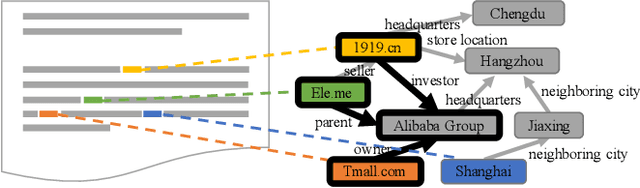

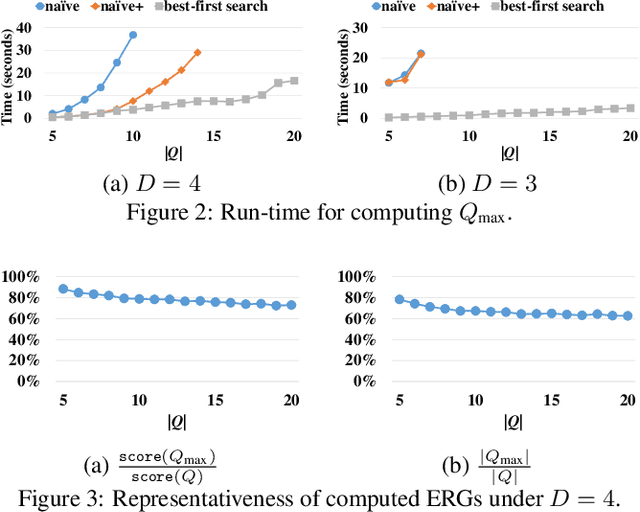
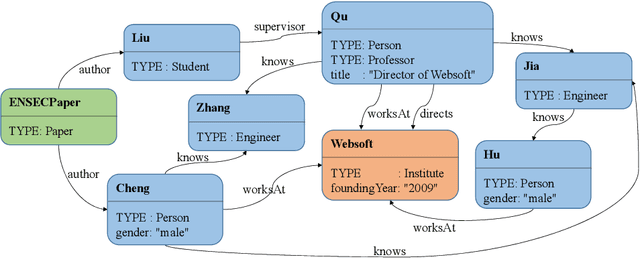
A prominent application of knowledge graph (KG) is document enrichment. Existing methods identify mentions of entities in a background KG and enrich documents with entity types and direct relations. We compute an entity relation subgraph (ERG) that can more expressively represent indirect relations among a set of mentioned entities. To find compact, representative, and relevant ERGs for effective enrichment, we propose an efficient best-first search algorithm to solve a new combinatorial optimization problem that achieves a trade-off between representativeness and compactness, and then we exploit ontological knowledge to rank ERGs by entity-based document-KG and intra-KG relevance. Extensive experiments and user studies show the promising performance of our approach.

ESBM: An Entity Summarization BenchMark
Mar 08, 2020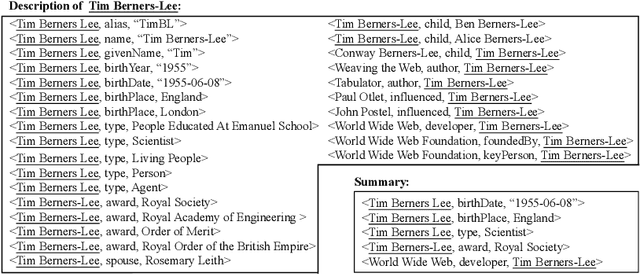
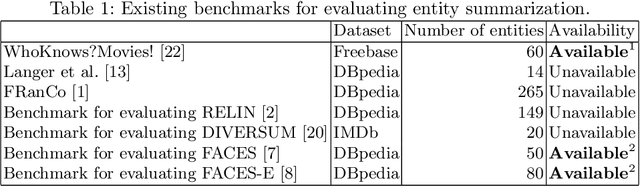
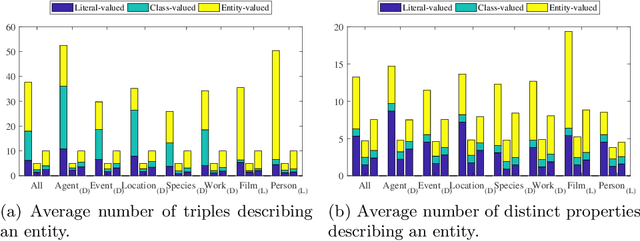
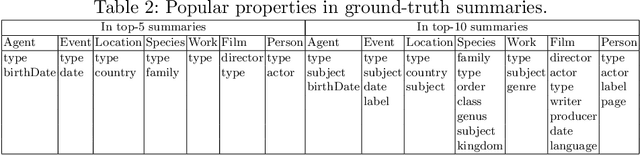
Entity summarization is the problem of computing an optimal compact summary for an entity by selecting a size-constrained subset of triples from RDF data. Entity summarization supports a multiplicity of applications and has led to fruitful research. However, there is a lack of evaluation efforts that cover the broad spectrum of existing systems. One reason is a lack of benchmarks for evaluation. Some benchmarks are no longer available, while others are small and have limitations. In this paper, we create an Entity Summarization BenchMark (ESBM) which overcomes the limitations of existing benchmarks and meets standard desiderata for a benchmark. Using this largest available benchmark for evaluating general-purpose entity summarizers, we perform the most extensive experiment to date where 9~existing systems are compared. Considering that all of these systems are unsupervised, we also implement and evaluate a supervised learning based system for reference.
Entity Summarization: State of the Art and Future Challenges
Oct 18, 2019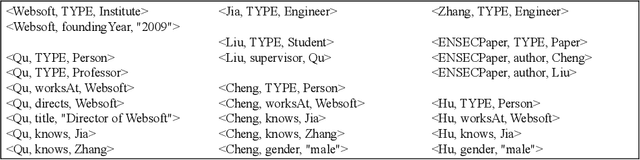
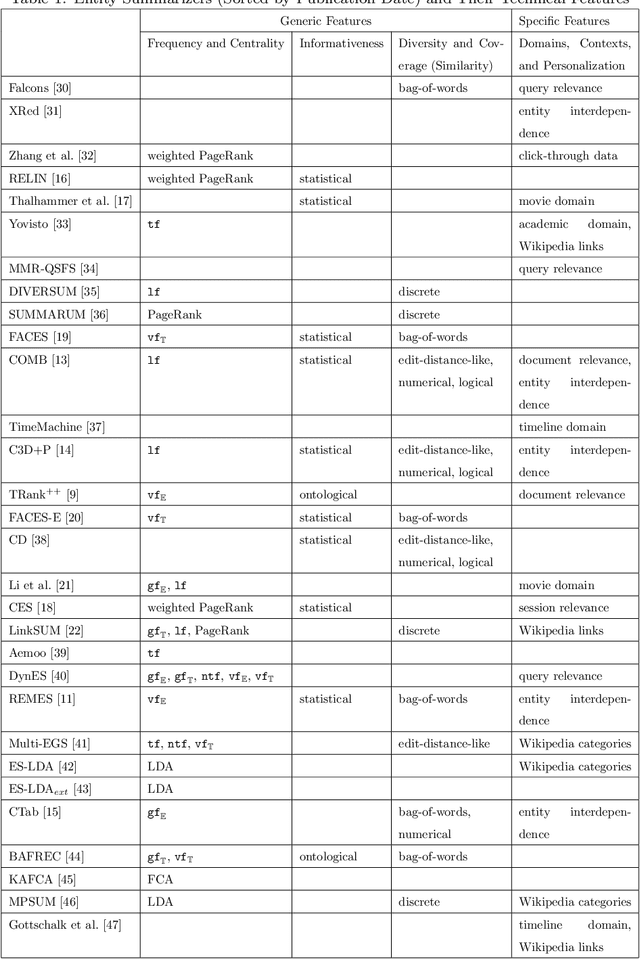
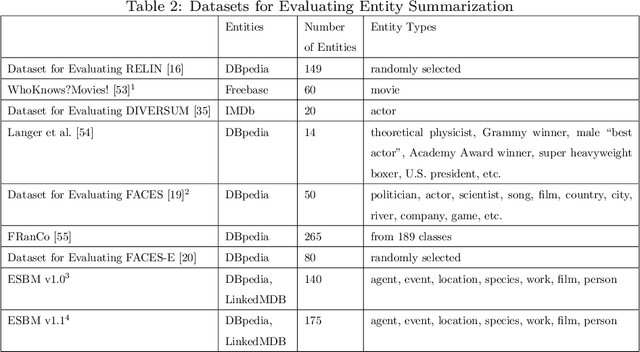
The increasing availability of semantic data, which is commonly represented as entity-property-value triples, has enabled novel information retrieval applications. However, the magnitude of semantic data, in particular the large number of triples describing an entity, could overload users with excessive amounts of information. This has motivated fruitful research on automated generation of summaries for entity descriptions to satisfy users' information needs efficiently and effectively. We focus on this important topic of entity summarization, and present the first comprehensive survey of existing research. We review existing methods and evaluation efforts, and suggest directions for future work.