 Add to Chrome
 Add to Firefox
 Add to Edge
REALISTA: Realistic Latent Adversarial Attacks that Elicit LLM Hallucinations
May 12, 2026
Large language models (LLMs) achieve strong performance across many tasks but remain vulnerable to hallucinations, motivating the need for realistic adversarial prompts that elicit such failures. We formulate hallucination elicitation as a constrained optimization problem, where the goal is to find semantically coherent adversarial prompts that are equivalent to benign user prompts. Existing methods remain limited: discrete prompt-based attacks preserve semantic equivalence and coherence but search only over a limited set of prompt variations, while continuous latent-space attacks explore a richer space but often decode into prompts that are no longer valid rephrasings. To address these limitations, we propose REALISTA, a realistic latent-space attack framework. REALISTA constructs an input-dependent dictionary of valid editing directions, each corresponding to a semantically equivalent and coherent rephrasing, and optimizes continuous combinations of these directions in latent space. This design combines the optimization flexibility of continuous attacks with the semantic realism of discrete rephrasing-based attacks. Experiments demonstrate that REALISTA achieves superior or comparable performance to state-of-the-art realistic attacks on open-source LLMs and, crucially, succeeds in attacking large reasoning models under free-form response settings, where prior realistic attacks fail. Code is available at https://github.com/Buyun-Liang/REALISTA.

Computerized Assessment of Motor Imitation for Distinguishing Autism in Video (CAMI-2DNet)
Jan 15, 2025Motor imitation impairments are commonly reported in individuals with autism spectrum conditions (ASCs), suggesting that motor imitation could be used as a phenotype for addressing autism heterogeneity. Traditional methods for assessing motor imitation are subjective, labor-intensive, and require extensive human training. Modern Computerized Assessment of Motor Imitation (CAMI) methods, such as CAMI-3D for motion capture data and CAMI-2D for video data, are less subjective. However, they rely on labor-intensive data normalization and cleaning techniques, and human annotations for algorithm training. To address these challenges, we propose CAMI-2DNet, a scalable and interpretable deep learning-based approach to motor imitation assessment in video data, which eliminates the need for data normalization, cleaning and annotation. CAMI-2DNet uses an encoder-decoder architecture to map a video to a motion encoding that is disentangled from nuisance factors such as body shape and camera views. To learn a disentangled representation, we employ synthetic data generated by motion retargeting of virtual characters through the reshuffling of motion, body shape, and camera views, as well as real participant data. To automatically assess how well an individual imitates an actor, we compute a similarity score between their motion encodings, and use it to discriminate individuals with ASCs from neurotypical (NT) individuals. Our comparative analysis demonstrates that CAMI-2DNet has a strong correlation with human scores while outperforming CAMI-2D in discriminating ASC vs NT children. Moreover, CAMI-2DNet performs comparably to CAMI-3D while offering greater practicality by operating directly on video data and without the need for ad-hoc data normalization and human annotations.
Efficient Vision Transformer for Human Pose Estimation via Patch Selection
Jun 07, 2023
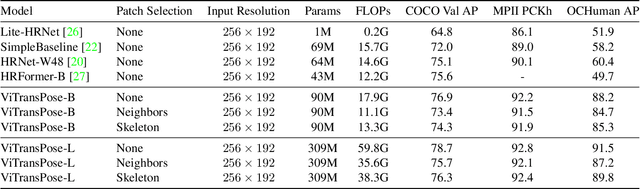


While Convolutional Neural Networks (CNNs) have been widely successful in 2D human pose estimation, Vision Transformers (ViTs) have emerged as a promising alternative to CNNs, boosting state-of-the-art performance. However, the quadratic computational complexity of ViTs has limited their applicability for processing high-resolution images and long videos. To address this challenge, we propose a simple method for reducing ViT's computational complexity based on selecting and processing a small number of most informative patches while disregarding others. We leverage a lightweight pose estimation network to guide the patch selection process, ensuring that the selected patches contain the most important information. Our experimental results on three widely used 2D pose estimation benchmarks, namely COCO, MPII and OCHuman, demonstrate the effectiveness of our proposed methods in significantly improving speed and reducing computational complexity with a slight drop in performance.
Analysis and Extensions of Adversarial Training for Video Classification
Jun 16, 2022Adversarial training (AT) is a simple yet effective defense against adversarial attacks to image classification systems, which is based on augmenting the training set with attacks that maximize the loss. However, the effectiveness of AT as a defense for video classification has not been thoroughly studied. Our first contribution is to show that generating optimal attacks for video requires carefully tuning the attack parameters, especially the step size. Notably, we show that the optimal step size varies linearly with the attack budget. Our second contribution is to show that using a smaller (sub-optimal) attack budget at training time leads to a more robust performance at test time. Based on these findings, we propose three defenses against attacks with variable attack budgets. The first one, Adaptive AT, is a technique where the attack budget is drawn from a distribution that is adapted as training iterations proceed. The second, Curriculum AT, is a technique where the attack budget is increased as training iterations proceed. The third, Generative AT, further couples AT with a denoising generative adversarial network to boost robust performance. Experiments on the UCF101 dataset demonstrate that the proposed methods improve adversarial robustness against multiple attack types.