 Add to Chrome
 Add to Firefox
 Add to Edge
PEFT-MuTS: A Multivariate Parameter-Efficient Fine-Tuning Framework for Remaining Useful Life Prediction based on Cross-domain Time Series Representation Model
Jan 30, 2026
The application of data-driven remaining useful life (RUL) prediction has long been constrained by the availability of large amount of degradation data. Mainstream solutions such as domain adaptation and meta-learning still rely on large amounts of historical degradation data from equipment that is identical or similar to the target, which imposes significant limitations in practical applications. This study investigates PEFT-MuTS, a Parameter-Efficient Fine-Tuning framework for few-shot RUL prediction, built on cross-domain pre-trained time-series representation models. Contrary to the widely held view that knowledge transfer in RUL prediction can only occur within similar devices, we demonstrate that substantial benefits can be achieved through pre-training process with large-scale cross-domain time series datasets. A independent feature tuning network and a meta-variable-based low rank multivariate fusion mechanism are developed to enable the pre-trained univariate time-series representation backbone model to fully exploit the multivariate relationships in degradation data for downstream RUL prediction task. Additionally, we introduce a zero-initialized regressor that stabilizes the fine-tuning process under few-shot conditions. Experiments on aero-engine and industrial bearing datasets demonstrate that our method can achieve effective RUL prediction even when less than 1\% of samples of target equipment are used. Meanwhile, it substantially outperforms conventional supervised and few-shot approaches while markedly reducing the data required to achieve high predictive accuracy. Our code is available at https://github.com/fuen1590/PEFT-MuTS.

Supervised Contrastive Learning based Dual-Mixer Model for Remaining Useful Life Prediction
Jan 29, 2024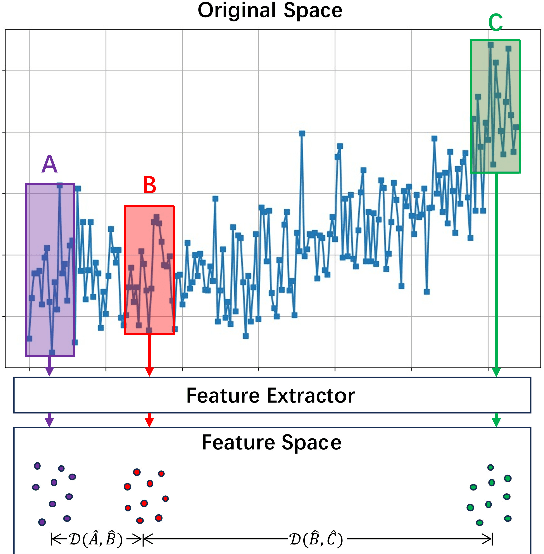

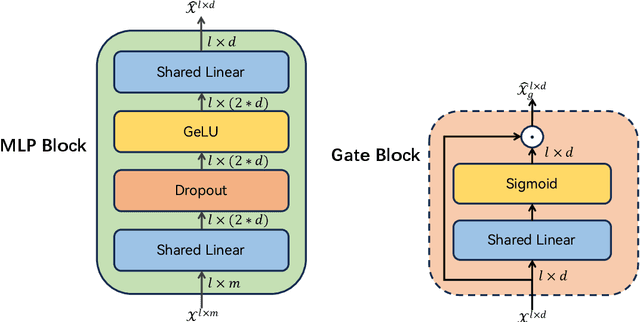
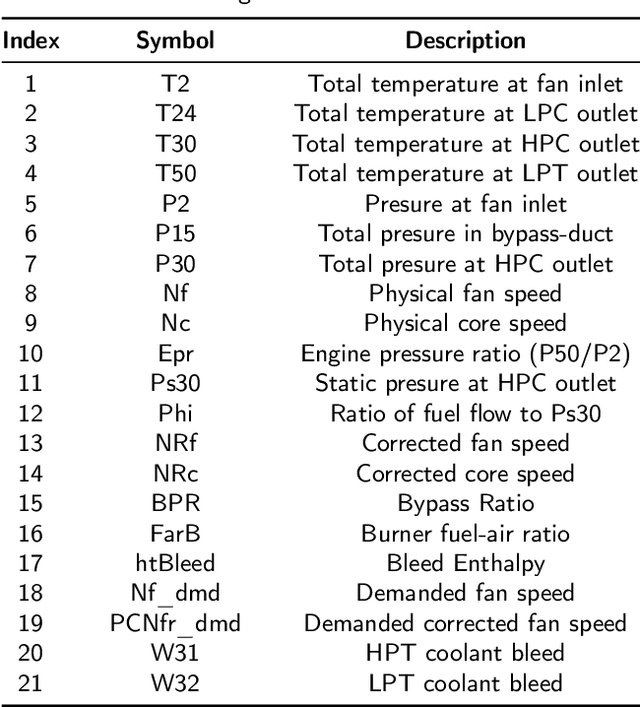
The problem of the Remaining Useful Life (RUL) prediction, aiming at providing an accurate estimate of the remaining time from the current predicting moment to the complete failure of the device, has gained significant attention from researchers in recent years. In this paper, to overcome the shortcomings of rigid combination for temporal and spatial features in most existing RUL prediction approaches, a spatial-temporal homogeneous feature extractor, named Dual-Mixer model, is firstly proposed. Flexible layer-wise progressive feature fusion is employed to ensure the homogeneity of spatial-temporal features and enhance the prediction accuracy. Secondly, the Feature Space Global Relationship Invariance (FSGRI) training method is introduced based on supervised contrastive learning. This method maintains the consistency of relationships among sample features with their degradation patterns during model training, simplifying the subsequently regression task in the output layer and improving the model's performance in RUL prediction. Finally, the effectiveness of the proposed method is validated through comparisons with other latest research works on the C-MAPSS dataset. The Dual-Mixer model demonstrates superiority across most metrics, while the FSGRI training method shows an average improvement of 7.00% and 2.41% in RMSE and MAPE, respectively, for all baseline models. Our experiments and model code are publicly available at https://github.com/fuen1590/PhmDeepLearningProjects.