 Add to Chrome
 Add to Firefox
 Add to Edge
EvoMemBench: Benchmarking Agent Memory from a Self-Evolving Perspective
May 18, 2026
Recent benchmarks for Large Language Model (LLM) agents mainly evaluate reasoning, planning, and execution. However, memory is also essential for agents, as it enables them to store, update, and retrieve information over time. This ability remains under-evaluated, largely because existing benchmarks do not provide a systematic way to assess memory mechanisms. In this paper, we study agent memory from a self-evolving perspective and introduce EvoMemBench, a unified benchmark organized along two axes: memory scope (in-episode vs. cross-episode) and memory content (knowledge-oriented vs. execution-oriented). We compare 15 representative memory methods with strong long-context baselines under a standardized protocol. Results show that current memory systems are still far from a general solution: long-context baselines remain highly competitive, memory helps most when the current context is insufficient or tasks are difficult, and no single memory form works consistently across all settings. Retrieval-based methods remain strong for knowledge-intensive settings, whereas procedural and long-term memory methods are more effective for execution-oriented tasks when their stored experience matches the task structure. We hope EvoMemBench facilitates future research on more effective memory systems for LLM-based agents. Our code is available at https://github.com/DSAIL-Memory/EvoMemBench.

ASTRA: Automated Synthesis of agentic Trajectories and Reinforcement Arenas
Jan 29, 2026Large language models (LLMs) are increasingly used as tool-augmented agents for multi-step decision making, yet training robust tool-using agents remains challenging. Existing methods still require manual intervention, depend on non-verifiable simulated environments, rely exclusively on either supervised fine-tuning (SFT) or reinforcement learning (RL), and struggle with stable long-horizon, multi-turn learning. To address these challenges, we introduce ASTRA, a fully automated end-to-end framework for training tool-augmented language model agents via scalable data synthesis and verifiable reinforcement learning. ASTRA integrates two complementary components. First, a pipeline that leverages the static topology of tool-call graphs synthesizes diverse, structurally grounded trajectories, instilling broad and transferable tool-use competence. Second, an environment synthesis framework that captures the rich, compositional topology of human semantic reasoning converts decomposed question-answer traces into independent, code-executable, and rule-verifiable environments, enabling deterministic multi-turn RL. Based on this method, we develop a unified training methodology that integrates SFT with online RL using trajectory-level rewards to balance task completion and interaction efficiency. Experiments on multiple agentic tool-use benchmarks demonstrate that ASTRA-trained models achieve state-of-the-art performance at comparable scales, approaching closed-source systems while preserving core reasoning ability. We release the full pipelines, environments, and trained models at https://github.com/LianjiaTech/astra.
AlgBench: To What Extent Do Large Reasoning Models Understand Algorithms?
Jan 08, 2026Reasoning ability has become a central focus in the advancement of Large Reasoning Models (LRMs). Although notable progress has been achieved on several reasoning benchmarks such as MATH500 and LiveCodeBench, existing benchmarks for algorithmic reasoning remain limited, failing to answer a critical question: Do LRMs truly master algorithmic reasoning? To answer this question, we propose AlgBench, an expert-curated benchmark that evaluates LRMs under an algorithm-centric paradigm. AlgBench consists of over 3,000 original problems spanning 27 algorithms, constructed by ACM algorithmic experts and organized under a comprehensive taxonomy, including Euclidean-structured, non-Euclidean-structured, non-optimized, local-optimized, global-optimized, and heuristic-optimized categories. Empirical evaluations on leading LRMs (e.g., Gemini-3-Pro, DeepSeek-v3.2-Speciale and GPT-o3) reveal substantial performance heterogeneity: while models perform well on non-optimized tasks (up to 92%), accuracy drops sharply to around 49% on globally optimized algorithms such as dynamic programming. Further analysis uncovers \textbf{strategic over-shifts}, wherein models prematurely abandon correct algorithmic designs due to necessary low-entropy tokens. These findings expose fundamental limitations of problem-centric reinforcement learning and highlight the necessity of an algorithm-centric training paradigm for robust algorithmic reasoning.
Toward Data-centric Directed Graph Learning: An Entropy-driven Approach
May 02, 2025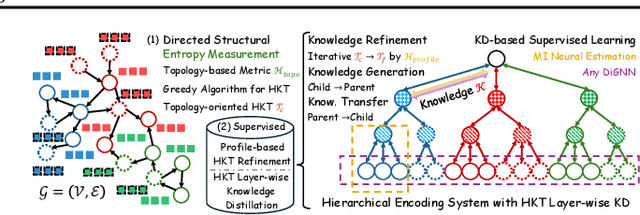
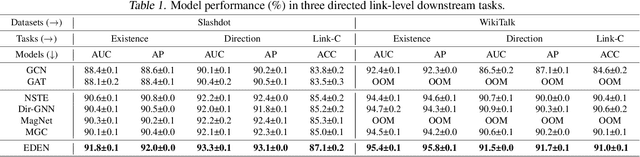
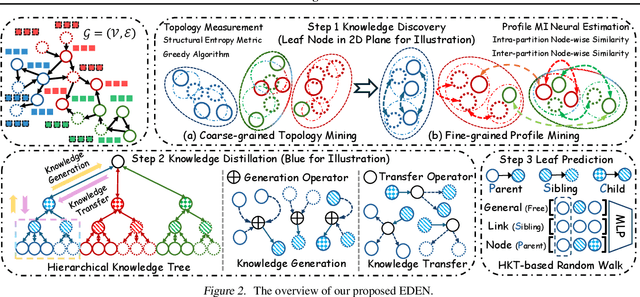
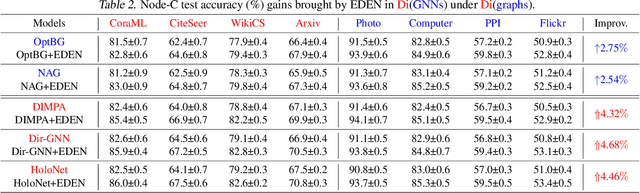
The directed graph (digraph), as a generalization of undirected graphs, exhibits superior representation capability in modeling complex topology systems and has garnered considerable attention in recent years. Despite the notable efforts made by existing DiGraph Neural Networks (DiGNNs) to leverage directed edges, they still fail to comprehensively delve into the abundant data knowledge concealed in the digraphs. This data-level limitation results in model-level sub-optimal predictive performance and underscores the necessity of further exploring the potential correlations between the directed edges (topology) and node profiles (feature and labels) from a data-centric perspective, thereby empowering model-centric neural networks with stronger encoding capabilities. In this paper, we propose \textbf{E}ntropy-driven \textbf{D}igraph knowl\textbf{E}dge distillatio\textbf{N} (EDEN), which can serve as a data-centric digraph learning paradigm or a model-agnostic hot-and-plug data-centric Knowledge Distillation (KD) module. The core idea is to achieve data-centric ML, guided by our proposed hierarchical encoding theory for structured data. Specifically, EDEN first utilizes directed structural measurements from a topology perspective to construct a coarse-grained Hierarchical Knowledge Tree (HKT). Subsequently, EDEN quantifies the mutual information of node profiles to refine knowledge flow in the HKT, enabling data-centric KD supervision within model training. As a general framework, EDEN can also naturally extend to undirected scenarios and demonstrate satisfactory performance. In our experiments, EDEN has been widely evaluated on 14 (di)graph datasets (homophily and heterophily) and across 4 downstream tasks. The results demonstrate that EDEN attains SOTA performance and exhibits strong improvement for prevalent (Di)GNNs.