 Add to Chrome
 Add to Firefox
 Add to Edge
Optuna Constrained Tree-Structured Parzen Estimator Is a Joint Density Generalization of c-TPE
Jun 03, 2026
Constrained hyperparameter optimization (HPO) is common in practice, yet Optuna's widely used constrained TPE lacks algorithmic analysis. While c-TPE proposes an expected constrained improvement (ECI) approach assuming independence between the objective and constraints, Optuna uses a single joint density over both. We show that Optuna's constrained TPE is joint c-TPE -- the same ECI acquisition function using a joint likelihood. We demonstrate joint c-TPE is invariant to constraint duplication whereas independent c-TPE degrades as the product accumulates duplicated factors. We outline practical tradeoffs between the formulations and directions for future study.

Batch Acquisition Function Evaluations and Decouple Optimizer Updates for Faster Bayesian Optimization
Nov 18, 2025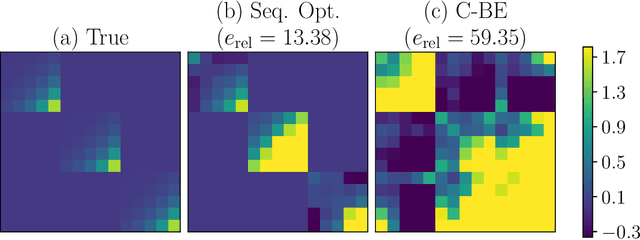
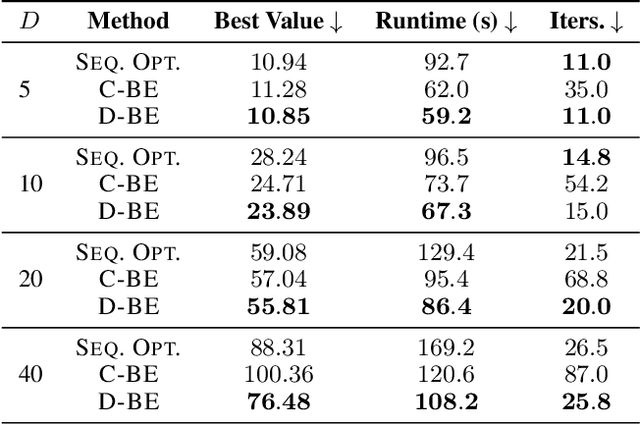
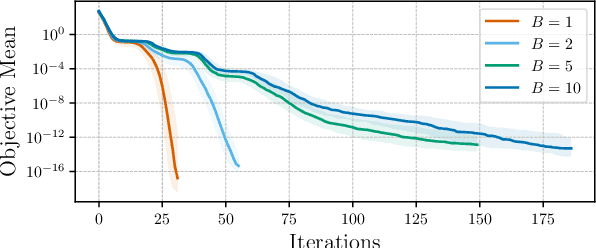
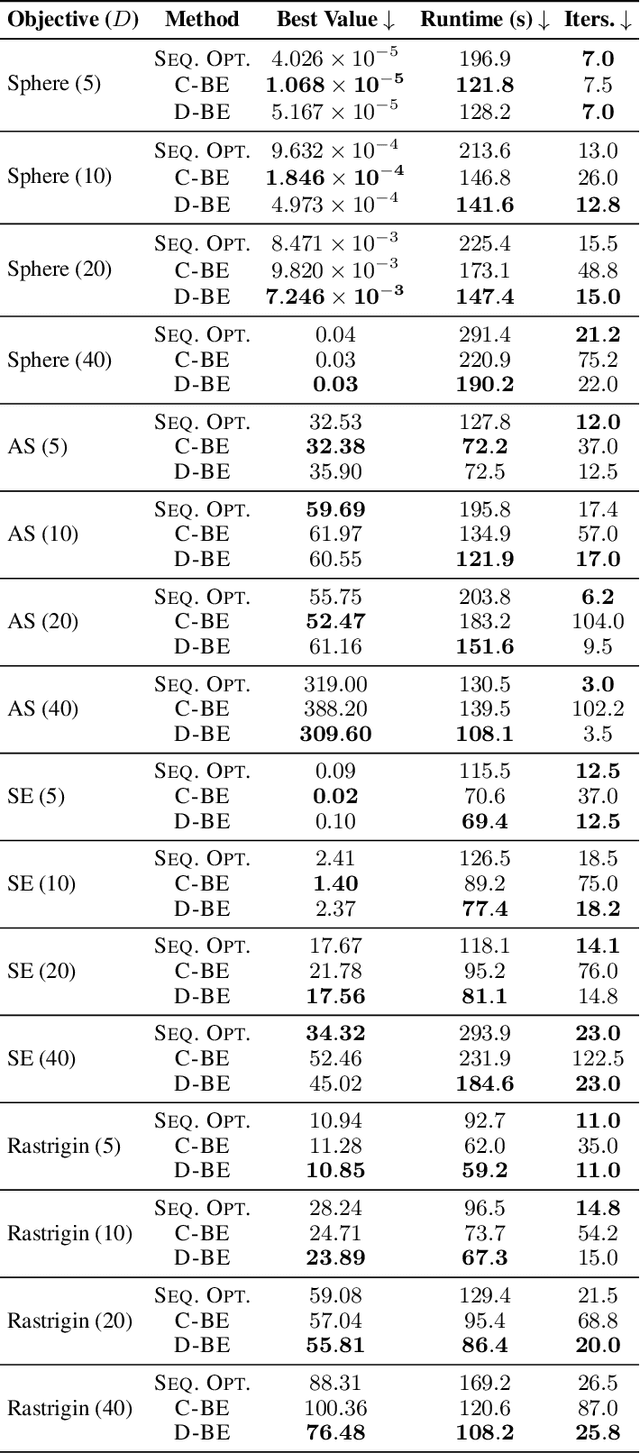
Bayesian optimization (BO) efficiently finds high-performing parameters by maximizing an acquisition function, which models the promise of parameters. A major computational bottleneck arises in acquisition function optimization, where multi-start optimization (MSO) with quasi-Newton (QN) methods is required due to the non-convexity of the acquisition function. BoTorch, a widely used BO library, currently optimizes the summed acquisition function over multiple points, leading to the speedup of MSO owing to PyTorch batching. Nevertheless, this paper empirically demonstrates the suboptimality of this approach in terms of off-diagonal approximation errors in the inverse Hessian of a QN method, slowing down its convergence. To address this problem, we propose to decouple QN updates using a coroutine while batching the acquisition function calls. Our approach not only yields the theoretically identical convergence to the sequential MSO but also drastically reduces the wall-clock time compared to the previous approaches. Our approach is available in GPSampler in Optuna, effectively reducing its computational overhead.