 Add to Chrome
 Add to Firefox
 Add to Edge
Topological Flow Matching
Jun 14, 2026
Flow matching is a powerful generative modeling framework, valued for its simplicity and strong empirical performance. However, its standard formulation treats signals on structured spaces, such as fMRI data on brain graphs, as points in Euclidean space, overlooking the rich topological features of their domains. To address this, we introduce topological flow matching, a topology-aware generalization of flow matching. We interpret flow matching as a framework for solving a degenerate Schrödinger bridge problem and inject topological information by augmenting the reference process with a Laplacian-derived drift. This principled modification captures the structure of the underlying domain while preserving the desirable properties of flow matching: a stable, simulation-free objective and deterministic sample paths. As a result, our framework serves as a drop-in replacement for standard flow matching. We demonstrate its effectiveness on diverse structured datasets, including brain fMRIs, ocean currents, seismic events, and traffic flows.

Residual Deep Gaussian Processes on Manifolds
Oct 31, 2024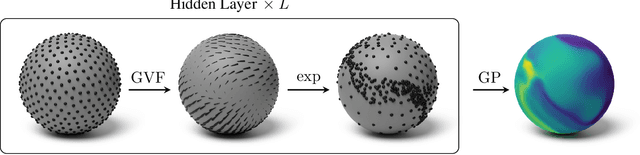
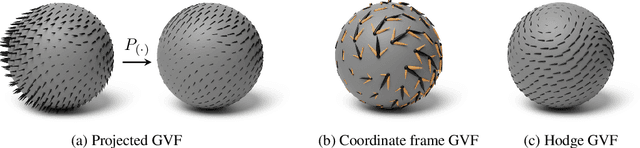
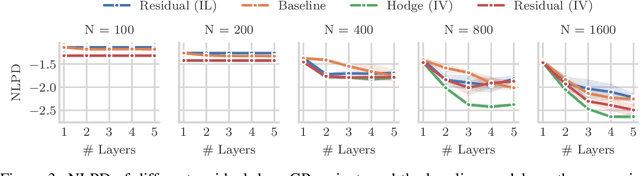
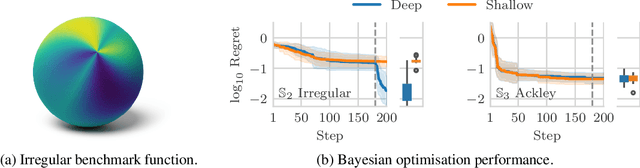
We propose practical deep Gaussian process models on Riemannian manifolds, similar in spirit to residual neural networks. With manifold-to-manifold hidden layers and an arbitrary last layer, they can model manifold- and scalar-valued functions, as well as vector fields. We target data inherently supported on manifolds, which is too complex for shallow Gaussian processes thereon. For example, while the latter perform well on high-altitude wind data, they struggle with the more intricate, nonstationary patterns at low altitudes. Our models significantly improve performance in these settings, enhancing prediction quality and uncertainty calibration, and remain robust to overfitting, reverting to shallow models when additional complexity is unneeded. We further showcase our models on Bayesian optimisation problems on manifolds, using stylised examples motivated by robotics, and obtain substantial improvements in later stages of the optimisation process. Finally, we show our models to have potential for speeding up inference for non-manifold data, when, and if, it can be mapped to a proxy manifold well enough.