 Add to Chrome
 Add to Firefox
 Add to Edge
Preserving Vertical Structure in 3D-to-2D Projection for Permafrost Thaw Mapping
Mar 17, 2026
Forecasting permafrost thaw from aerial lidar requires projecting 3D point cloud features onto 2D prediction grids, yet naive aggregation methods destroy the vertical structure critical in forest environments where ground, understory, and canopy carry distinct information about subsurface conditions. We propose a projection decoder with learned height embeddings that enable height-dependent feature transformations, allowing the network to differentiate ground-level signals from canopy returns. Combined with stratified sampling that ensures all forest strata remain represented, our approach preserves the vertical information critical for predicting subsurface conditions. Our approach pairs this decoder with a Point Transformer V3 encoder to predict dense thaw depth maps from drone-collected lidar over boreal forest in interior Alaska. Experiments demonstrate that z-stratified projection outperforms standard averaging-based methods, particularly in areas with complex vertical vegetation structure. Our method enables scalable, high-resolution monitoring of permafrost degradation from readily deployable UAV platforms.

Deep Learning-based RF Fingerprint Authentication with Chaotic Antenna Arrays
Mar 13, 2023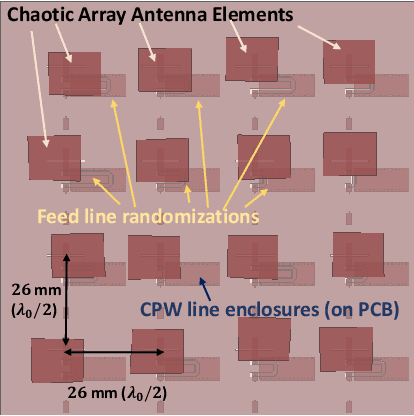
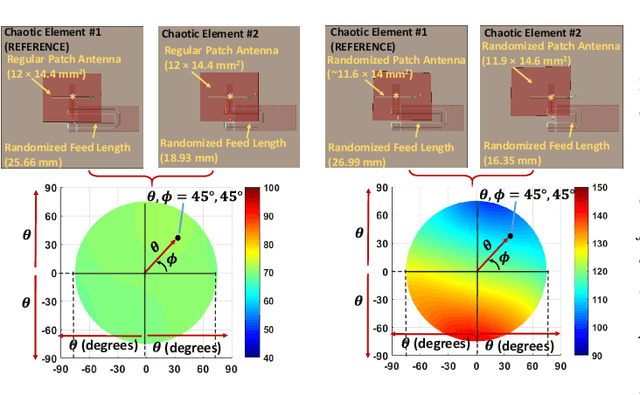
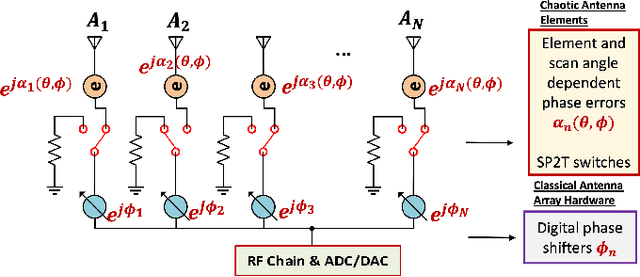
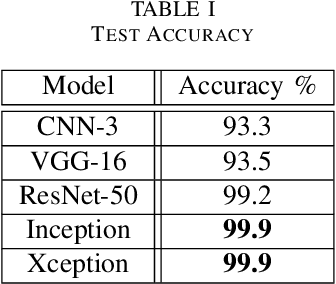
Radio frequency (RF) fingerprinting is a tool which allows for authentication by utilizing distinct and random distortions in a received signal based on characteristics of the transmitter. We introduce a deep learning-based authentication method for a novel RF fingerprinting system called Physically Unclonable Wireless Systems (PUWS). An element of PUWS is based on the concept of Chaotic Antenna Arrays (CAAs) that can be cost effectively manufactured by utilizing mask-free laser-enhanced direct print additive manufacturing (LE-DPAM). In our experiments, using simulation data of 300 CAAs each exhibiting 4 antenna elements, we test 3 different convolutional neural network (CNN) architectures under different channel conditions and compare their authentication performance to the current state-of-the-art RF fingerprinting authentication methods.