 Add to Chrome
 Add to Firefox
 Add to Edge
AdsMind: A Physics-Grounded Multi-Agent System for Self-Correcting Discovery of Adsorption Configurations on Heterogeneous Catalyst Surfaces
Jun 17, 2026
Identifying the lowest-energy surface-adsorbate configuration is critical for modeling heterogeneous catalysis, yet exhaustive exploration with ab initio calculations is computationally prohibitive. Machine-learning force fields (MLFFs) accelerate structural relaxation but leave the search over the vast configurational space a major bottleneck, and open-loop large language model (LLM) agents lack a physics-grounded feedback mechanism to correct erroneous initial guesses. We propose AdsMind (Adsorption configuration discovery with Machine intelligence and relaxation feedback), a closed-loop multi-agent framework that enables autonomous error correction through MLFF relaxation feedback. Across four LLM backends, AdsMind achieves consistently high search reliability, with success rates of 100% and 98.8% on the benchmarks AA20 and OCD-GMAE62. Relative to its single-pass (1-Shot) ablation it reduces cross-backend energy dispersion, and it uses only 4.11 and 4.67 MLFF relaxations per case, respectively -- an approximately 14-fold reduction over heuristic enumeration baselines. Density functional theory (DFT) validation using VASP/PBE on six representative AA20 systems shows that the reported open-loop Adsorb-Agent outputs exhibit qualitative adsorption-energy sign errors for molecular adsorbates, whereas AdsMind preserves the correct sign in all tested cases with closer quantitative agreement. AdsMind thus delivers reliability, self-reflection, and interpretability simultaneously, supporting more DFT-informed autonomous chemistry workflows.

CASCADE: Cumulative Agentic Skill Creation through Autonomous Development and Evolution
Dec 29, 2025Large language model (LLM) agents currently depend on predefined tools or brittle tool generation, constraining their capability and adaptability to complex scientific tasks. We introduce CASCADE, a self-evolving agentic framework representing an early instantiation of the transition from "LLM + tool use" to "LLM + skill acquisition". CASCADE enables agents to master complex external tools and codify knowledge through two meta-skills: continuous learning via web search and code extraction, and self-reflection via introspection and knowledge graph exploration, among others. We evaluate CASCADE on SciSkillBench, a benchmark of 116 materials science and chemistry research tasks. CASCADE achieves a 93.3% success rate using GPT-5, compared to 35.4% without evolution mechanisms. We further demonstrate real-world applications in computational analysis, autonomous laboratory experiments, and selective reproduction of published papers. Along with human-agent collaboration and memory consolidation, CASCADE accumulates executable skills that can be shared across agents and scientists, moving toward scalable AI-assisted scientific research.
Molecular Hypergraph Neural Networks
Dec 21, 2023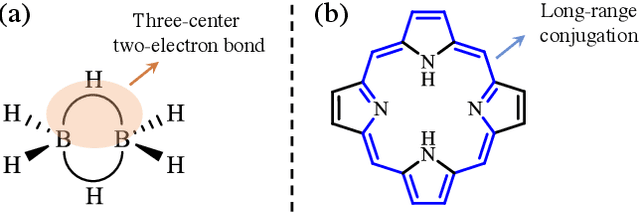
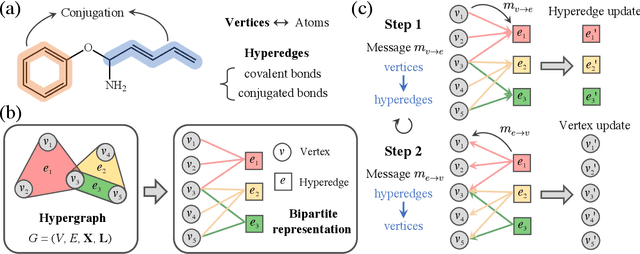
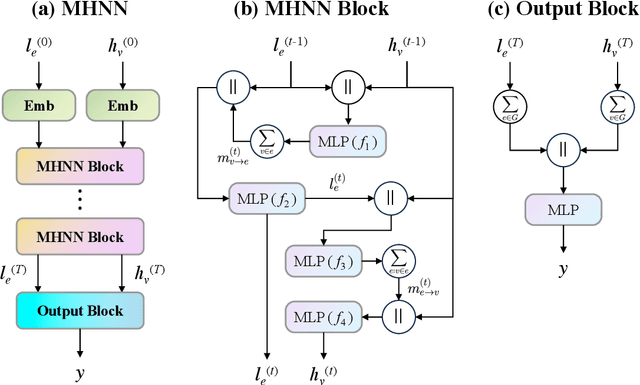
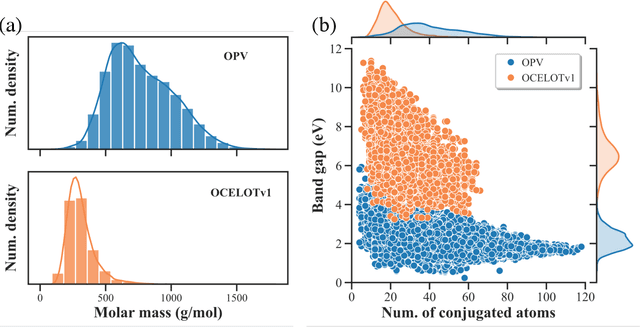
Graph neural networks (GNNs) have demonstrated promising performance across various chemistry-related tasks. However, conventional graphs only model the pairwise connectivity in molecules, failing to adequately represent higher-order connections like multi-center bonds and conjugated structures. To tackle this challenge, we introduce molecular hypergraphs and propose Molecular Hypergraph Neural Networks (MHNN) to predict the optoelectronic properties of organic semiconductors, where hyperedges represent conjugated structures. A general algorithm is designed for irregular high-order connections, which can efficiently operate on molecular hypergraphs with hyperedges of various orders. The results show that MHNN outperforms all baseline models on most tasks of OPV, OCELOTv1 and PCQM4Mv2 datasets. Notably, MHNN achieves this without any 3D geometric information, surpassing the baseline model that utilizes atom positions. Moreover, MHNN achieves better performance than pretrained GNNs under limited training data, underscoring its excellent data efficiency. This work provides a new strategy for more general molecular representations and property prediction tasks related to high-order connections.