 Add to Chrome
 Add to Firefox
 Add to Edge
Who Brought Easter Eggs to Eid? Auditing Cultural Translation of Math Word Problems Across Diverse Languages and Regions
Jun 09, 2026
Large language models are increasingly used to adapt math word problems for personalized learning at scale, but it remains an open question whether those adaptations are consistent across models, preserve cultural diversity at scale, and reveal which cultural entities models treat as most salient. We analyze how Claude Opus 4, GPT-4.1, and Gemini 2.5 Pro adapt 60 English math word problems into Bengali, Hindi, Punjabi (India), Urdu, Sindhi (Pakistan), Italian, and Sicilian (Italy), a language set spanning the full resource spectrum, from high-resource Italian and Hindi to under-studied Sindhi, Sicilian, and Punjabi. We annotate 6,489 entity transformations, coding whether models preserve, localize, generalize, omit, or change entities such as names, foods, and places. Models agree on transformation type in 62.5% of cases and on specific substitutions in only 33.5%, meaning model choice directly shapes which cultural world students encounter. All 21 language-model combinations show entropy collapse, with adaptation compressing rather than expanding cultural diversity. Models prioritize surface markers such as names, foods, and currencies while preserving deeper structural features such as grade-level systems that embed culturally specific assumptions. Despite prompts specifying target countries, models misattribute regional context by using Bangladeshi taka for Indian Bengali students and produce cross-cultural contamination, such as adapting egg hunts as Eid activities. Some failures are visible in individual translations. Others, including diversity collapse, systematic preference for surface markers, and consistent regional misattribution, emerge only through corpus-level analysis. The surface plausibility that makes adapted problems look correct is precisely what makes deeper failures easy to overlook.

MetaOthello: A Controlled Study of Multiple World Models in Transformers
Feb 26, 2026Foundation models must handle multiple generative processes, yet mechanistic interpretability largely studies capabilities in isolation; it remains unclear how a single transformer organizes multiple, potentially conflicting "world models". Previous experiments on Othello playing neural-networks test world-model learning but focus on a single game with a single set of rules. We introduce MetaOthello, a controlled suite of Othello variants with shared syntax but different rules or tokenizations, and train small GPTs on mixed-variant data to study how multiple world models are organized in a shared representation space. We find that transformers trained on mixed-game data do not partition their capacity into isolated sub-models; instead, they converge on a mostly shared board-state representation that transfers causally across variants. Linear probes trained on one variant can intervene on another's internal state with effectiveness approaching that of matched probes. For isomorphic games with token remapping, representations are equivalent up to a single orthogonal rotation that generalizes across layers. When rules partially overlap, early layers maintain game-agnostic representations while a middle layer identifies game identity, and later layers specialize. MetaOthello offers a path toward understanding not just whether transformers learn world models, but how they organize many at once.
More Data Types More Problems: A Temporal Analysis of Complexity, Stability, and Sensitivity in Privacy Policies
Feb 17, 2023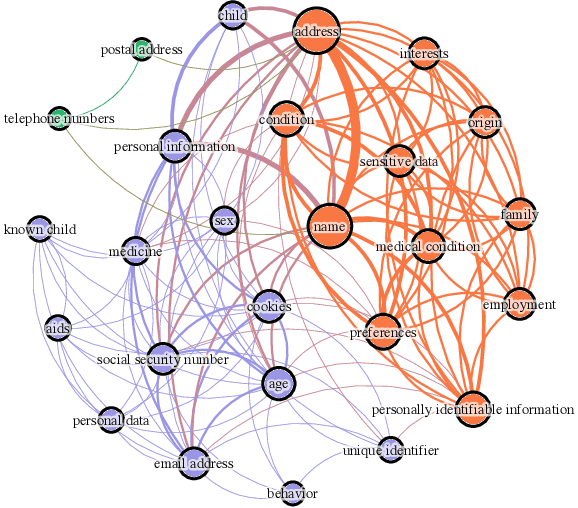
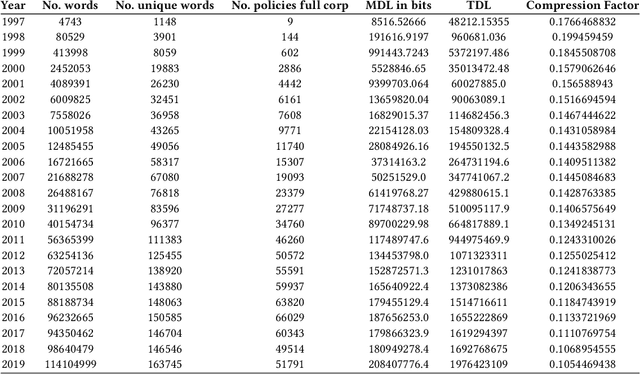

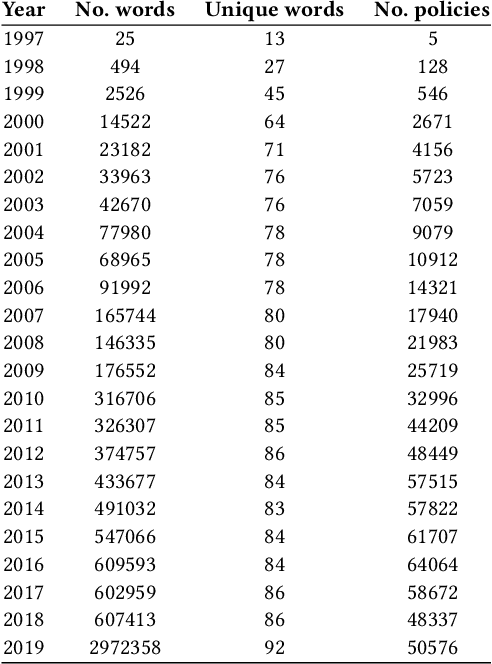
Collecting personally identifiable information (PII) on data subjects has become big business. Data brokers and data processors are part of a multi-billion-dollar industry that profits from collecting, buying, and selling consumer data. Yet there is little transparency in the data collection industry which makes it difficult to understand what types of data are being collected, used, and sold, and thus the risk to individual data subjects. In this study, we examine a large textual dataset of privacy policies from 1997-2019 in order to investigate the data collection activities of data brokers and data processors. We also develop an original lexicon of PII-related terms representing PII data types curated from legislative texts. This mesoscale analysis looks at privacy policies overtime on the word, topic, and network levels to understand the stability, complexity, and sensitivity of privacy policies over time. We find that (1) privacy legislation correlates with changes in stability and turbulence of PII data types in privacy policies; (2) the complexity of privacy policies decreases over time and becomes more regularized; (3) sensitivity rises over time and shows spikes that are correlated with events when new privacy legislation is introduced.