 Add to Chrome
 Add to Firefox
 Add to Edge
Beyond On-Policy Exploration: Integrating External Policy Rollouts for Reinforcement Learning in Diffusion Language Models
Aug 03, 2026
Recent reinforcement learning methods for diffusion large language models (dLLMs) commonly rely on on-policy rollouts generated by the target dLLM itself. When successful on-policy rollouts are scarce, however, on-policy training may receive little positive reward and make only limited progress. To mitigate this problem, we explore incorporating higher-reward rollouts generated by a stronger external policy alongside on-policy rollouts from the target dLLM. However, directly incorporating these external rollouts introduces two practical challenges: differences in rollout length and instability when jointly processing rewards from on-policy and external rollouts. To address these challenges, we propose External Rollout Integration with Length Control and Source-Specific Processing (ERILS), which controls external-rollout length and processes the rewards of on-policy and external rollouts separately. Experiments on Sudoku, Countdown, and MATH500 under zero-shot evaluation show that ERILS improves multi-sample performance across all three tasks, with the largest gains on Sudoku. On Sudoku, ERILS achieves 98.4% best-of-4 completion accuracy, compared with 40.3% for the strongest baseline. ERILS also maintains approximately 90% deterministic single-completion accuracy on Sudoku across generation lengths of 128, 256, and 512 tokens. Our component analysis further shows that length-controlled external rollouts are more effective than uncontrolled external rollouts, and that source-specific reward processing avoids the training collapse observed with joint reward processing. These results show that rollout construction and reward processing are important design dimensions when integrating external rollouts into dLLM reinforcement learning.

Personalized Deep Learning for Short-Term Forecasting of Impending Atrial Fibrillation from Continuous Wearable ECG Signals
Jun 09, 2026Background and Objective: Continuous wearable electrocardiogram (ECG) monitoring is increasingly used for ambulatory arrhythmia surveillance, yet forecasting impending atrial fibrillation (AF) is challenged by inter-patient ECG variability. This study investigated whether personalizing a global model via fine-tuning on an individual's ECG signals improves short-term forecasting of impending AF. Methods: A global model trained on the ICENTIA11K dataset was compared against personalized models fine-tuned across three cohorts: ICENTIA11K, IRIDIA-AF, and MobiCARE. Following preprocessing, models processed 60-second ECG segments for a five-minute forecast horizon. We evaluated the impact of adaptation data volume and analyzed ECG features, such as heart rate and RMSSD. Results: Personalized models significantly outperformed the global model, achieving AUROCs of 0.711 vs. 0.614 in ICENTIA11K and 0.686 vs. 0.585 in MobiCARE. Personalization benefits increased with the amount of patient-specific fine-tuning data. While the global model's accuracy rose as AF onset approached, personalized models in the two external cohorts exhibited distinct temporal dynamics, which may indicate the capture of patient-specific characteristics less dependent on proximity to the AF event. Pre-AF episodes showed elevated heart rates and RMSSD. Feature attributions highlighted clinically relevant precursors, including frequent premature atrial complexes (PACs) and short supraventricular tachycardias (SVTs). Conclusions: Adapting deep learning models with patient-specific wearable ECG data significantly enhances short-term forecasting of impending AF. This personalized framework supports timely preventive interventions and improved AF management in ambulatory monitoring environments.
Orthogonal Negative Guidance in Attention Feature Space for Text-to-Image Generation
May 28, 2026Text-to-image (T2I) models have become increasingly capable of generating high-quality images. Yet, enforcing the explicit absence of a specified object or attribute remains a fundamentally challenging problem. Existing approaches, including prompt negation, post-hoc editing, and negative guidance, remain insufficient for explicit concept suppression, often failing to remove the target concept or degrading overall image quality. To this end, we propose Orthogonal Negative Guidance in attention feature space, a training-free method that operates in the attention output space of MM-DiT-based T2I transformers. Our method orthogonalizes negative-prompt attention features with respect to positive-prompt features and subtracts only the orthogonal component, suppressing unwanted concepts while preserving desired semantics. Experiments on FLUX-dev and FLUX-schnell show that our method achieves favorable trade-offs between concept suppression, prompt alignment, and image quality. In human evaluation, our method outperforms the second-best baseline by 18.78%. We further show that our method supports multi-concept suppression and adjustable concept suppression.
When Confidence Misleads: Suffix Anchoring and Anchor-Proximity Confidence Modulation for Diffusion Language Models
May 27, 2026Diffusion language models decode text by iteratively denoising masked token sequences, making the choice of which positions to decode a central inference-time decision. Most training-free decoding strategies use model confidence for position selection, assuming that high-confidence positions are ready to be decoded. In this work, we revisit this assumption by studying when confidence misleads fully non-autoregressive (fully non-AR) decoding. EOT tokens can receive high confidence and cause incomplete generation; inserting a suffix anchor can mitigate this issue but introduces local overconfidence near the anchor, causing anchor-adjacent tokens to be decoded too early. To address these issues, we propose Suffix-Anchored Confidence Modulation, a simple training-free method that inserts a short suffix anchor to encourage response completion and modulates confidence near the anchor according to decoding progress. This preserves the response-completion benefit of suffix anchoring while reducing premature decoding of anchor-adjacent tokens. Across text-only reasoning, vision-language reasoning, and code-generation benchmarks, our method consistently improves confidence-based fully non-AR decoding, outperforms explicit EOT suppression, and preserves the parallel decoding advantage of fully non-AR generation.
Selective Aggregation of Attention Maps Improves Diffusion-Based Visual Interpretation
Apr 07, 2026Numerous studies on text-to-image (T2I) generative models have utilized cross-attention maps to boost application performance and interpret model behavior. However, the distinct characteristics of attention maps from different attention heads remain relatively underexplored. In this study, we show that selectively aggregating cross-attention maps from heads most relevant to a target concept can improve visual interpretability. Compared to the diffusion-based segmentation method DAAM, our approach achieves higher mean IoU scores. We also find that the most relevant heads capture concept-specific features more accurately than the least relevant ones, and that selective aggregation helps diagnose prompt misinterpretations. These findings suggest that attention head selection offers a promising direction for improving the interpretability and controllability of T2I generation.
Cross-Attention Head Position Patterns Can Align with Human Visual Concepts in Text-to-Image Generative Models
Dec 03, 2024


Recent text-to-image diffusion models leverage cross-attention layers, which have been effectively utilized to enhance a range of visual generative tasks. However, our understanding of cross-attention layers remains somewhat limited. In this study, we present a method for constructing Head Relevance Vectors (HRVs) that align with useful visual concepts. An HRV for a given visual concept is a vector with a length equal to the total number of cross-attention heads, where each element represents the importance of the corresponding head for the given visual concept. We develop and employ an ordered weakening analysis to demonstrate the effectiveness of HRVs as interpretable features. To demonstrate the utility of HRVs, we propose concept strengthening and concept adjusting methods and apply them to enhance three visual generative tasks. We show that misinterpretations of polysemous words in image generation can be corrected in most cases, five challenging attributes in image editing can be successfully modified, and catastrophic neglect in multi-concept generation can be mitigated. Overall, our work provides an advancement in understanding cross-attention layers and introduces new approaches for fine-controlling these layers at the head level.
Unveiling Key Aspects of Fine-Tuning in Sentence Embeddings: A Representation Rank Analysis
May 18, 2024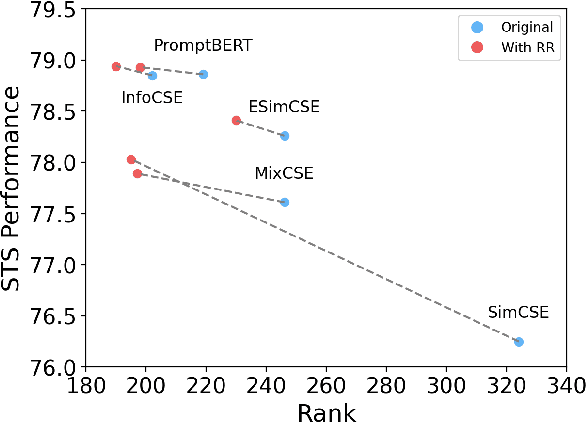
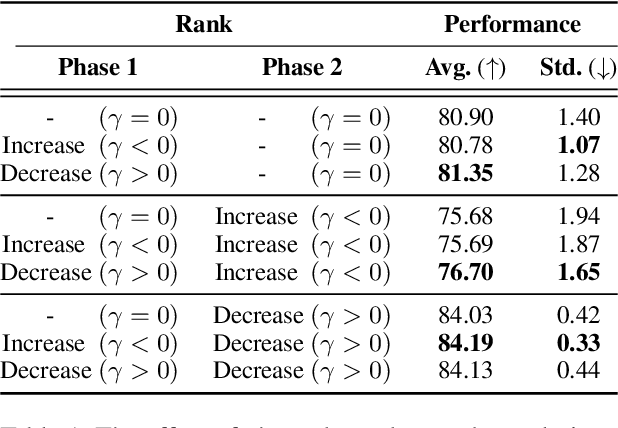
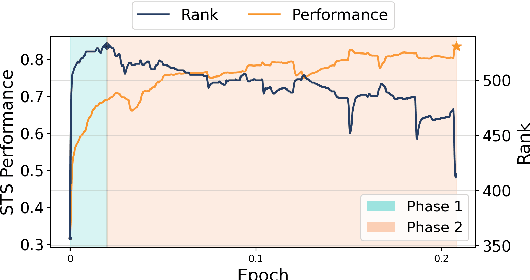
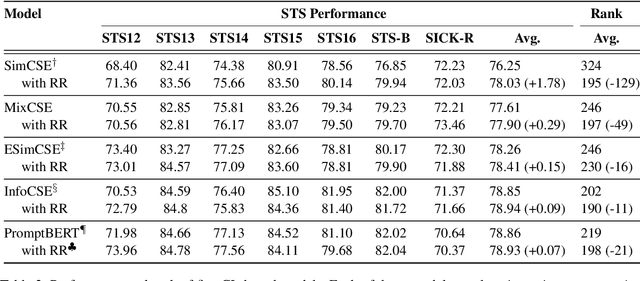
The latest advancements in unsupervised learning of sentence embeddings predominantly involve employing contrastive learning-based (CL-based) fine-tuning over pre-trained language models. In this study, we analyze the latest sentence embedding methods by adopting representation rank as the primary tool of analysis. We first define Phase 1 and Phase 2 of fine-tuning based on when representation rank peaks. Utilizing these phases, we conduct a thorough analysis and obtain essential findings across key aspects, including alignment and uniformity, linguistic abilities, and correlation between performance and rank. For instance, we find that the dynamics of the key aspects can undergo significant changes as fine-tuning transitions from Phase 1 to Phase 2. Based on these findings, we experiment with a rank reduction (RR) strategy that facilitates rapid and stable fine-tuning of the latest CL-based methods. Through empirical investigations, we showcase the efficacy of RR in enhancing the performance and stability of five state-of-the-art sentence embedding methods.