 Add to Chrome
 Add to Firefox
 Add to Edge
A Statistical Framework for Data-Driven Discovery of Differential Performance in Clinical Risk Prediction Models
Aug 02, 2026
Predictive models employing artificial intelligence (AI) and machine learning (ML) are increasingly being used for decision support in healthcare settings. These models may exhibit differential performance across population subgroups defined by race, age, sex, and other factors and cause disparate clinical impacts, leading to intensive recent study of what has been termed "model fairness". While many methods have been proposed to assess risk prediction model fairness, these techniques generally require that the end user pre-specify the groups across which fairness is to be evaluated. In real-world settings, however, important model performance disparities may arise in unknown subgroups defined by multiple intersecting characteristics. To address this problem, we propose the unfairness tree (utree), a data-driven recursive partitioning framework for identifying subgroups with differential model performance. In simulations, the utree exhibits nominal empirical type I error rates and good ability to detect, quantify, and characterize performance discrepancies defined by higher-order variable interactions. In six mortality risk models fit to the GUSTO-I acute myocardial infarction trial dataset, utrees identified subgroup-specific performance patterns, with age, sex, blood pressure, and Killip class consistently associated with differential model performance.

MEBoost: Variable Selection in the Presence of Measurement Error
Oct 25, 2017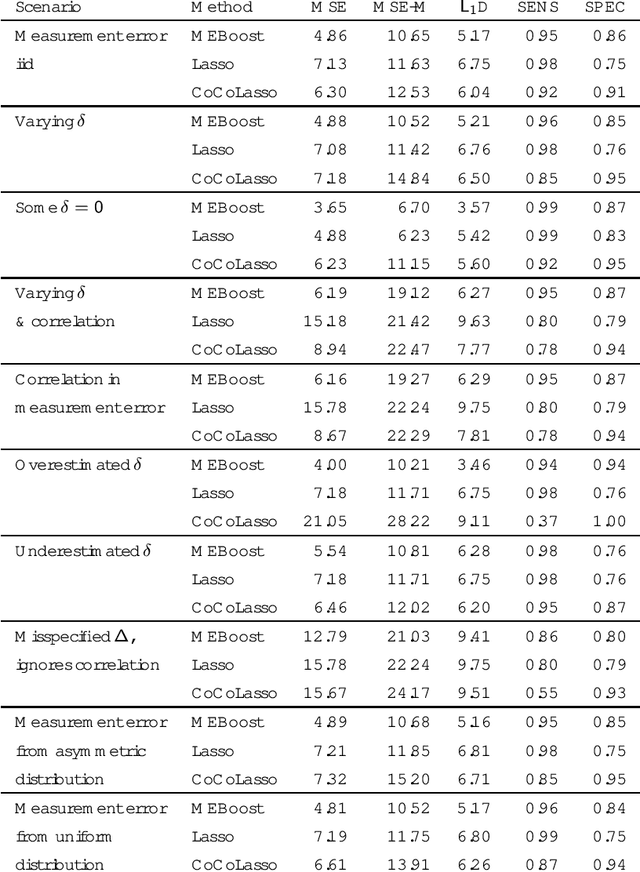
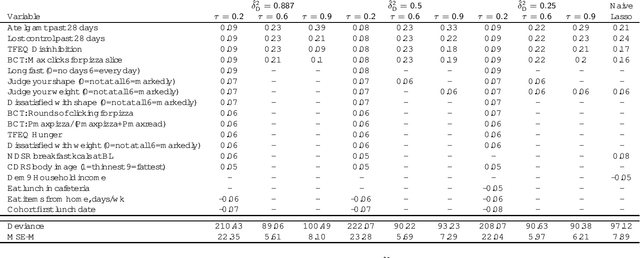
We present a novel method for variable selection in regression models when covariates are measured with error. The iterative algorithm we propose, MEBoost, follows a path defined by estimating equations that correct for covariate measurement error. Via simulation, we evaluated our method and compare its performance to the recently-proposed Convex Conditioned Lasso (CoCoLasso) and to the "naive" Lasso which does not correct for measurement error. Increasing the degree of measurement error increased prediction error and decreased the probability of accurate covariate selection, but this loss of accuracy was least pronounced when using MEBoost. We illustrate the use of MEBoost in practice by analyzing data from the Box Lunch Study, a clinical trial in nutrition where several variables are based on self-report and hence measured with error.
Data mining for censored time-to-event data: A Bayesian network model for predicting cardiovascular risk from electronic health record data
Apr 08, 2014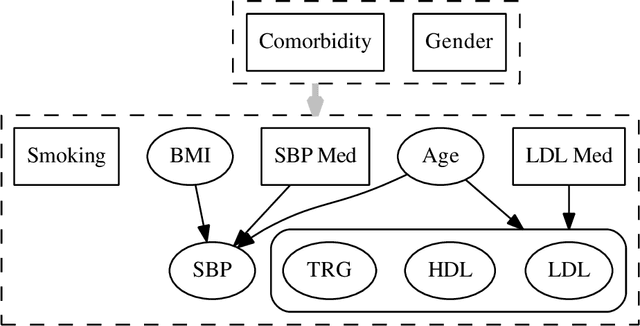
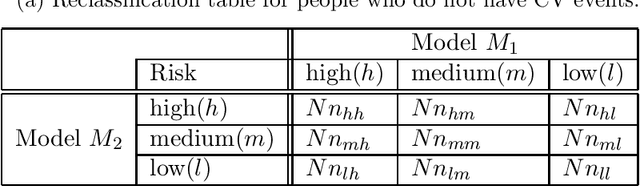
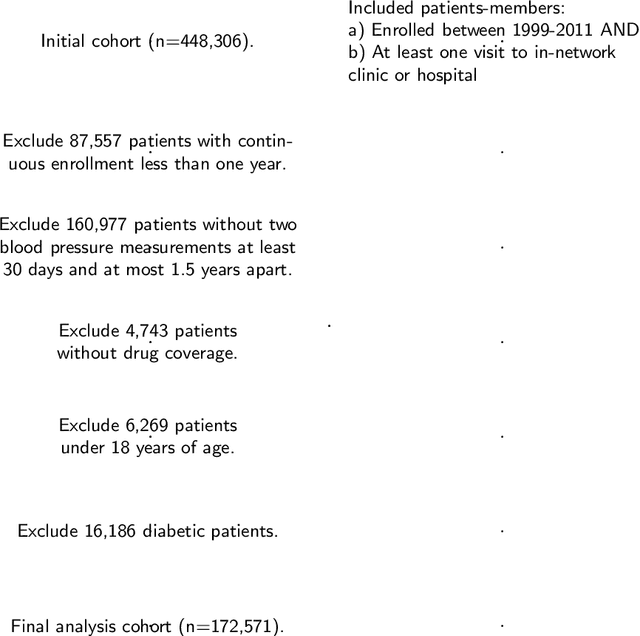
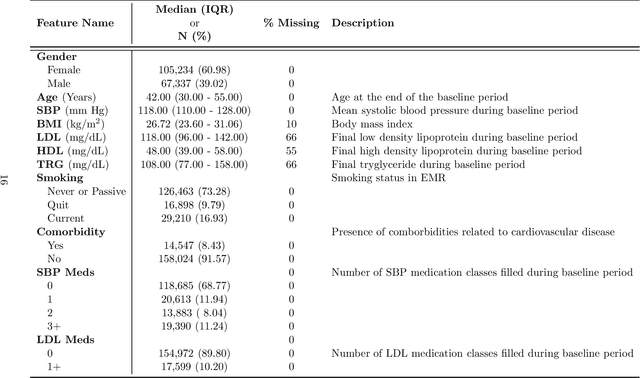
Models for predicting the risk of cardiovascular events based on individual patient characteristics are important tools for managing patient care. Most current and commonly used risk prediction models have been built from carefully selected epidemiological cohorts. However, the homogeneity and limited size of such cohorts restricts the predictive power and generalizability of these risk models to other populations. Electronic health data (EHD) from large health care systems provide access to data on large, heterogeneous, and contemporaneous patient populations. The unique features and challenges of EHD, including missing risk factor information, non-linear relationships between risk factors and cardiovascular event outcomes, and differing effects from different patient subgroups, demand novel machine learning approaches to risk model development. In this paper, we present a machine learning approach based on Bayesian networks trained on EHD to predict the probability of having a cardiovascular event within five years. In such data, event status may be unknown for some individuals as the event time is right-censored due to disenrollment and incomplete follow-up. Since many traditional data mining methods are not well-suited for such data, we describe how to modify both modelling and assessment techniques to account for censored observation times. We show that our approach can lead to better predictive performance than the Cox proportional hazards model (i.e., a regression-based approach commonly used for censored, time-to-event data) or a Bayesian network with {\em{ad hoc}} approaches to right-censoring. Our techniques are motivated by and illustrated on data from a large U.S. Midwestern health care system.
A Naive Bayes machine learning approach to risk prediction using censored, time-to-event data
Apr 08, 2014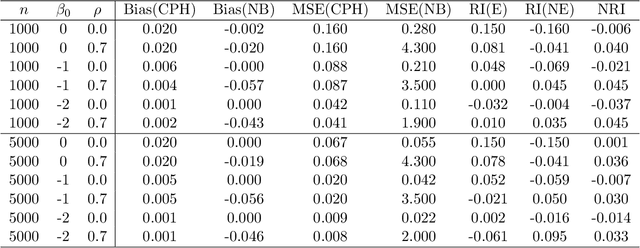
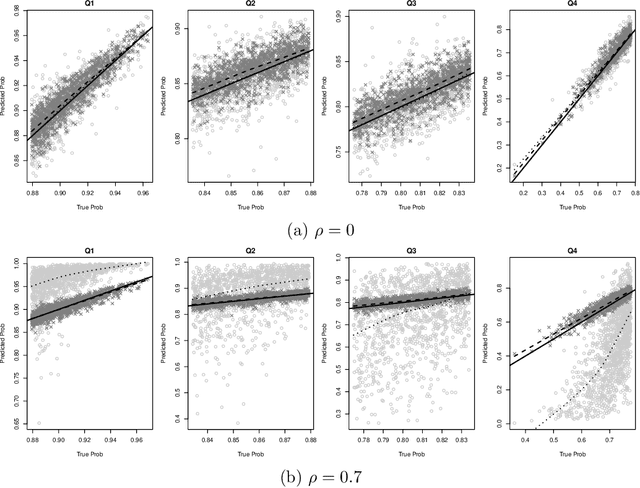
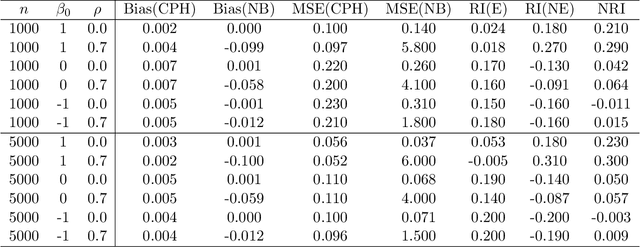
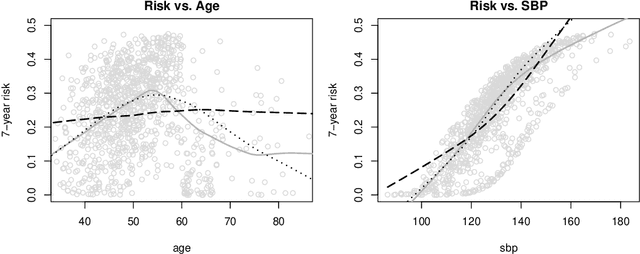
Predicting an individual's risk of experiencing a future clinical outcome is a statistical task with important consequences for both practicing clinicians and public health experts. Modern observational databases such as electronic health records (EHRs) provide an alternative to the longitudinal cohort studies traditionally used to construct risk models, bringing with them both opportunities and challenges. Large sample sizes and detailed covariate histories enable the use of sophisticated machine learning techniques to uncover complex associations and interactions, but observational databases are often ``messy,'' with high levels of missing data and incomplete patient follow-up. In this paper, we propose an adaptation of the well-known Naive Bayes (NB) machine learning approach for classification to time-to-event outcomes subject to censoring. We compare the predictive performance of our method to the Cox proportional hazards model which is commonly used for risk prediction in healthcare populations, and illustrate its application to prediction of cardiovascular risk using an EHR dataset from a large Midwest integrated healthcare system.