 Add to Chrome
 Add to Firefox
 Add to Edge
TT-DAC-PS: Twin-Target Deterministic Actor-Critic with Policy Smoothing for Optimal Trade Execution
Jun 07, 2026
This study addresses the optimal execution of large stock sell programs by introducing TT-DAC-PS (Twin-Target Deterministic Actor-Critic with Policy Smoothing), a deterministic actor-critic architecture that combines twin exponential-moving-average critic targets with pessimistic min backup, TD3-style target policy smoothing noise, delayed actor updates, and conservative Q regularisation to curb overestimation. Exploration uses Ornstein-Uhlenbeck (OU) noise with a hybrid schedule: deterministic episode-wise decay, variance-guided adjustment based on recent reward dispersion, and a Soft Actor-Critic (SAC)-style temperature that is learned and mapped to the noise scale. The environment integrates Almgren-Chriss (AC) trade impact with Limit Order Book (LOB) prices and volumes, normalised state features, per-step volume participation caps, and a utility-based reward. The trade execution algorithm is applied to LOB data for ten U.S. stocks. Performance is assessed against reinforcement-learning baseline algorithms, including Proximal Policy Optimisation (PPO), Soft Actor-Critic (SAC), and Advantage Actor-Critic (A2C), as well as alternative trade execution algorithms, including Time-Weighted Average Price (TWAP), Volume-Weighted Average Price (VWAP), and AC. The proposed model consistently reduces mean implementation shortfall percentage with competitive variance, outperforming classical baselines and standard reinforcement-learning benchmark models.

AdamZ: An Enhanced Optimisation Method for Neural Network Training
Nov 22, 2024AdamZ is an advanced variant of the Adam optimiser, developed to enhance convergence efficiency in neural network training. This optimiser dynamically adjusts the learning rate by incorporating mechanisms to address overshooting and stagnation, that are common challenges in optimisation. Specifically, AdamZ reduces the learning rate when overshooting is detected and increases it during periods of stagnation, utilising hyperparameters such as overshoot and stagnation factors, thresholds, and patience levels to guide these adjustments. While AdamZ may lead to slightly longer training times compared to some other optimisers, it consistently excels in minimising the loss function, making it particularly advantageous for applications where precision is critical. Benchmarking results demonstrate the effectiveness of AdamZ in maintaining optimal learning rates, leading to improved model performance across diverse tasks.
DECICE: Device-Edge-Cloud Intelligent Collaboration Framework
May 04, 2023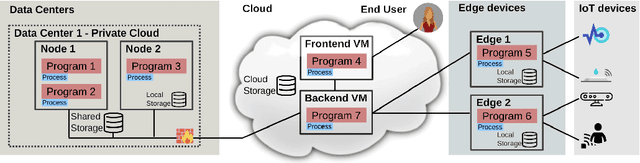
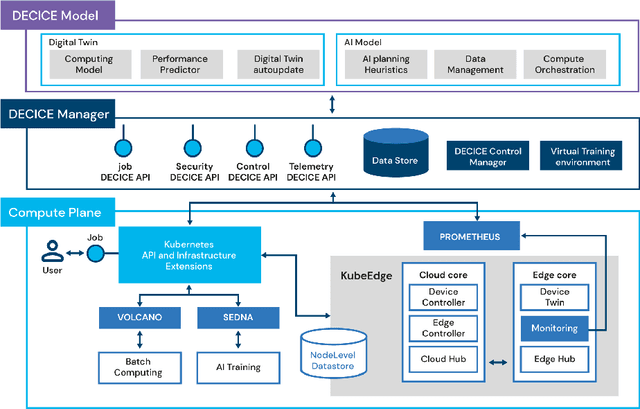
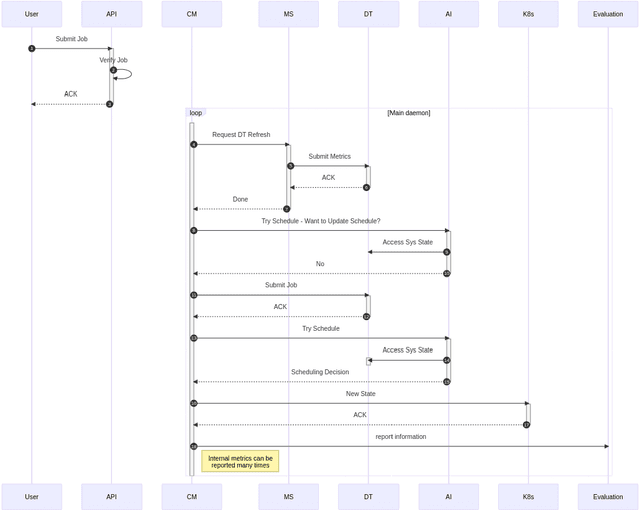
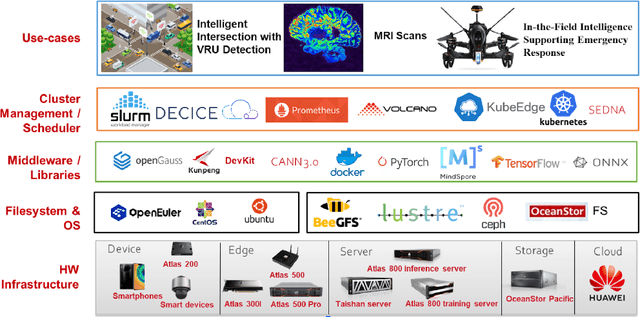
DECICE is a Horizon Europe project that is developing an AI-enabled open and portable management framework for automatic and adaptive optimization and deployment of applications in computing continuum encompassing from IoT sensors on the Edge to large-scale Cloud / HPC computing infrastructures. In this paper, we describe the DECICE framework and architecture. Furthermore, we highlight use-cases for framework evaluation: intelligent traffic intersection, magnetic resonance imaging, and emergency response.