 Add to Chrome
 Add to Firefox
 Add to Edge
ReLeaf: Benchmarking Leaf Segmentation across Domains and Species
May 05, 2026
Rising global food demand and growing climate pressure increase the need for sustainable, precise agricultural practices. Automated, individualized plant treatment relies on fine-grained visual analysis, yet leaf-level segmentation remains underexplored despite its value for assessing crop health, growth dynamics, yield potential and localized stress symptoms. Progress is limited by a lack of dedicated datasets, especially regarding species coverage, and by the absence of systematic evaluations of modern instance-segmentation architectures for this task. We address these gaps by surveying current data and identifying four suitable, publicly available leaf-segmentation datasets. Using them, we compare one-stage, two-stage and Transformer-based detectors and identify a YOLO26 model configuration to provide the best trade-off for real-world precision-agriculture tasks. Extensive cross-domain generalization experiments reveal substantial performance drops across plant species and recording setups, especially for models trained solely on laboratory data. To strengthen data availability, we introduce a new benchmark dataset with leaf-level masks for 23 plant species, created via semi-automatic annotation of selected CropAndWeed images. A model trained on all four existing datasets achieves a mean mAP50-95 of 83.9% across their corresponding test sets and 40.2% on our new benchmark, demonstrating improved generalization and highlighting the need for diverse leaf-segmentation datasets in robust precision agriculture.

SemanticSugarBeets: A Multi-Task Framework and Dataset for Inspecting Harvest and Storage Characteristics of Sugar Beets
Apr 23, 2025While sugar beets are stored prior to processing, they lose sugar due to factors such as microorganisms present in adherent soil and excess vegetation. Their automated visual inspection promises to aide in quality assurance and thereby increase efficiency throughout the processing chain of sugar production. In this work, we present a novel high-quality annotated dataset and two-stage method for the detection, semantic segmentation and mass estimation of post-harvest and post-storage sugar beets in monocular RGB images. We conduct extensive ablation experiments for the detection of sugar beets and their fine-grained semantic segmentation regarding damages, rot, soil adhesion and excess vegetation. For these tasks, we evaluate multiple image sizes, model architectures and encoders, as well as the influence of environmental conditions. Our experiments show an mAP50-95 of 98.8 for sugar-beet detection and an mIoU of 64.0 for the best-performing segmentation model.
TimberVision: A Multi-Task Dataset and Framework for Log-Component Segmentation and Tracking in Autonomous Forestry Operations
Jan 13, 2025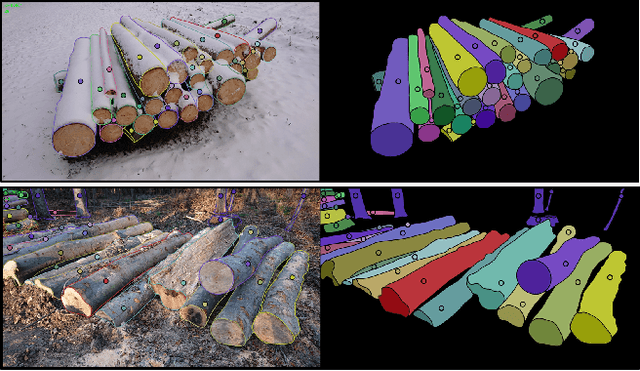
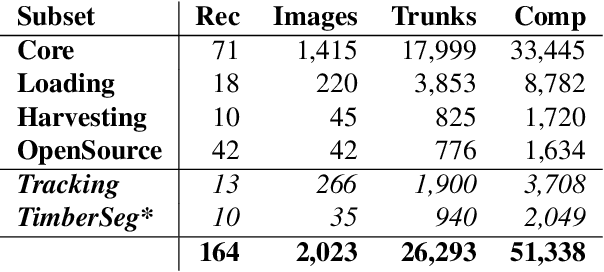
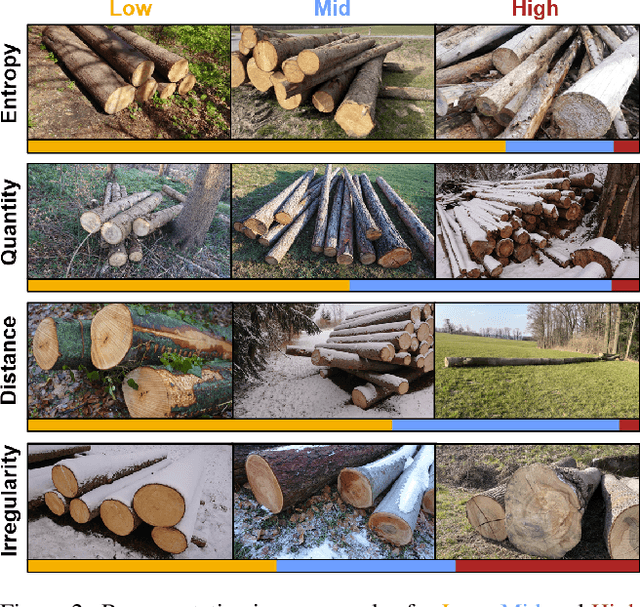
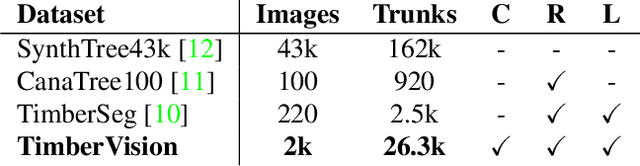
Timber represents an increasingly valuable and versatile resource. However, forestry operations such as harvesting, handling and measuring logs still require substantial human labor in remote environments posing significant safety risks. Progressively automating these tasks has the potential of increasing their efficiency as well as safety, but requires an accurate detection of individual logs as well as live trees and their context. Although initial approaches have been proposed for this challenging application domain, specialized data and algorithms are still too scarce to develop robust solutions. To mitigate this gap, we introduce the TimberVision dataset, consisting of more than 2k annotated RGB images containing a total of 51k trunk components including cut and lateral surfaces, thereby surpassing any existing dataset in this domain in terms of both quantity and detail by a large margin. Based on this data, we conduct a series of ablation experiments for oriented object detection and instance segmentation and evaluate the influence of multiple scene parameters on model performance. We introduce a generic framework to fuse the components detected by our models for both tasks into unified trunk representations. Furthermore, we automatically derive geometric properties and apply multi-object tracking to further enhance robustness. Our detection and tracking approach provides highly descriptive and accurate trunk representations solely from RGB image data, even under challenging environmental conditions. Our solution is suitable for a wide range of application scenarios and can be readily combined with other sensor modalities.