 Add to Chrome
 Add to Firefox
 Add to Edge
Noise-Adaptive Regularization for Robust Multi-Label Remote Sensing Image Classification
Jan 13, 2026
The development of reliable methods for multi-label classification (MLC) has become a prominent research direction in remote sensing (RS). As the scale of RS data continues to expand, annotation procedures increasingly rely on thematic products or crowdsourced procedures to reduce the cost of manual annotation. While cost-effective, these strategies often introduce multi-label noise in the form of partially incorrect annotations. In MLC, label noise arises as additive noise, subtractive noise, or a combination of both in the form of mixed noise. Previous work has largely overlooked this distinction and commonly treats noisy annotations as supervised signals, lacking mechanisms that explicitly adapt learning behavior to different noise types. To address this limitation, we propose NAR, a noise-adaptive regularization method that explicitly distinguishes between additive and subtractive noise within a semi-supervised learning framework. NAR employs a confidence-based label handling mechanism that dynamically retains label entries with high confidence, temporarily deactivates entries with moderate confidence, and corrects low confidence entries via flipping. This selective attenuation of supervision is integrated with early-learning regularization (ELR) to stabilize training and mitigate overfitting to corrupted labels. Experiments across additive, subtractive, and mixed noise scenarios demonstrate that NAR consistently improves robustness compared with existing methods. Performance improvements are most pronounced under subtractive and mixed noise, indicating that adaptive suppression and selective correction of noisy supervision provide an effective strategy for noise robust learning in RS MLC.

Annotation Cost Efficient Active Learning for Content Based Image Retrieval
Jun 26, 2023

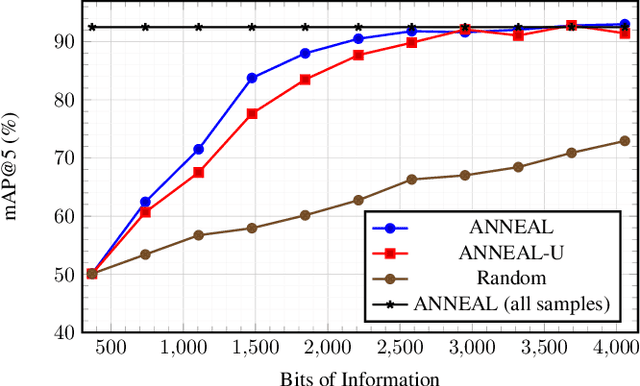

Deep metric learning (DML) based methods have been found very effective for content-based image retrieval (CBIR) in remote sensing (RS). For accurately learning the model parameters of deep neural networks, most of the DML methods require a high number of annotated training images, which can be costly to gather. To address this problem, in this paper we present an annotation cost efficient active learning (AL) method (denoted as ANNEAL). The proposed method aims to iteratively enrich the training set by annotating the most informative image pairs as similar or dissimilar, while accurately modelling a deep metric space. This is achieved by two consecutive steps. In the first step the pairwise image similarity is modelled based on the available training set. Then, in the second step the most uncertain and diverse (i.e., informative) image pairs are selected to be annotated. Unlike the existing AL methods for CBIR, at each AL iteration of ANNEAL a human expert is asked to annotate the most informative image pairs as similar/dissimilar. This significantly reduces the annotation cost compared to annotating images with land-use/land cover class labels. Experimental results show the effectiveness of our method. The code of ANNEAL is publicly available at https://git.tu-berlin.de/rsim/ANNEAL.