 Add to Chrome
 Add to Firefox
 Add to Edge
Beyond $L_2$: Generalizing Abductive Latent Explanations to Diverse Prototype-Based Architectures
Aug 17, 2026
Prototype-based neural networks are hailed as interpretable-by-design architectures. Recently, Abductive Latent Explanations (ALE) were introduced to provide formal, mathematically guaranteed explanations that leverage the intrinsic structure of these networks to ensure both predictive safety and human readability. ALEs rely on computing tight bounds on latent space distances to produce formal explanations. However, existing ALE formulations are rigidly confined to Euclidean latent spaces. This leaves a critical gap: modern state-of-the-art architectures increasingly rely on non-Euclidean representations - such as spherical metrics, Gaussian densities, and dimensional projections - rendering current formal explanation methods incompatible. In this work, we generalize the ALE framework to support non-Euclidean prototype architectures. For each geometric variant, we systematically derive how to either map the architecture to existing bounds or construct novel, architecture-specific bounding algorithms. We validate our theoretical constructions by computing subset-minimal formal explanations on fully trained image classifiers. By unifying these diverse models under a single formal framework, we enable the first rigorous, cross-architecture comparison of their interpretability.

Integrating the Wikidata Taxonomy into YAGO
Aug 23, 2023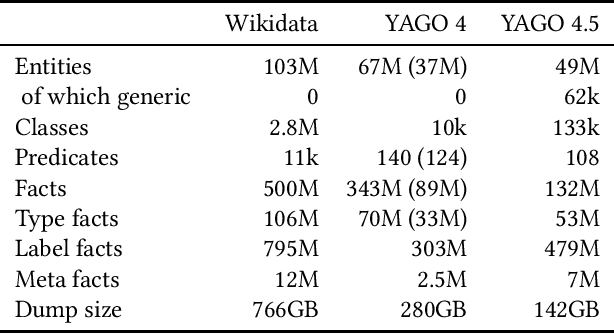
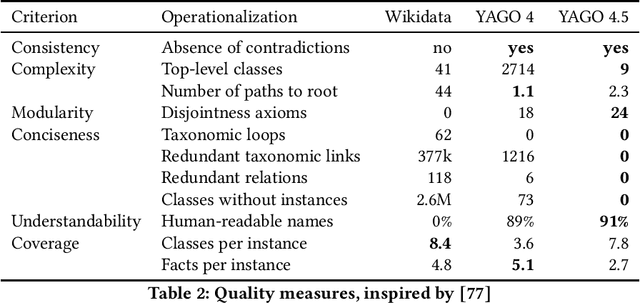
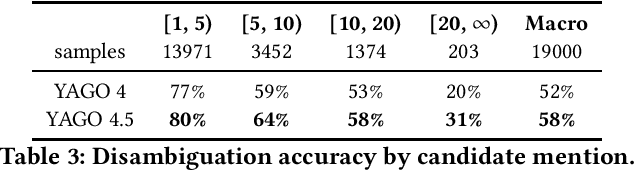
Wikidata is one of the largest public general-purpose Knowledge Bases (KBs). Yet, due to its collaborative nature, its schema and taxonomy have become convoluted. For the YAGO 4 KB, we combined Wikidata with the ontology from Schema.org, which reduced and cleaned up the taxonomy and constraints and made it possible to run automated reasoners on the data. However, it also cut away large parts of the Wikidata taxonomy. In this paper, we present our effort to merge the entire Wikidata taxonomy into the YAGO KB as much as possible. We pay particular attention to logical constraints and a careful distinction of classes and instances. Our work creates YAGO 4.5, which adds a rich layer of informative classes to YAGO, while at the same time keeping the KB logically consistent.