 Add to Chrome
 Add to Firefox
 Add to Edge
Token Warping Helps MLLMs Look from Nearby Viewpoints
Apr 03, 2026
Can warping tokens, rather than pixels, help multimodal large language models (MLLMs) understand how a scene appears from a nearby viewpoint? While MLLMs perform well on visual reasoning, they remain fragile to viewpoint changes, as pixel-wise warping is highly sensitive to small depth errors and often introduces geometric distortions. Drawing on theories of mental imagery that posit part-level structural representations as the basis for human perspective transformation, we examine whether image tokens in ViT-based MLLMs serve as an effective substrate for viewpoint changes. We compare forward and backward warping, finding that backward token warping, which defines a dense grid on the target view and retrieves a corresponding source-view token for each grid point, achieves greater stability and better preserves semantic coherence under viewpoint shifts. Experiments on our proposed ViewBench benchmark demonstrate that token-level warping enables MLLMs to reason reliably from nearby viewpoints, consistently outperforming all baselines including pixel-wise warping approaches, spatially fine-tuned MLLMs, and a generative warping method.

BoxSplitGen: A Generative Model for 3D Part Bounding Boxes in Varying Granularity
Feb 24, 2026Human creativity follows a perceptual process, moving from abstract ideas to finer details during creation. While 3D generative models have advanced dramatically, models specifically designed to assist human imagination in 3D creation -- particularly for detailing abstractions from coarse to fine -- have not been explored. We propose a framework that enables intuitive and interactive 3D shape generation by iteratively splitting bounding boxes to refine the set of bounding boxes. The main technical components of our framework are two generative models: the box-splitting generative model and the box-to-shape generative model. The first model, named BoxSplitGen, generates a collection of 3D part bounding boxes with varying granularity by iteratively splitting coarse bounding boxes. It utilizes part bounding boxes created through agglomerative merging and learns the reverse of the merging process -- the splitting sequences. The model consists of two main components: the first learns the categorical distribution of the box to be split, and the second learns the distribution of the two new boxes, given the set of boxes and the indication of which box to split. The second model, the box-to-shape generative model, is trained by leveraging the 3D shape priors learned by an existing 3D diffusion model while adapting the model to incorporate bounding box conditioning. In our experiments, we demonstrate that the box-splitting generative model outperforms token prediction models and the inpainting approach with an unconditional diffusion model. Also, we show that our box-to-shape model, based on a state-of-the-art 3D diffusion model, provides superior results compared to a previous model.
DiffusionRollout: Uncertainty-Aware Rollout Planning in Long-Horizon PDE Solving
Feb 14, 2026We propose DiffusionRollout, a novel selective rollout planning strategy for autoregressive diffusion models, aimed at mitigating error accumulation in long-horizon predictions of physical systems governed by partial differential equations (PDEs). Building on the recently validated probabilistic approach to PDE solving, we further explore its ability to quantify predictive uncertainty and demonstrate a strong correlation between prediction errors and standard deviations computed over multiple samples-supporting their use as a proxy for the model's predictive confidence. Based on this observation, we introduce a mechanism that adaptively selects step sizes during autoregressive rollouts, improving long-term prediction reliability by reducing the compounding effect of conditioning on inaccurate prior outputs. Extensive evaluation on long-trajectory PDE prediction benchmarks validates the effectiveness of the proposed uncertainty measure and adaptive planning strategy, as evidenced by lower prediction errors and longer predicted trajectories that retain a high correlation with their ground truths.
BézierFlow: Learning Bézier Stochastic Interpolant Schedulers for Few-Step Generation
Dec 28, 2025We introduce BézierFlow, a lightweight training approach for few-step generation with pretrained diffusion and flow models. BézierFlow achieves a 2-3x performance improvement for sampling with $\leq$ 10 NFEs while requiring only 15 minutes of training. Recent lightweight training approaches have shown promise by learning optimal timesteps, but their scope remains restricted to ODE discretizations. To broaden this scope, we propose learning the optimal transformation of the sampling trajectory by parameterizing stochastic interpolant (SI) schedulers. The main challenge lies in designing a parameterization that satisfies critical desiderata, including boundary conditions, differentiability, and monotonicity of the SNR. To effectively meet these requirements, we represent scheduler functions as Bézier functions, where control points naturally enforce these properties. This reduces the problem to learning an ordered set of points in the time range, while the interpretation of the points changes from ODE timesteps to Bézier control points. Across a range of pretrained diffusion and flow models, BézierFlow consistently outperforms prior timestep-learning methods, demonstrating the effectiveness of expanding the search space from discrete timesteps to Bézier-based trajectory transformations.
BézierFlow: Bézier Stochastic Interpolant Schedulers for Few-Step Generation
Dec 15, 2025We introduce BézierFlow, a lightweight training approach for few-step generation with pretrained diffusion and flow models. BézierFlow achieves a 2-3x performance improvement for sampling with $\leq$ 10 NFEs while requiring only 15 minutes of training. Recent lightweight training approaches have shown promise by learning optimal timesteps, but their scope remains restricted to ODE discretizations. To broaden this scope, we propose learning the optimal transformation of the sampling trajectory by parameterizing stochastic interpolant (SI) schedulers. The main challenge lies in designing a parameterization that satisfies critical desiderata, including boundary conditions, differentiability, and monotonicity of the SNR. To effectively meet these requirements, we represent scheduler functions as Bézier functions, where control points naturally enforce these properties. This reduces the problem to learning an ordered set of points in the time range, while the interpretation of the points changes from ODE timesteps to Bézier control points. Across a range of pretrained diffusion and flow models, BézierFlow consistently outperforms prior timestep-learning methods, demonstrating the effectiveness of expanding the search space from discrete timesteps to Bézier-based trajectory transformations.
Toward Ambulatory Vision: Learning Visually-Grounded Active View Selection
Dec 15, 2025Vision Language Models (VLMs) excel at visual question answering (VQA) but remain limited to snapshot vision, reasoning from static images. In contrast, embodied agents require ambulatory vision, actively moving to obtain more informative views. We introduce Visually Grounded Active View Selection (VG-AVS), a task that selects the most informative next viewpoint using only the visual information in the current image, without relying on scene memory or external knowledge. To support this task, we construct a synthetic dataset with automatically generated paired query-target views and question-answer prompts. We also propose a framework that fine-tunes pretrained VLMs through supervised fine-tuning (SFT) followed by RL-based policy optimization. Our approach achieves strong question answering performance based on viewpoint selection and generalizes robustly to unseen synthetic and real scenes. Furthermore, incorporating our learned VG-AVS framework into existing scene-exploration-based EQA systems improves downstream question-answering accuracy.
VideoHandles: Editing 3D Object Compositions in Videos Using Video Generative Priors
Mar 03, 2025Generative methods for image and video editing use generative models as priors to perform edits despite incomplete information, such as changing the composition of 3D objects shown in a single image. Recent methods have shown promising composition editing results in the image setting, but in the video setting, editing methods have focused on editing object's appearance and motion, or camera motion, and as a result, methods to edit object composition in videos are still missing. We propose \name as a method for editing 3D object compositions in videos of static scenes with camera motion. Our approach allows editing the 3D position of a 3D object across all frames of a video in a temporally consistent manner. This is achieved by lifting intermediate features of a generative model to a 3D reconstruction that is shared between all frames, editing the reconstruction, and projecting the features on the edited reconstruction back to each frame. To the best of our knowledge, this is the first generative approach to edit object compositions in videos. Our approach is simple and training-free, while outperforming state-of-the-art image editing baselines.
Neural Pose Representation Learning for Generating and Transferring Non-Rigid Object Poses
Jun 14, 2024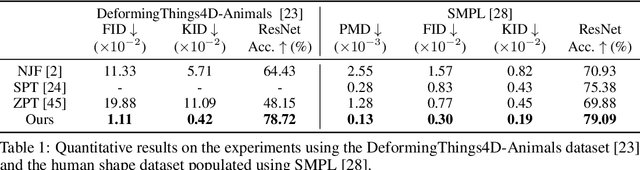
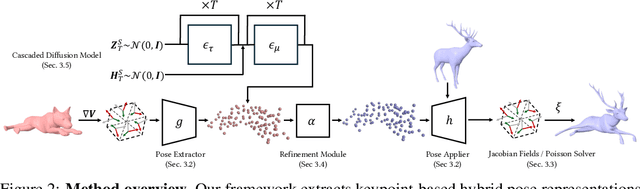
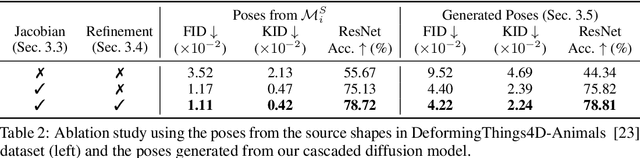
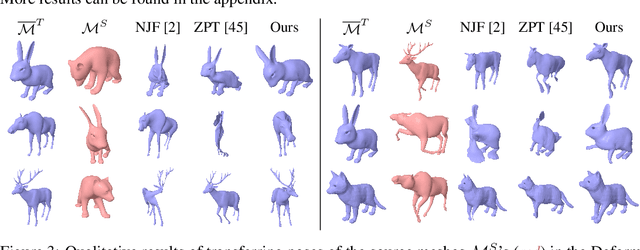
We propose a novel method for learning representations of poses for 3D deformable objects, which specializes in 1) disentangling pose information from the object's identity, 2) facilitating the learning of pose variations, and 3) transferring pose information to other object identities. Based on these properties, our method enables the generation of 3D deformable objects with diversity in both identities and poses, using variations of a single object. It does not require explicit shape parameterization such as skeletons or joints, point-level or shape-level correspondence supervision, or variations of the target object for pose transfer. To achieve pose disentanglement, compactness for generative models, and transferability, we first design the pose extractor to represent the pose as a keypoint-based hybrid representation and the pose applier to learn an implicit deformation field. To better distill pose information from the object's geometry, we propose the implicit pose applier to output an intrinsic mesh property, the face Jacobian. Once the extracted pose information is transferred to the target object, the pose applier is fine-tuned in a self-supervised manner to better describe the target object's shapes with pose variations. The extracted poses are also used to train a cascaded diffusion model to enable the generation of novel poses. Our experiments with the DeformThings4D and Human datasets demonstrate state-of-the-art performance in pose transfer and the ability to generate diverse deformed shapes with various objects and poses.
SyncTweedies: A General Generative Framework Based on Synchronized Diffusions
Mar 22, 2024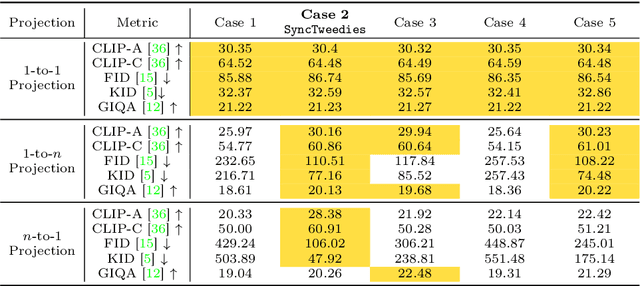
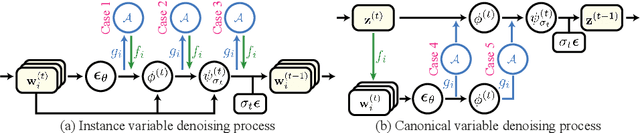
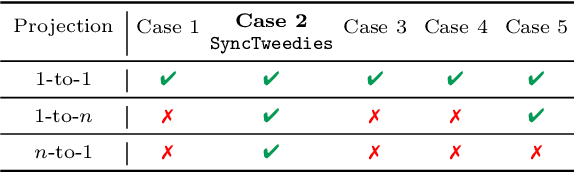
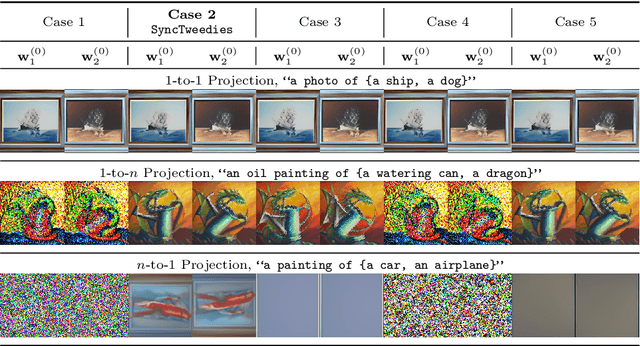
We introduce a general framework for generating diverse visual content, including ambiguous images, panorama images, mesh textures, and Gaussian splat textures, by synchronizing multiple diffusion processes. We present exhaustive investigation into all possible scenarios for synchronizing multiple diffusion processes through a canonical space and analyze their characteristics across applications. In doing so, we reveal a previously unexplored case: averaging the outputs of Tweedie's formula while conducting denoising in multiple instance spaces. This case also provides the best quality with the widest applicability to downstream tasks. We name this case SyncTweedies. In our experiments generating visual content aforementioned, we demonstrate the superior quality of generation by SyncTweedies compared to other synchronization methods, optimization-based and iterative-update-based methods.
Posterior Distillation Sampling
Nov 23, 2023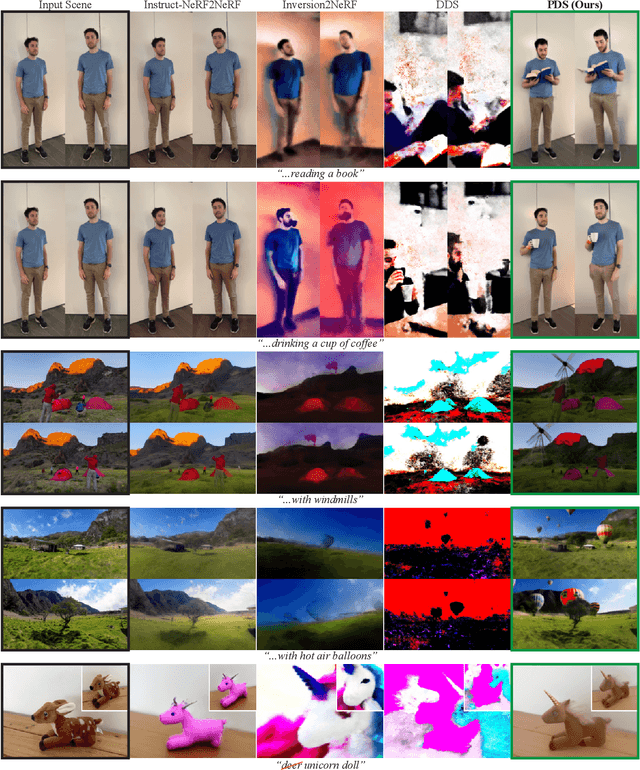
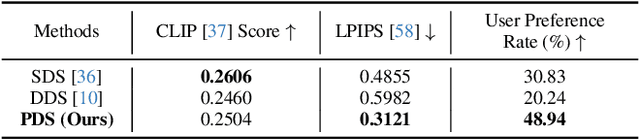
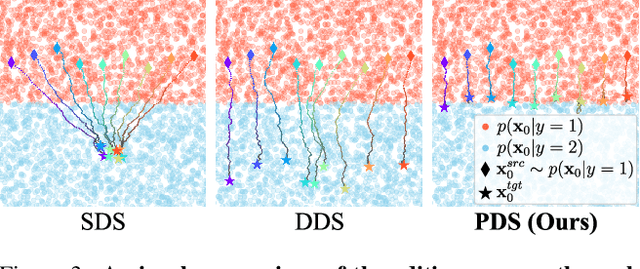
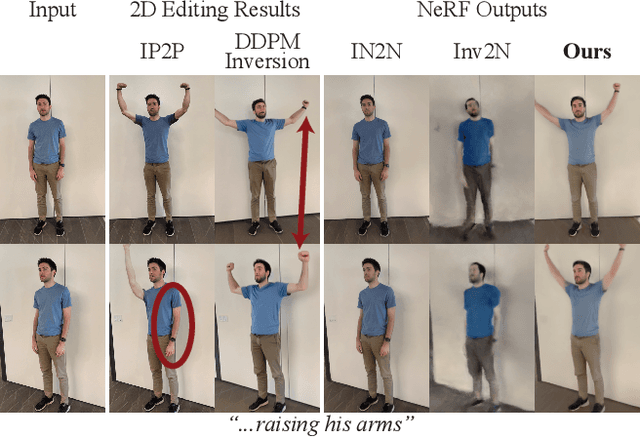
We introduce Posterior Distillation Sampling (PDS), a novel optimization method for parametric image editing based on diffusion models. Existing optimization-based methods, which leverage the powerful 2D prior of diffusion models to handle various parametric images, have mainly focused on generation. Unlike generation, editing requires a balance between conforming to the target attribute and preserving the identity of the source content. Recent 2D image editing methods have achieved this balance by leveraging the stochastic latent encoded in the generative process of diffusion models. To extend the editing capabilities of diffusion models shown in pixel space to parameter space, we reformulate the 2D image editing method into an optimization form named PDS. PDS matches the stochastic latents of the source and the target, enabling the sampling of targets in diverse parameter spaces that align with a desired attribute while maintaining the source's identity. We demonstrate that this optimization resembles running a generative process with the target attribute, but aligning this process with the trajectory of the source's generative process. Extensive editing results in Neural Radiance Fields and Scalable Vector Graphics representations demonstrate that PDS is capable of sampling targets to fulfill the aforementioned balance across various parameter spaces.