 Add to Chrome
 Add to Firefox
 Add to Edge
Simple Image Processing and Similarity Measures Can Link Data Samples across Databases through Brain MRI
Feb 10, 2026
Head Magnetic Resonance Imaging (MRI) is routinely collected and shared for research under strict regulatory frameworks. These frameworks require removing potential identifiers before sharing. But, even after skull stripping, the brain parenchyma contains unique signatures that can match other MRIs from the same participants across databases, posing a privacy risk if additional data features are available. Current regulatory frameworks often mandate evaluating such risks based on the assessment of a certain level of reasonableness. Prior studies have already suggested that a brain MRI could enable participant linkage, but they have relied on training-based or computationally intensive methods. Here, we demonstrate that linking an individual's skull-stripped T1-weighted MRI, which may lead to re-identification if other identifiers are available, is possible using standard preprocessing followed by image similarity computation. Nearly perfect linkage accuracy was achieved in matching data samples across various time intervals, scanner types, spatial resolutions, and acquisition protocols, despite potential cognitive decline, simulating MRI matching across databases. These results aim to contribute meaningfully to the development of thoughtful, forward-looking policies in medical data sharing.

Federated Learning for Predicting Mild Cognitive Impairment to Dementia Conversion
Mar 05, 2025Dementia is a progressive condition that impairs an individual's cognitive health and daily functioning, with mild cognitive impairment (MCI) often serving as its precursor. The prediction of MCI to dementia conversion has been well studied, but previous studies have almost always focused on traditional Machine Learning (ML) based methods that require sharing sensitive clinical information to train predictive models. This study proposes a privacy-enhancing solution using Federated Learning (FL) to train predictive models for MCI to dementia conversion without sharing sensitive data, leveraging socio demographic and cognitive measures. We simulated and compared two network architectures, Peer to Peer (P2P) and client-server, to enable collaborative learning. Our results demonstrated that FL had comparable predictive performance to centralized ML, and each clinical site showed similar performance without sharing local data. Moreover, the predictive performance of FL models was superior to site specific models trained without collaboration. This work highlights that FL can eliminate the need for data sharing without compromising model efficacy.
MAMAF-Net: Motion-Aware and Multi-Attention Fusion Network for Stroke Diagnosis
Apr 19, 2023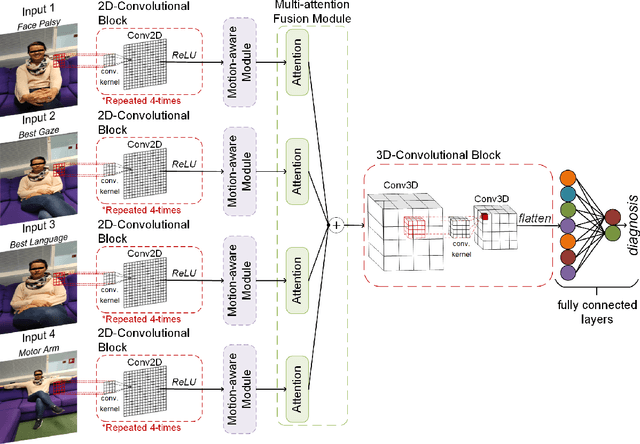
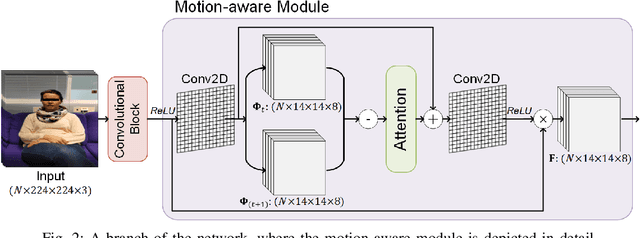
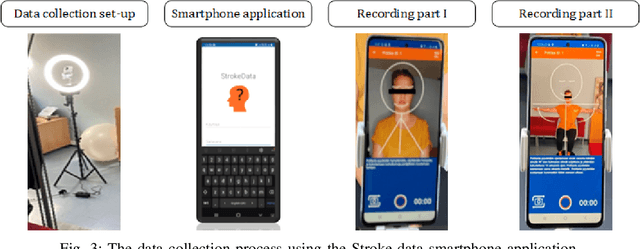
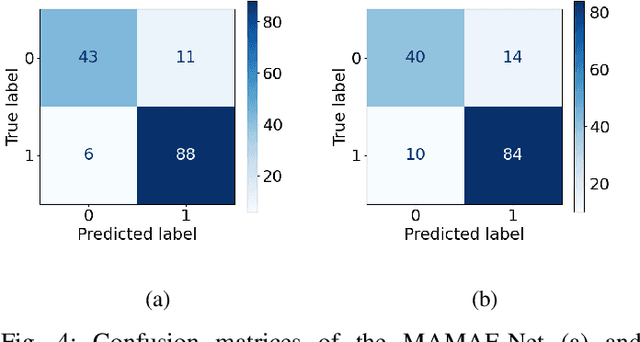
Stroke is a major cause of mortality and disability worldwide from which one in four people are in danger of incurring in their lifetime. The pre-hospital stroke assessment plays a vital role in identifying stroke patients accurately to accelerate further examination and treatment in hospitals. Accordingly, the National Institutes of Health Stroke Scale (NIHSS), Cincinnati Pre-hospital Stroke Scale (CPSS) and Face Arm Speed Time (F.A.S.T.) are globally known tests for stroke assessment. However, the validity of these tests is skeptical in the absence of neurologists. Therefore, in this study, we propose a motion-aware and multi-attention fusion network (MAMAF-Net) that can detect stroke from multimodal examination videos. Contrary to other studies on stroke detection from video analysis, our study for the first time proposes an end-to-end solution from multiple video recordings of each subject with a dataset encapsulating stroke, transient ischemic attack (TIA), and healthy controls. The proposed MAMAF-Net consists of motion-aware modules to sense the mobility of patients, attention modules to fuse the multi-input video data, and 3D convolutional layers to perform diagnosis from the attention-based extracted features. Experimental results over the collected StrokeDATA dataset show that the proposed MAMAF-Net achieves a successful detection of stroke with 93.62% sensitivity and 95.33% AUC score.