 Add to Chrome
 Add to Firefox
 Add to Edge
Computed Tomography (CT)-derived Cardiovascular Flow Estimation Using Physics-Informed Neural Networks Improves with Sinogram-based Training: A Simulation Study
Nov 05, 2025
Background: Non-invasive imaging-based assessment of blood flow plays a critical role in evaluating heart function and structure. Computed Tomography (CT) is a widely-used imaging modality that can robustly evaluate cardiovascular anatomy and function, but direct methods to estimate blood flow velocity from movies of contrast evolution have not been developed. Purpose: This study evaluates the impact of CT imaging on Physics-Informed Neural Networks (PINN)-based flow estimation and proposes an improved framework, SinoFlow, which uses sinogram data directly to estimate blood flow. Methods: We generated pulsatile flow fields in an idealized 2D vessel bifurcation using computational fluid dynamics and simulated CT scans with varying gantry rotation speeds, tube currents, and pulse mode imaging settings. We compared the performance of PINN-based flow estimation using reconstructed images (ImageFlow) to SinoFlow. Results: SinoFlow significantly improved flow estimation performance by avoiding propagating errors introduced by filtered backprojection. SinoFlow was robust across all tested gantry rotation speeds and consistently produced lower mean squared error and velocity errors than ImageFlow. Additionally, SinoFlow was compatible with pulsed-mode imaging and maintained higher accuracy with shorter pulse widths. Conclusions: This study demonstrates the potential of SinoFlow for CT-based flow estimation, providing a more promising approach for non-invasive blood flow assessment. The findings aim to inform future applications of PINNs to CT images and provide a solution for image-based estimation, with reasonable acquisition parameters yielding accurate flow estimates.

Estimation of Blood Flow Parameters in the Left Atrial Appendage from 4DCT Dynamic Contrast Enhancement
Feb 04, 2025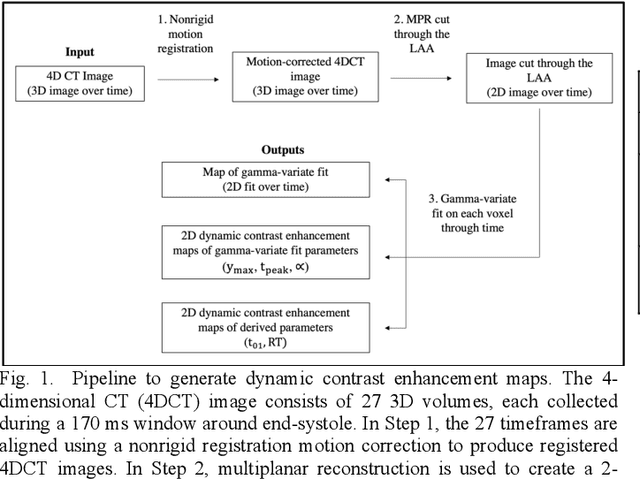
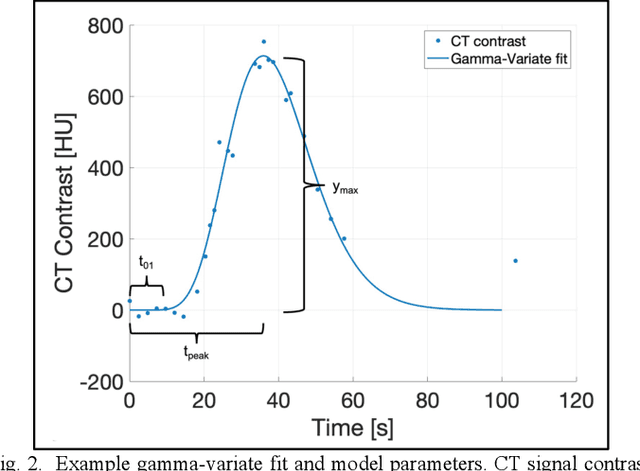
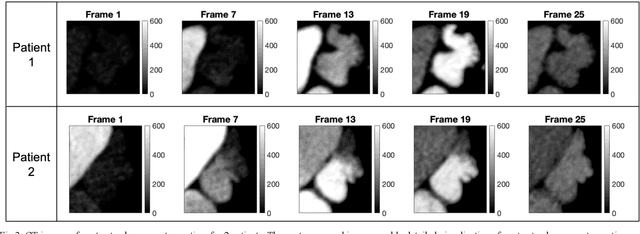
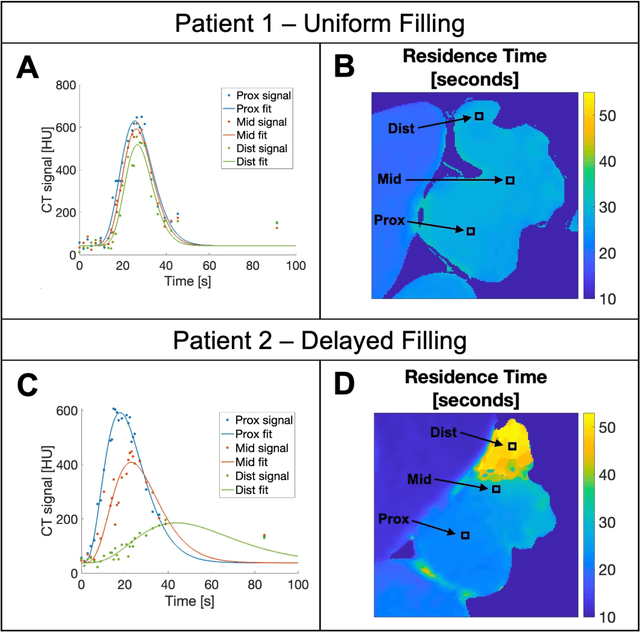
Cardiac CT is often used clinically in electrophysiology to evaluate cardiac morphology. One such case is to evaluate patients with Atrial Fibrillation (AF). AF can cause regions of slow blood flow and blood stasis through the left atrial appendage (LAA), and therefore, it may be preferable to evaluate blood flow through the LAA in addition to morphology. Although CT cannot measure flow directly, CT data has been used to estimate flow using modeling approaches such as Computational Fluid Dynamics, which take into account the cardiac geometry to simulate flow. Advances in CT technology now enable high-resolution imaging of the whole heart with low radiation doses. With multi-heartbeat imaging during a contrast injection, we can obtain 4-dimentional CT (4DCT) images to measure dynamic contrast enhancement directly. In this study, we use high-resolution 4DCT to acquire images of contrast enhancement across the LAA over multiple heartbeats. The CT contrast signal at each voxel over time is used to create dynamic contrast enhancement maps of parameters derived from a gamma-variate fit. These contrast enhancement maps enable quantification and visualization of spatial-temporal characteristics of flow parameters across the LAA.