 Add to Chrome
 Add to Firefox
 Add to Edge
MD-ProTector: Positioning Multiple Data-Driven Prototypes for LLM-Generated Text Detection
Aug 11, 2026
As LLM-generated content becomes more sophisticated, detection systems for distinguishing those texts from human-written text must operate at scale while handling diverse writing styles, domains, languages, and generator models. Input-only encoder detectors are suitable for practical deployment setting, but standard binary classification supplies only the class label and does not explicitly organize the substantial variation within either class. We propose MD-ProTector, which represents each class with multiple trainable reference vectors in the encoder embedding space, referred to as prototypes. These prototypes provide separate decision boundaries for different groups of texts within the same class. However, adding multiple prototypes alone does not determine which variation each prototype should represent. MD-ProTector addresses this problem with Prototype Positioning loss, which separates class-level structure from the within-class variation that differentiates individual prototypes. Evaluated across five settings from three large-scale benchmarks covering domain, generator, language, and adversarial variation, MD-ProTector achieves the highest AvgRec on MAGE CDCM and RAID and the highest AUROC and lowest FPR95 on RAID among the compared encoder-based methods.

SpectCount: Spectrotemporal Counting via Synthetic Signals Improves Large Audio Language Models
Jun 05, 2026Large audio language models (LALMs) extend large language models with an audio encoder and large-scale audio data. However, the scarcity of high-quality annotated audio data remains a fundamental bottleneck for scaling. Through probing signal detectability analysis, we identify fine-grained spectrotemporal perceptual weaknesses in a foundation LALM. To address these challenges, we propose Spectrotemporal Counting (SpectCount), a data-efficient fine-tuning approach based on fully synthetic audio signals generated on-the-fly, without relying on real-world audio, annotations, or pretrained generative models. SpectCount not only resolves the observed weaknesses but also improves performance on diverse auditory benchmarks spanning sound, music, and speech, unseen during fine-tuning. These results suggest that weakness-targeted synthetic signals provide a data-efficient path toward enhanced auditory understanding capabilities in LALMs.
FADEL: Uncertainty-aware Fake Audio Detection with Evidential Deep Learning
Apr 22, 2025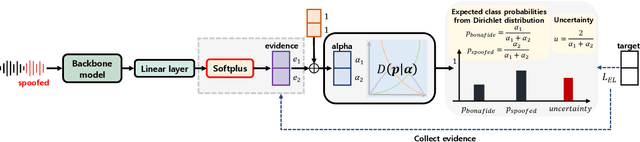
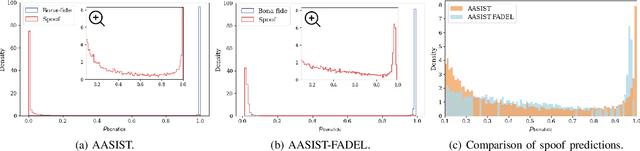
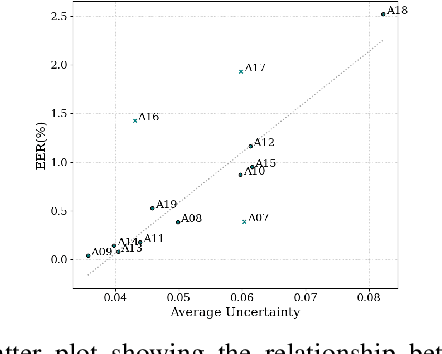
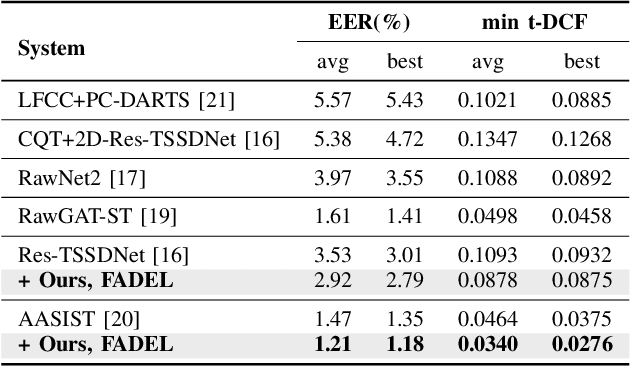
Recently, fake audio detection has gained significant attention, as advancements in speech synthesis and voice conversion have increased the vulnerability of automatic speaker verification (ASV) systems to spoofing attacks. A key challenge in this task is generalizing models to detect unseen, out-of-distribution (OOD) attacks. Although existing approaches have shown promising results, they inherently suffer from overconfidence issues due to the usage of softmax for classification, which can produce unreliable predictions when encountering unpredictable spoofing attempts. To deal with this limitation, we propose a novel framework called fake audio detection with evidential learning (FADEL). By modeling class probabilities with a Dirichlet distribution, FADEL incorporates model uncertainty into its predictions, thereby leading to more robust performance in OOD scenarios. Experimental results on the ASVspoof2019 Logical Access (LA) and ASVspoof2021 LA datasets indicate that the proposed method significantly improves the performance of baseline models. Furthermore, we demonstrate the validity of uncertainty estimation by analyzing a strong correlation between average uncertainty and equal error rate (EER) across different spoofing algorithms.