 Add to Chrome
 Add to Firefox
 Add to Edge
Dharma, Data and Deception: An LLM-Powered Rhetorical Analysis of Cow-Urine Health Claims on YouTube
Apr 24, 2026
Health misinformation remains one of the most pressing challenges on social media, particularly when cultural traditions intersect with scientific-sounding claims. These dynamics are not only global but also deeply local, manifesting in culturally specific controversies that require careful analysis. Motivated by this, we examine 100 YouTube transcripts that promote or debunk cow urine (gomutra) as a health remedy, focusing on rhetorical strategies such as appeals to authority, efficacy appeals, and conspiracy framing. We employ large language models (LLMs) including GPT-4, GPT-4o, GPT-4.1, GPT-5, Gemini 2.5 Pro, and Mistral Medium 3 to annotate transcripts using a 14-category taxonomy of persuasive tactics. Our analysis reveals that promoters predominantly rely on efficacy appeals and social proof, while debunkers emphasize authority and rebuttal. Human evaluation of a subset of annotations yielded 90.1\% inter-annotator agreement, confirming the reliability of our taxonomy and validation process. This work advances computational methods for misinformation analysis and demonstrates how LLMs can support large-scale studies of cultural discourse online.

Divided We Rule: Influencer Polarization on Twitter During Political Crises in India
May 18, 2021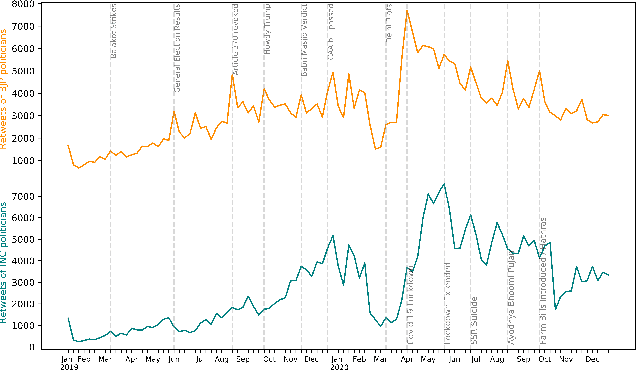
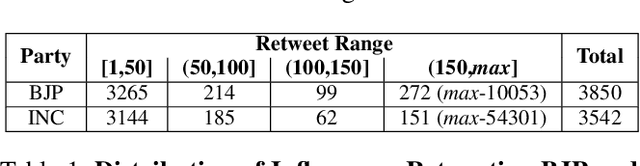
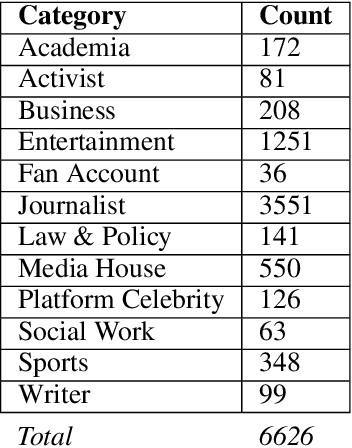
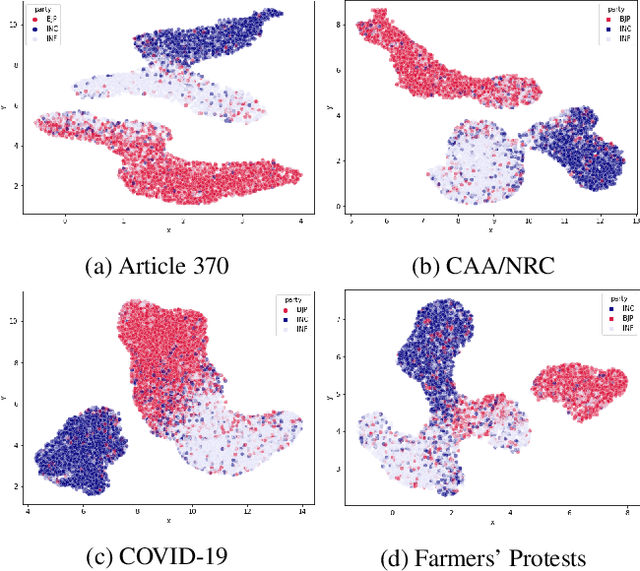
Influencers are key to the nature and networks of information propagation on social media. Influencers are particularly important in political discourse through their engagement with issues, and may derive their legitimacy either solely or partly through online operation, or have an offline sphere of expertise such as entertainers, journalists etc. To quantify influencers' political engagement and polarity, we use Google's Universal Sentence Encoder (USE) to encode the tweets of 6k influencers and 26k Indian politicians during political crises in India. We then obtain aggregate vector representations of the influencers based on their tweet embeddings, which alongside retweet graphs help compute the stance and polarity of these influencers with respect to the political issues. We find that while on COVID-19 there is a confluence of influencers on the side of the government, on three other contentious issues around citizenship, Kashmir's statehood, and farmers' protests, it is mainly government-aligned fan accounts that amplify the incumbent's positions. We propose that this method offers insight into the political schisms in present-day India, but also offers a means to study influencers and polarization in other contexts.