 Add to Chrome
 Add to Firefox
 Add to Edge
PolySLGen: Online Multimodal Speaking-Listening Reaction Generation in Polyadic Interaction
Apr 09, 2026
Human-like multimodal reaction generation is essential for natural group interactions between humans and embodied AI. However, existing approaches are limited to single-modality or speaking-only responses in dyadic interactions, making them unsuitable for realistic social scenarios. Many also overlook nonverbal cues and complex dynamics of polyadic interactions, both critical for engagement and conversational coherence. In this work, we present PolySLGen, an online framework for Polyadic multimodal Speaking and Listening reaction Generation. Given past conversation and motion from all participants, PolySLGen generates a future speaking or listening reaction for a target participant, including speech, body motion, and speaking state score. To model group interactions effectively, we propose a pose fusion module and a social cue encoder that jointly aggregate motion and social signals from the group. Extensive experiments, along with quantitative and qualitative evaluations, show that PolySLGen produces contextually appropriate and temporally coherent multi-modal reactions, outperforming several adapted and state-of-the-art baselines in motion quality, motion-speech alignment, speaking state prediction, and human-perceived realism.

MuPPet: Multi-person 2D-to-3D Pose Lifting
Apr 08, 2026Multi-person social interactions are inherently built on coherence and relationships among all individuals within the group, making multi-person localization and body pose estimation essential to understanding these social dynamics. One promising approach is 2D-to-3D pose lifting which provides a 3D human pose consisting of rich spatial details by building on the significant advances in 2D pose estimation. However, the existing 2D-to-3D pose lifting methods often neglect inter-person relationships or cannot handle varying group sizes, limiting their effectiveness in multi-person settings. We propose MuPPet, a novel multi-person 2D-to-3D pose lifting framework that explicitly models inter-person correlations. To leverage these inter-person dependencies, our approach introduces Person Encoding to structure individual representations, Permutation Augmentation to enhance training diversity, and Dynamic Multi-Person Attention to adaptively model correlations between individuals. Extensive experiments on group interaction datasets demonstrate MuPPet significantly outperforms state-of-the-art single- and multi-person 2D-to-3D pose lifting methods, and improves robustness in occlusion scenarios. Our findings highlight the importance of modeling inter-person correlations, paving the way for accurate and socially-aware 3D pose estimation. Our code is available at: https://github.com/Thomas-Markhorst/MuPPet
Diffusion-Based Imitation Learning for Social Pose Generation
Jan 18, 2025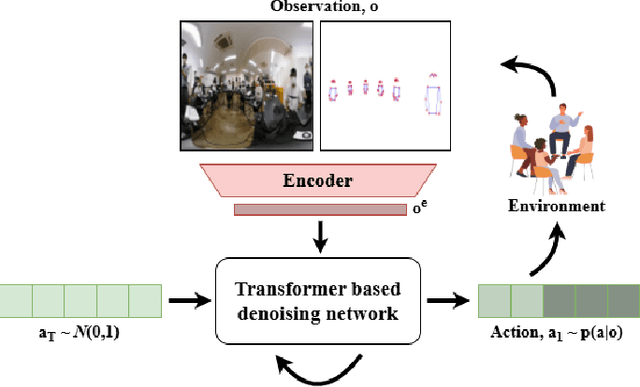
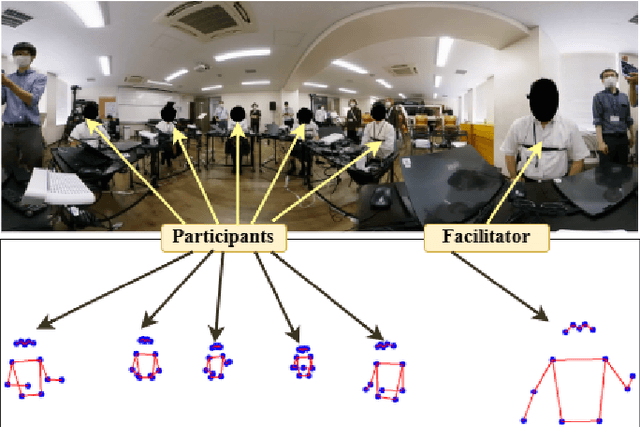
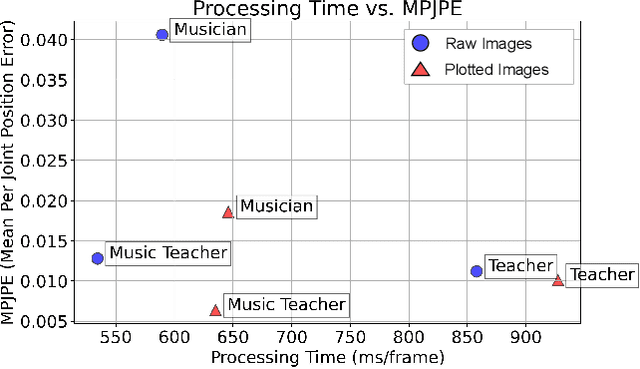
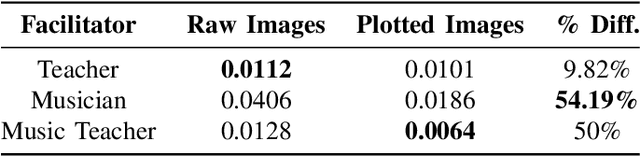
Intelligent agents, such as robots and virtual agents, must understand the dynamics of complex social interactions to interact with humans. Effectively representing social dynamics is challenging because we require multi-modal, synchronized observations to understand a scene. We explore how using a single modality, the pose behavior, of multiple individuals in a social interaction can be used to generate nonverbal social cues for the facilitator of that interaction. The facilitator acts to make a social interaction proceed smoothly and is an essential role for intelligent agents to replicate in human-robot interactions. In this paper, we adapt an existing diffusion behavior cloning model to learn and replicate facilitator behaviors. Furthermore, we evaluate two representations of pose observations from a scene, one representation has pre-processing applied and one does not. The purpose of this paper is to introduce a new use for diffusion behavior cloning for pose generation in social interactions. The second is to understand the relationship between performance and computational load for generating social pose behavior using two different techniques for collecting scene observations. As such, we are essentially testing the effectiveness of two different types of conditioning for a diffusion model. We then evaluate the resulting generated behavior from each technique using quantitative measures such as mean per-joint position error (MPJPE), training time, and inference time. Additionally, we plot training and inference time against MPJPE to examine the trade-offs between efficiency and performance. Our results suggest that the further pre-processed data can successfully condition diffusion models to generate realistic social behavior, with reasonable trade-offs in accuracy and processing time.
GazeHTA: End-to-end Gaze Target Detection with Head-Target Association
Apr 19, 2024We propose an end-to-end approach for gaze target detection: predicting a head-target connection between individuals and the target image regions they are looking at. Most of the existing methods use independent components such as off-the-shelf head detectors or have problems in establishing associations between heads and gaze targets. In contrast, we investigate an end-to-end multi-person Gaze target detection framework with Heads and Targets Association (GazeHTA), which predicts multiple head-target instances based solely on input scene image. GazeHTA addresses challenges in gaze target detection by (1) leveraging a pre-trained diffusion model to extract scene features for rich semantic understanding, (2) re-injecting a head feature to enhance the head priors for improved head understanding, and (3) learning a connection map as the explicit visual associations between heads and gaze targets. Our extensive experimental results demonstrate that GazeHTA outperforms state-of-the-art gaze target detection methods and two adapted diffusion-based baselines on two standard datasets.