 Add to Chrome
 Add to Firefox
 Add to Edge
Embedding-Based Federated Learning with Runtime Governance for Iron Deficiency Prediction
May 20, 2026
Recent reviews find that the vast majority of published healthcare federated learning (FL) studies never reach real-world deployment. We developed an embedding-based FL pipeline for iron deficiency prediction from routine full blood count (FBC) data and deployed it across real institutional environments at Amsterdam University Medical Centre (AUMC) and NHS Blood and Transplant (NHSBT), two clinical environments that differ markedly in iron deficiency prevalence, ferritin distribution, and subject populations. A frozen domain-specific haematology foundation model, DeepCBC, performs site-local representation extraction, restricting federated training to a compact downstream classifier and substantially reducing recurrent communication relative to full-encoder federation. The two clinical datasets are structurally not independent and identically distributed (non-IID), with heterogeneity arising from distinct population differences rather than sampling artefacts. Runtime governance is enforced by FLA$^3$, a healthcare-oriented FL platform providing study-scoped execution, policy-based authorisation, and signed audit logging. Standard sample-size-weighted aggregation (FedAvg) reduced the area under the receiver operating characteristic curve (ROC-AUC) at both sites relative to local-only training, as the global update was biased towards the larger AUMC distribution. FedMAP, a personalised aggregation method, raised ROC-AUC from 0.9470 to 0.9594 at AUMC and from 0.8558 to 0.8671 at NHSBT relative to local-only training, achieving the highest macro ROC-AUC of 0.9133 and the best macro balanced accuracy overall. These results support personalised aggregation in clinical federations where client sample size and task relevance diverge substantially.

VAIR: Visuo-Acoustic Implicit Representations for Low-Cost, Multi-Modal Transparent Surface Reconstruction in Indoor Scenes
Nov 07, 2024


Mobile robots operating indoors must be prepared to navigate challenging scenes that contain transparent surfaces. This paper proposes a novel method for the fusion of acoustic and visual sensing modalities through implicit neural representations to enable dense reconstruction of transparent surfaces in indoor scenes. We propose a novel model that leverages generative latent optimization to learn an implicit representation of indoor scenes consisting of transparent surfaces. We demonstrate that we can query the implicit representation to enable volumetric rendering in image space or 3D geometry reconstruction (point clouds or mesh) with transparent surface prediction. We evaluate our method's effectiveness qualitatively and quantitatively on a new dataset collected using a custom, low-cost sensing platform featuring RGB-D cameras and ultrasonic sensors. Our method exhibits significant improvement over state-of-the-art for transparent surface reconstruction.
Deep Generative Classification of Blood Cell Morphology
Aug 16, 2024


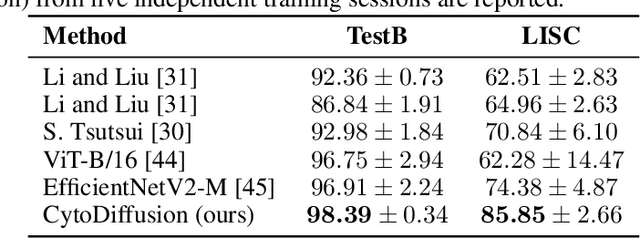
Accurate classification of haematological cells is critical for diagnosing blood disorders, but presents significant challenges for machine automation owing to the complexity of cell morphology, heterogeneities of biological, pathological, and imaging characteristics, and the imbalance of cell type frequencies. We introduce CytoDiffusion, a diffusion-based classifier that effectively models blood cell morphology, combining accurate classification with robust anomaly detection, resistance to distributional shifts, interpretability, data efficiency, and superhuman uncertainty quantification. Our approach outperforms state-of-the-art discriminative models in anomaly detection (AUC 0.976 vs. 0.919), resistance to domain shifts (85.85% vs. 74.38% balanced accuracy), and performance in low-data regimes (95.88% vs. 94.95% balanced accuracy). Notably, our model generates synthetic blood cell images that are nearly indistinguishable from real images, as demonstrated by a Turing test in which expert haematologists achieved only 52.3% accuracy (95% CI: [50.5%, 54.2%]). Furthermore, we enhance model explainability through the generation of directly interpretable counterfactual heatmaps. Our comprehensive evaluation framework, encompassing these multiple performance dimensions, establishes a new benchmark for medical image analysis in haematology, ultimately enabling improved diagnostic accuracy in clinical settings. Our code is available at https://github.com/Deltadahl/CytoDiffusion.