 Add to Chrome
 Add to Firefox
 Add to Edge
NeuReasoner: Theory-grounded Mapping of Reasoning Elicitation Boundaries
Jun 29, 2026
A growing body of work suggests that the reasoning capabilities of large language models are largely latent in their base form, with post-training primarily amplifying rather than introducing them. However, this evidence comes mainly from mathematical and coding benchmarks, leaving the boundary conditions of that claim largely unexplored, namely which cognitive tasks can be recovered through elicitation and where that recovery fails. To investigate this, we introduce NeuReasoner, a theory-grounded elicitation instrument. At each step, an orchestrator pairs a Neuro Lens, inspired by functional specificity, with a Cognitive Lens, drawn from the Erotetic Theory of Reasoning, and integrates their outputs through internal modularization of a single model, without external tools. We evaluate NeuReasoner on CogBench, a suite of behavioral tasks from cognitive psychology, alongside standard mathematical and coding benchmarks, measuring both its improvement over vanilla inference and its ability to match a model's post-trained thinking mode. At sufficient scale, NeuReasoner matches or exceeds thinking-mode baselines on arithmetic reasoning, code generation, Bayesian reasoning, and reward learning; these gains persist against self-consistency and iterative-refinement baselines matched to NeuReasoner's per-decision call budget. Using NeuReasoner allows us to find clear boundaries: risk-taking and decision making under uncertainty remains hard to recover through elicitation alone, and model scale interacts with elicitation in both directions: widening its advantage on some cognitive signatures while erasing it on others. Overall, through NeuReasoner as a modular, interpretable, theory-grounded elicitation instrument, we empirically map where reasoning elicitation succeeds and fails, beyond the mathematical and coding benchmarks where prior claims have rested.

EventChat: Implementation and user-centric evaluation of a large language model-driven conversational recommender system for exploring leisure events in an SME context
Jul 05, 2024
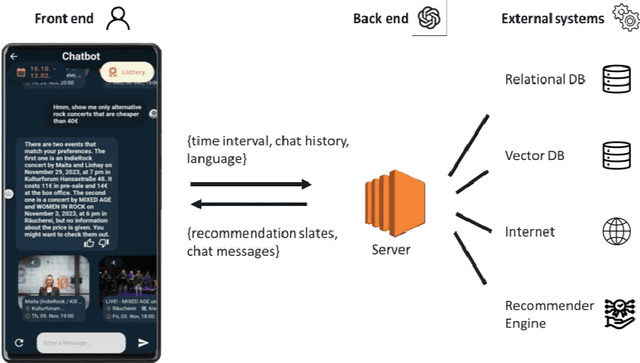


Large language models (LLMs) present an enormous evolution in the strategic potential of conversational recommender systems (CRS). Yet to date, research has predominantly focused upon technical frameworks to implement LLM-driven CRS, rather than end-user evaluations or strategic implications for firms, particularly from the perspective of a small to medium enterprises (SME) that makeup the bedrock of the global economy. In the current paper, we detail the design of an LLM-driven CRS in an SME setting, and its subsequent performance in the field using both objective system metrics and subjective user evaluations. While doing so, we additionally outline a short-form revised ResQue model for evaluating LLM-driven CRS, enabling replicability in a rapidly evolving field. Our results reveal good system performance from a user experience perspective (85.5% recommendation accuracy) but underscore latency, cost, and quality issues challenging business viability. Notably, with a median cost of $0.04 per interaction and a latency of 5.7s, cost-effectiveness and response time emerge as crucial areas for achieving a more user-friendly and economically viable LLM-driven CRS for SME settings. One major driver of these costs is the use of an advanced LLM as a ranker within the retrieval-augmented generation (RAG) technique. Our results additionally indicate that relying solely on approaches such as Prompt-based learning with ChatGPT as the underlying LLM makes it challenging to achieve satisfying quality in a production environment. Strategic considerations for SMEs deploying an LLM-driven CRS are outlined, particularly considering trade-offs in the current technical landscape.