 Add to Chrome
 Add to Firefox
 Add to Edge
Greedy and Transformer-Based Multi-Port Selection for Slow Fluid Antenna Multiple Access
Apr 06, 2026
We address the port-selection problem in fluid antenna multiple access (FAMA) systems with multi-port fluid antenna (FA) receivers. Existing methods either achieve near-optimal spectral efficiency (SE) at prohibitive computational cost or sacrifice significant performance for lower complexity. We propose two complementary strategies: (i) GFwd+S, a greedy forward-selection method with swap refinement that consistently outperforms state-of-the-art reference schemes in terms of SE, and (ii) a Transformer-based neural network trained via imitation learning followed by a Reinforce policy-gradient stage, which approaches GFwd+S performance at lower computational cost.

Joint User Scheduling and Precoding for XL-MIMO Systems with Imperfect CSI
Feb 25, 2023We propose an algorithm for joint precoding and user selection in multiple-input multiple-output systems with extremely-large aperture arrays, assuming realistic channel conditions and imperfect channel estimates. The use of long-term channel state information (CSI) for user scheduling, and a proper selection of the set of users for which CSI is updated allow for obtaining an improved achievable sum spectral efficiency. We also confirm that the effect of imperfect CSI in the precoding vector design and the cost of training must be taken into consideration for realistic performance prediction.
Leakage Subspace Precoding for Physical Layer Security in Multi-User XL-MIMO Systems
May 23, 2022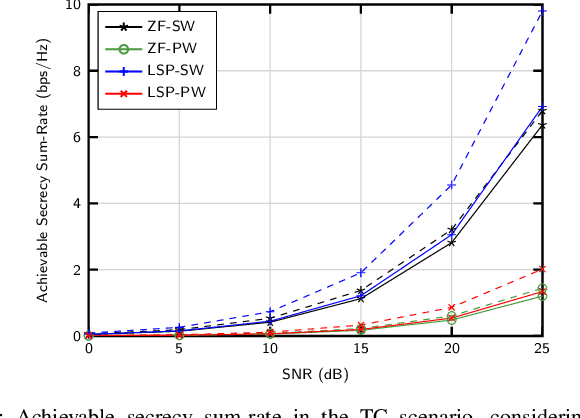
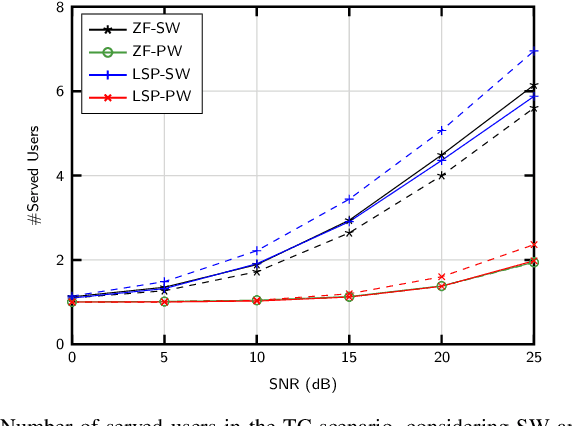
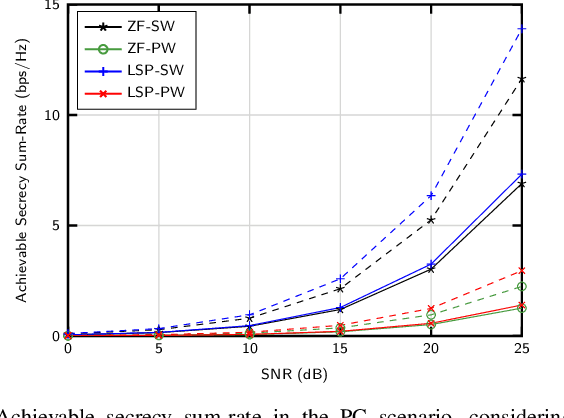
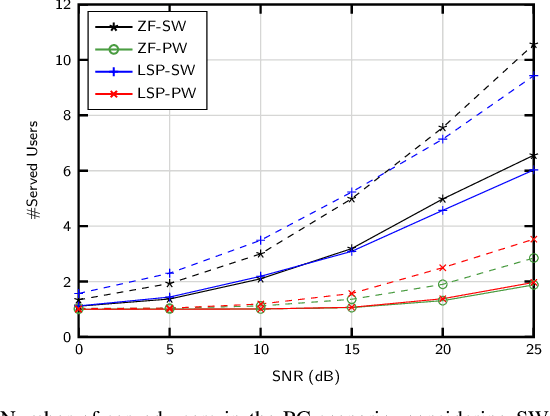
We investigate the achievable secrecy sum-rate in a multi-user XL-MIMO system, on which user distances to the base station become comparable to the antenna array dimensions. We show that the consideration of spherical-wavefront propagation inherent to these set-ups is beneficial for physical-layer security, as it provides immunity against eavesdroppers located in similar angular directions that would otherwise prevent secure communication under classical planar-wavefront propagation. A leakage subspace precoding strategy is also proposed for joint secure precoding and user scheduling, which allows to improve the secrecy sum-rate compared to conventional zero-forcing based strategies, under different eavesdropper collusion strategies.