 Add to Chrome
 Add to Firefox
 Add to Edge
Exact Discrete Stochastic Simulation with Deep-Learning-Scale Gradient Optimization
Feb 23, 2026
Exact stochastic simulation of continuous-time Markov chains (CTMCs) is essential when discreteness and noise drive system behavior, but the hard categorical event selection in Gillespie-type algorithms blocks gradient-based learning. We eliminate this constraint by decoupling forward simulation from backward differentiation, with hard categorical sampling generating exact trajectories and gradients propagating through a continuous massively-parallel Gumbel-Softmax straight-through surrogate. Our approach enables accurate optimization at parameter scales over four orders of magnitude beyond existing simulators. We validate for accuracy, scalability, and reliability on a reversible dimerization model (0.09% error), a genetic oscillator (1.2% error), a 203,796-parameter gene regulatory network achieving 98.4% MNIST accuracy (a prototypical deep-learning multilayer perceptron benchmark), and experimental patch-clamp recordings of ion channel gating (R^2 = 0.987) in the single-channel regime. Our GPU implementation delivers 1.9 billion steps per second, matching the scale of non-differentiable simulators. By making exact stochastic simulation massively parallel and autodiff-compatible, our results enable high-dimensional parameter inference and inverse design across systems biology, chemical kinetics, physics, and related CTMC-governed domains.

Dynamics-informed deconvolutional neural networks for super-resolution identification of regime changes in epidemiological time series
Sep 16, 2022Inferring the timing and amplitude of perturbations in epidemiological systems from their stochastically spread low-resolution outcomes is as relevant as challenging. It is a requirement for current approaches to overcome the need to know the details of the perturbations to proceed with the analyses. However, the general problem of connecting epidemiological curves with the underlying incidence lacks the highly effective methodology present in other inverse problems, such as super-resolution and dehazing from computer vision. Here, we develop an unsupervised physics-informed convolutional neural network approach in reverse to connect death records with incidence that allows the identification of regime changes at single-day resolution. Applied to COVID-19 data with proper regularization and model-selection criteria, the approach can identify the implementation and removal of lockdowns and other nonpharmaceutical interventions with 0.93-day accuracy over the time span of a year.
Winning the Big Data Technologies Horizon Prize: Fast and reliable forecasting of electricity grid traffic by identification of recurrent fluctuations
Feb 12, 2019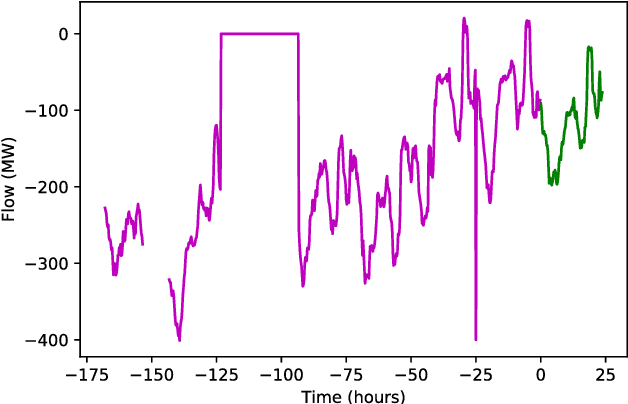
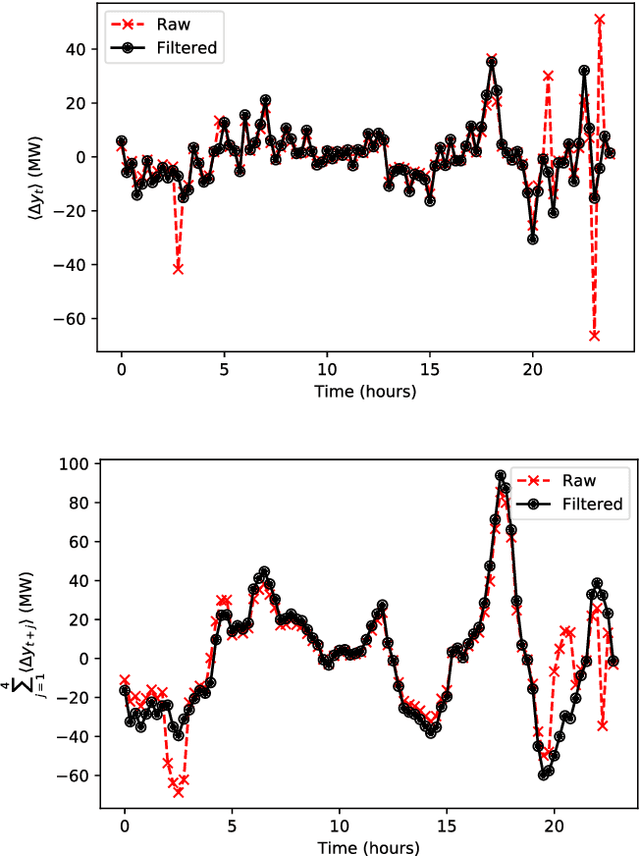
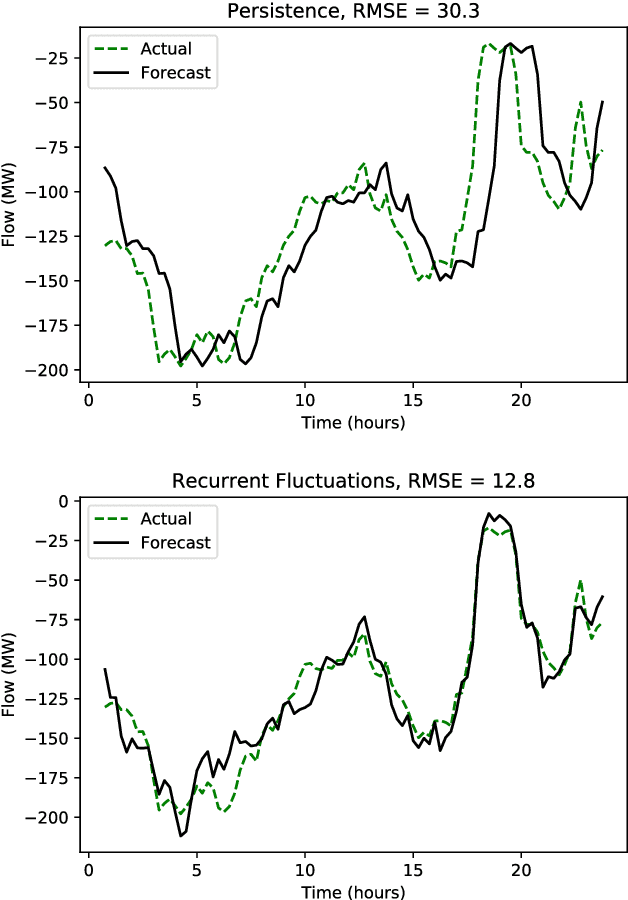
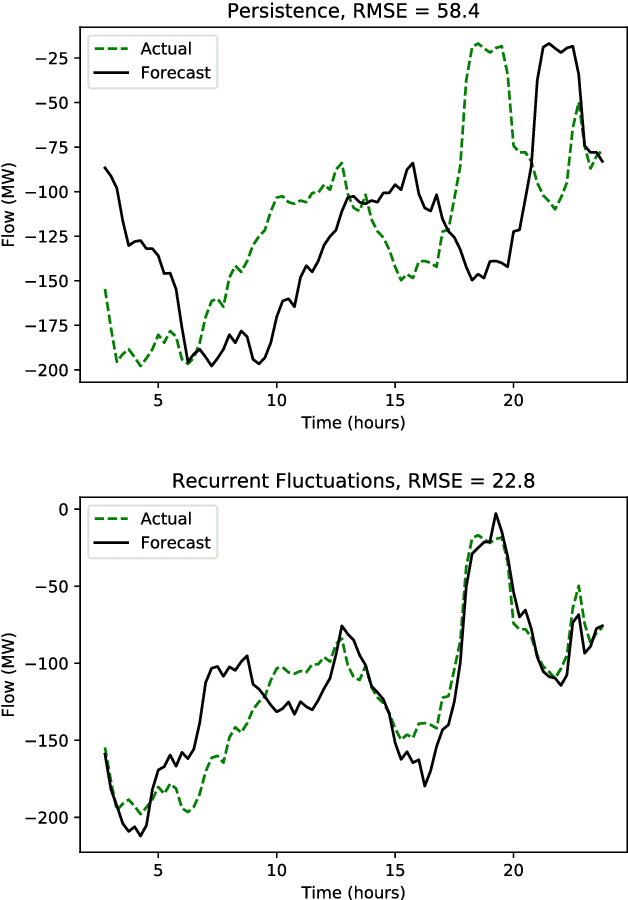
This paper provides a description of the approach and methodology I used in winning the European Union Big Data Technologies Horizon Prize on data-driven prediction of electricity grid traffic. The methodology relies on identifying typical short-term recurrent fluctuations, which is subsequently refined through a regression-of-fluctuations approach. The key points and strategic considerations that led to selecting or discarding different methodological aspects are also discussed. The criteria include adaptability to changing conditions, reliability with outliers and missing data, robustness to noise, and efficiency in implementation.