 Add to Chrome
 Add to Firefox
 Add to Edge
Convergence of Byzantine-Resilient Gradient Tracking via Probabilistic Edge Dropout
Apr 01, 2026
We study distributed optimization over networks with Byzantine agents that may send arbitrary adversarial messages. We propose \emph{Gradient Tracking with Probabilistic Edge Dropout} (GT-PD), a stochastic gradient tracking method that preserves the convergence properties of gradient tracking under adversarial communication. GT-PD combines two complementary defense layers: a universal self-centered projection that clips each incoming message to a ball of radius $τ$ around the receiving agent, and a fully decentralized probabilistic dropout rule driven by a dual-metric trust score in the decision and tracking channels. This design bounds adversarial perturbations while preserving the doubly stochastic mixing structure, a property often lost under robust aggregation in decentralized settings. Under complete Byzantine isolation ($p_b=0$), GT-PD converges linearly to a neighborhood determined solely by stochastic gradient variance. For partial isolation ($p_b>0$), we introduce \emph{Gradient Tracking with Probabilistic Edge Dropout and Leaky Integration} (GT-PD-L), which uses a leaky integrator to control the accumulation of tracking errors caused by persistent perturbations and achieves linear convergence to a bounded neighborhood determined by the stochastic variance and the clipping-to-leak ratio. We further show that under two-tier dropout with $p_h=1$, isolating Byzantine agents introduces no additional variance into the honest consensus dynamics. Experiments on MNIST under Sign Flip, ALIE, and Inner Product Manipulation attacks show that GT-PD-L outperforms coordinate-wise trimmed mean by up to 4.3 percentage points under stealth attacks.

Study on Patterns and Effect of Task Diversity in Software Crowdsourcing
May 29, 2020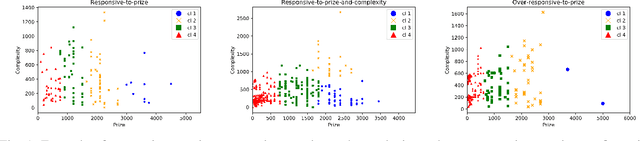
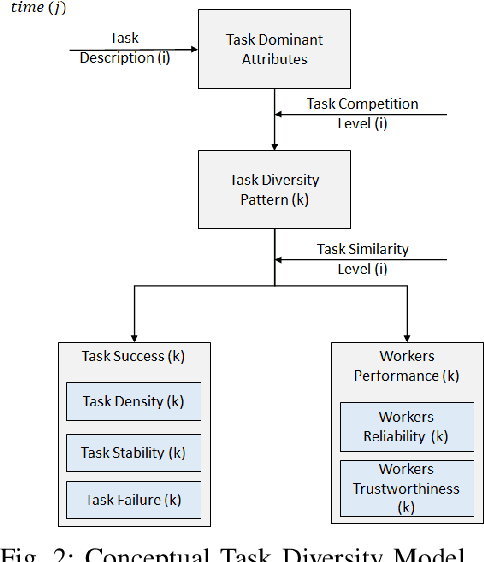
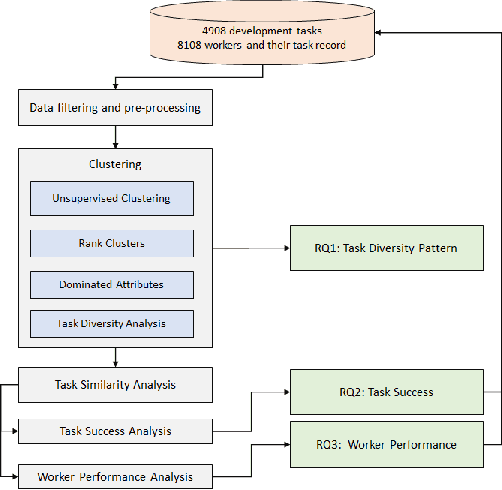
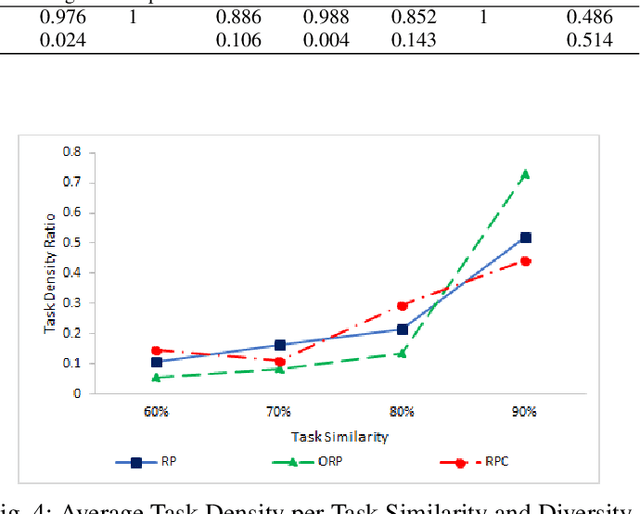
Context: The success of software crowdsourcing depends on steady tasks supply and active worker pool. Existing analysis reveals an average task failure ratio of 15.7% in software crowdsourcing market. Goal: The objective of this study is to empirically investigate patterns and effect of task diversity in software crowdsourcing platform in order to improve the success and efficiency of software crowdsourcing. Method: We propose a conceptual task diversity model, and develop an approach to measuring and analyzing task diversity.More specifically, this includes grouping similar tasks, ranking them based on their competition level and identifying the dominant attributes that distinguish among these levels, and then studying the impact of task diversity on task success and worker performance in crowdsourcing platform. The empirical study is conducted on more than one year's real-world data from TopCoder, the leading software crowdsourcing platform. Results: We identified that monetary prize and task complexity are the dominant attributes that differentiate among different competition levels. Based on these dominant attributes, we found three task diversity patterns (configurations) from workers behavior perspective: responsive to prize, responsive to prize and complexity and over responsive to prize. This study supports that1) responsive to prize configuration provides highest level of task density and workers' reliability in a platform; 2) responsive to prize and complexity configuration leads to attracting high level of trustworthy workers; 3) over responsive to prize configuration results in highest task stability and the lowest failure ratio in the platform for not high similar tasks.