 Add to Chrome
 Add to Firefox
 Add to Edge
Learning functional components of PDEs from data using neural networks
Feb 13, 2026
Partial differential equations often contain unknown functions that are difficult or impossible to measure directly, hampering our ability to derive predictions from the model. Workflows for recovering scalar PDE parameters from data are well studied: here we show how similar workflows can be used to recover functions from data. Specifically, we embed neural networks into the PDE and show how, as they are trained on data, they can approximate unknown functions with arbitrary accuracy. Using nonlocal aggregation-diffusion equations as a case study, we recover interaction kernels and external potentials from steady state data. Specifically, we investigate how a wide range of factors, such as the number of available solutions, their properties, sampling density, and measurement noise, affect our ability to successfully recover functions. Our approach is advantageous because it can utilise standard parameter-fitting workflows, and in that the trained PDE can be treated as a normal PDE for purposes such as generating system predictions.

FedCBO: Reaching Group Consensus in Clustered Federated Learning through Consensus-based Optimization
May 04, 2023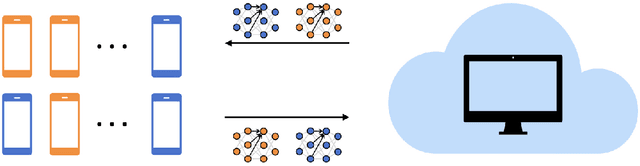


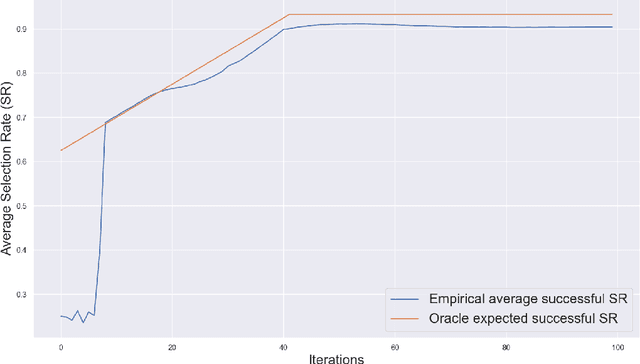
Federated learning is an important framework in modern machine learning that seeks to integrate the training of learning models from multiple users, each user having their own local data set, in a way that is sensitive to data privacy and to communication loss constraints. In clustered federated learning, one assumes an additional unknown group structure among users, and the goal is to train models that are useful for each group, rather than simply training a single global model for all users. In this paper, we propose a novel solution to the problem of clustered federated learning that is inspired by ideas in consensus-based optimization (CBO). Our new CBO-type method is based on a system of interacting particles that is oblivious to group memberships. Our model is motivated by rigorous mathematical reasoning, including a mean field analysis describing the large number of particles limit of our particle system, as well as convergence guarantees for the simultaneous global optimization of general non-convex objective functions (corresponding to the loss functions of each cluster of users) in the mean-field regime. Experimental results demonstrate the efficacy of our FedCBO algorithm compared to other state-of-the-art methods and help validate our methodological and theoretical work.