 Add to Chrome
 Add to Firefox
 Add to Edge
High Performance, Low Reliability: Uncertainty Benchmarking for Tabular Foundation Models
May 27, 2026
Recent Tabular Foundation Models (TFMs) have demonstrated state-of-the-art predictive performance, often surpassing Gradient-Boosted Decision Trees (GBDTs). However, the trustworthiness of these models, particularly their uncertainty quantification, has been largely overlooked. We investigate this gap through an extensive study comparing TFMs, GBDTs, and classical baselines on the 112 datasets of the TALENT benchmark. Our results reveal a performance-uncertainty trade-off: although TFMs achieve the highest predictive performance, measured by AUC, they exhibit lower conditional coverage under conformal prediction, measured by SSCS, compared to GBDTs. Complementary experiments on synthetic datasets further characterize the regimes in which this effect intensifies. We conclude that while TFMs advance predictive frontiers, achieving well-calibrated uncertainty remains a major open challenge for their reliable adoption. Code is available at: https://github.com/jose-melo/high-performance-low-reliability
* 6 pages, 2 figures, 2 tables. Accepted at ESANN 2026 (European Symposium on Artificial Neural Networks, Computational Intelligence and Machine Learning), 22-24 April 2026, Bruges (Belgium)

T-JEPA: Augmentation-Free Self-Supervised Learning for Tabular Data
Oct 07, 2024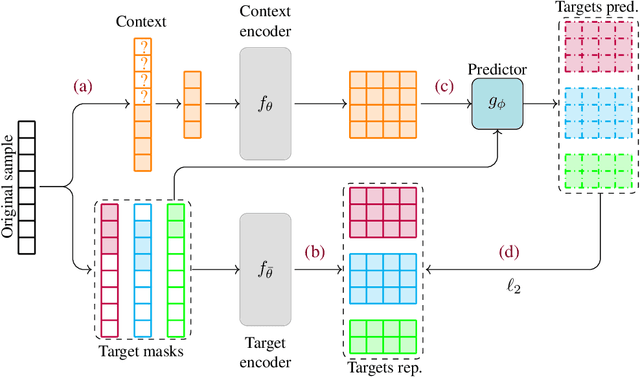
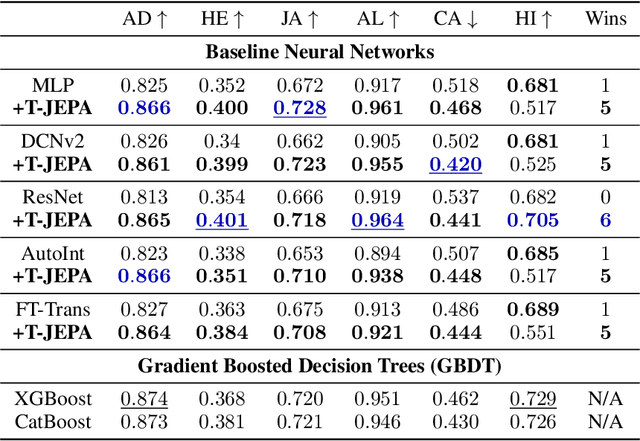
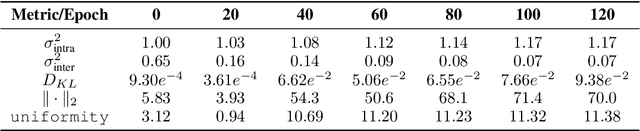

Self-supervision is often used for pre-training to foster performance on a downstream task by constructing meaningful representations of samples. Self-supervised learning (SSL) generally involves generating different views of the same sample and thus requires data augmentations that are challenging to construct for tabular data. This constitutes one of the main challenges of self-supervision for structured data. In the present work, we propose a novel augmentation-free SSL method for tabular data. Our approach, T-JEPA, relies on a Joint Embedding Predictive Architecture (JEPA) and is akin to mask reconstruction in the latent space. It involves predicting the latent representation of one subset of features from the latent representation of a different subset within the same sample, thereby learning rich representations without augmentations. We use our method as a pre-training technique and train several deep classifiers on the obtained representation. Our experimental results demonstrate a substantial improvement in both classification and regression tasks, outperforming models trained directly on samples in their original data space. Moreover, T-JEPA enables some methods to consistently outperform or match the performance of traditional methods likes Gradient Boosted Decision Trees. To understand why, we extensively characterize the obtained representations and show that T-JEPA effectively identifies relevant features for downstream tasks without access to the labels. Additionally, we introduce regularization tokens, a novel regularization method critical for training of JEPA-based models on structured data.