 Add to Chrome
 Add to Firefox
 Add to Edge
XDoGE: Multilingual Data Reweighting to Enhance Language Inclusivity in LLMs
Dec 11, 2025
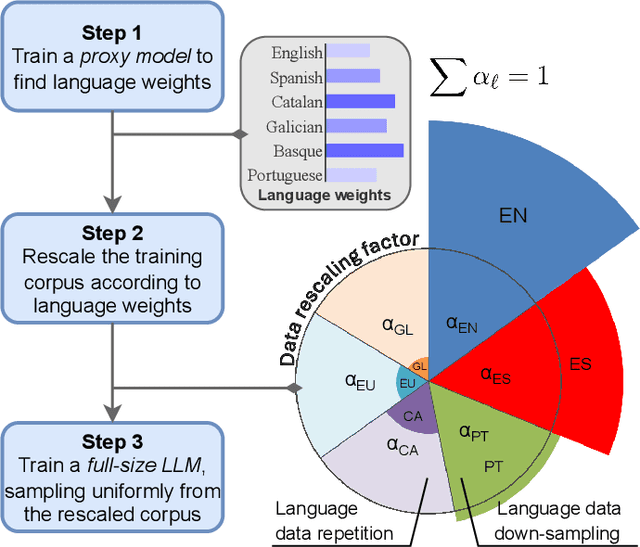
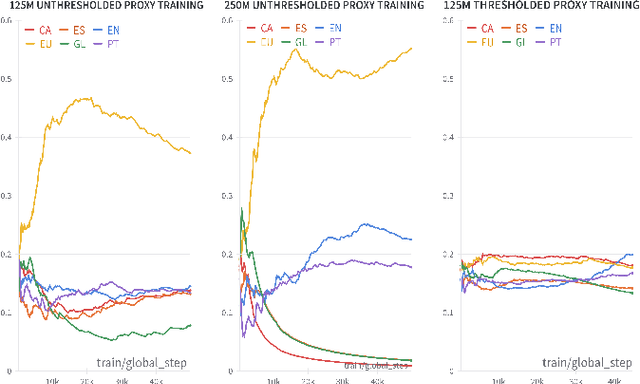
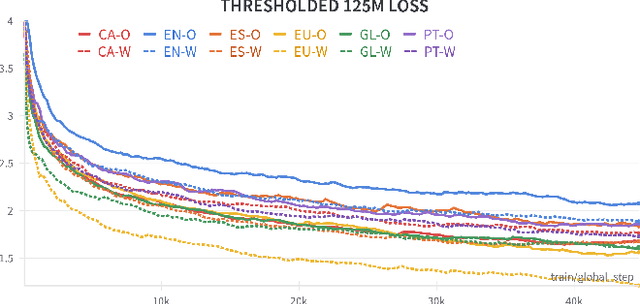
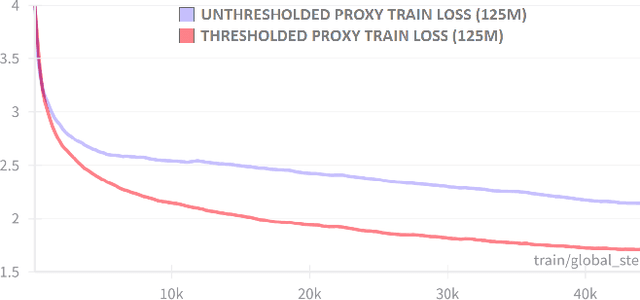
Current large language models (LLMs) are trained on massive amounts of text data, primarily from a few dominant languages. Studies suggest that this over-reliance on high-resource languages, such as English, hampers LLM performance in mid- and low-resource languages. To mitigate this problem, we propose to (i) optimize the language distribution by training a small proxy model within a domain-reweighing DoGE algorithm that we extend to XDoGE for a multilingual setup, and (ii) rescale the data and train a full-size model with the established language weights either from scratch or within a continual pre-training phase (CPT). We target six languages possessing a variety of geographic and intra- and inter-language-family relations, namely, English and Spanish (high-resource), Portuguese and Catalan (mid-resource), Galician and Basque (low-resource). We experiment with Salamandra-2b, which is a promising model for these languages. We investigate the effects of substantial data repetition on minor languages and under-sampling on dominant languages using the IberoBench framework for quantitative evaluation. Finally, we release a new promising IberianLLM-7B-Instruct model centering on Iberian languages and English that we pretrained from scratch and further improved using CPT with the XDoGE weights.

Salamandra Technical Report
Feb 12, 2025This work introduces Salamandra, a suite of open-source decoder-only large language models available in three different sizes: 2, 7, and 40 billion parameters. The models were trained from scratch on highly multilingual data that comprises text in 35 European languages and code. Our carefully curated corpus is made exclusively from open-access data compiled from a wide variety of sources. Along with the base models, supplementary checkpoints that were fine-tuned on public-domain instruction data are also released for chat applications. Additionally, we also share our preliminary experiments on multimodality, which serve as proof-of-concept to showcase potential applications for the Salamandra family. Our extensive evaluations on multilingual benchmarks reveal that Salamandra has strong capabilities, achieving competitive performance when compared to similarly sized open-source models. We provide comprehensive evaluation results both on standard downstream tasks as well as key aspects related to bias and safety.With this technical report, we intend to promote open science by sharing all the details behind our design choices, data curation strategy and evaluation methodology. In addition to that, we deviate from the usual practice by making our training and evaluation scripts publicly accessible. We release all models under a permissive Apache 2.0 license in order to foster future research and facilitate commercial use, thereby contributing to the open-source ecosystem of large language models.