 Add to Chrome
 Add to Firefox
 Add to Edge
Interpolation of Non-Linear Functions for LLMs using Partial Reconfiguration in FPGAs
Aug 04, 2026
Non-linear functions such as exponential and sigmoid are essential in AI and LLM acceleration, although implementing them efficiently on FPGAs is still costly. This paper proposes a PWL interpolation framework based on partial reconfiguration to reduce hardware cost while preserving flexibility. The architecture separates the design into a static region for communication and control, and a reconfigurable region where different interpolation modules can be dynamically loaded. Uniform and non-uniform segmentation strategies are evaluated for exponential and sigmoid functions using FP16 and FP32 arithmetic. Results show that non-uniform segmentation can improve accuracy in high-curvature regions, while uniform segmentation offers lower hardware overhead. At the system level, the reconfigurable implementation achieved significant area savings, reaching up to 43\% less LUTs, 50\% less flip-flops, BRAMs and DSPs cells, compared against a static design containing both operators; all this with predictable reconfiguration latency. These results show that partial reconfiguration is a practical approach for exploring area-latency trade-offs in FPGA-based acceleration of non-linear functions for LLM workloads.

CAMTA: A Reconfigurable Multi-Region Activation Unit for Nonlinear Function Approximation
Aug 04, 2026Nonlinear activation functions are widely used in machine learning workloads, but their direct hardware implementation is often costly, function-specific, or difficult to reuse across different models. This work introduces CAMTA, a 16-bit reconfigurable multi-region activation unit for nonlinear function approximation in FPGA and ASIC accelerators. CAMTA combines independent region thresholds, per-region polynomial degrees, coefficient sets, and execution modes over a shared Horner-based datapath. Unlike conventional polynomial or piecewise approximation units that mainly reconfigure coefficients or segment selection, CAMTA also reconfigures the computational behavior of each region through HORNER, CONST, ZERO, and IDENTITY modes, enabling the same hardware to support functions with different symmetry and tail behavior without resynthesis. FPGA validation on an AMD Alveo platform shows RMSE as low as \(3.60\times10^{-6}\) for CAMTA-assisted Softmax, outperforming the CORDIC-based Softmax baseline considered in this work by nearly one order of magnitude. FPGA HLS synthesis reports 3 DSPs, 802 FFs, 1756 LUTs, and an 11-cycle datapath latency. ASIC synthesis in TSMC 65~nm at 250~MHz reports \(6632.40~μ\mathrm{m}^2\) total cell area and \(1.3634~\mathrm{mW}\) total power. Compared with a same-node, function-specific PLAC implementation, CAMTA incurs \(2.20\times\) area and \(1.75\times\) power overhead, in exchange for runtime configurability and reuse across multiple nonlinear functions.
Exploring DNN Robustness Against Adversarial Attacks Using Approximate Multipliers
Apr 17, 2024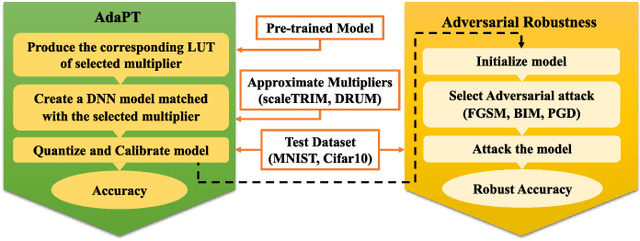
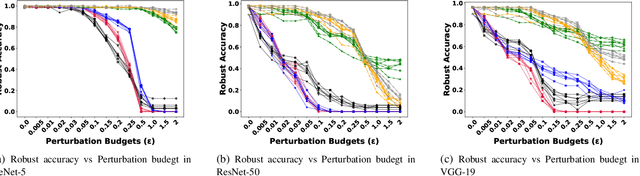
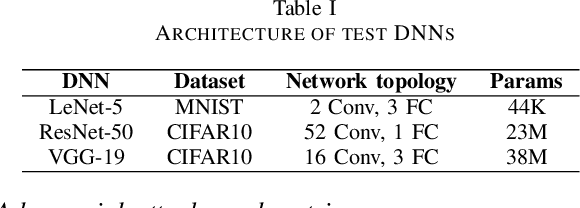
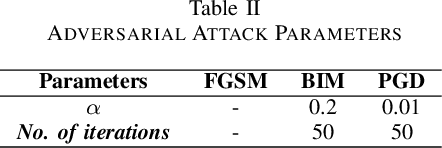
Deep Neural Networks (DNNs) have advanced in many real-world applications, such as healthcare and autonomous driving. However, their high computational complexity and vulnerability to adversarial attacks are ongoing challenges. In this letter, approximate multipliers are used to explore DNN robustness improvement against adversarial attacks. By uniformly replacing accurate multipliers for state-of-the-art approximate ones in DNN layer models, we explore the DNNs robustness against various adversarial attacks in a feasible time. Results show up to 7% accuracy drop due to approximations when no attack is present while improving robust accuracy up to 10% when attacks applied.