 Add to Chrome
 Add to Firefox
 Add to Edge
From Simulation to Deep Learning: Survey on Network Performance Modeling Approaches
Mar 30, 2026
Network performance modeling is a field that predates early computer networks and the beginning of the Internet. It aims to predict the traffic performance of packet flows in a given network. Its applications range from network planning and troubleshooting to feeding information to network controllers for configuration optimization. Traditional network performance modeling has relied heavily on Discrete Event Simulation (DES) and analytical methods grounded in mathematical theories such as Queuing Theory and Network Calculus. However, as of late, we have observed a paradigm shift, with attempts to obtain efficient Parallel DES, the surge of Machine Learning models, and their integration with other methodologies in hybrid approaches. This has resulted in a great variety of modeling approaches, each with its strengths and often tailored to specific scenarios or requirements. In this paper, we comprehensively survey the relevant network performance modeling approaches for wired networks over the last decades. With this understanding, we also define a taxonomy of approaches, summarizing our understanding of the state-of-the-art and how both technology and the concerns of the research community evolve over time. Finally, we also consider how these models are evaluated, how their different nature results in different evaluation requirements and goals, and how this may complicate their comparison.

RouteNet-Gauss: Hardware-Enhanced Network Modeling with Machine Learning
Jan 15, 2025
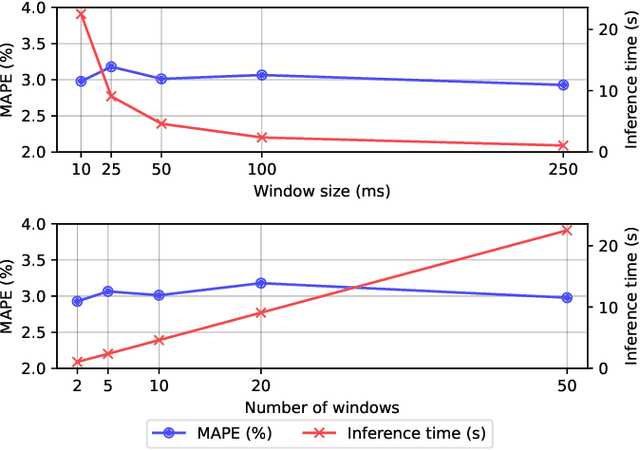
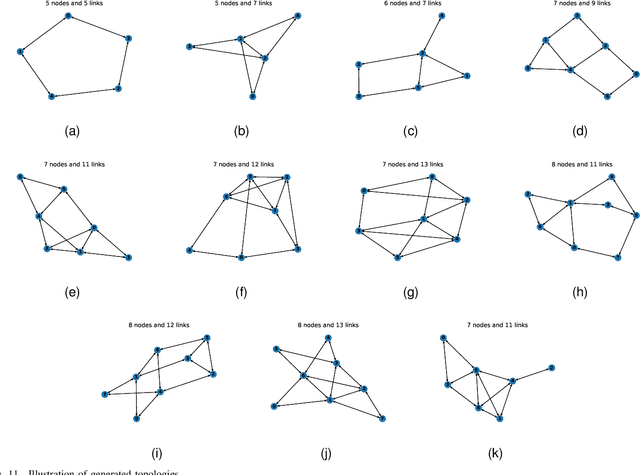
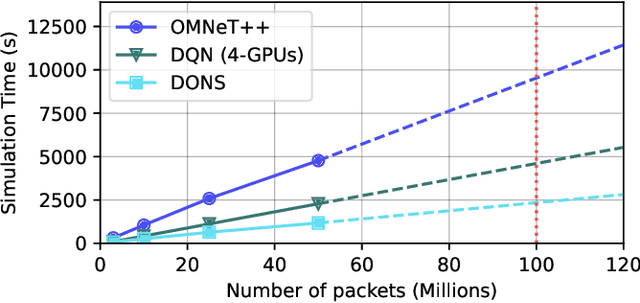
Network simulation is pivotal in network modeling, assisting with tasks ranging from capacity planning to performance estimation. Traditional approaches such as Discrete Event Simulation (DES) face limitations in terms of computational cost and accuracy. This paper introduces RouteNet-Gauss, a novel integration of a testbed network with a Machine Learning (ML) model to address these challenges. By using the testbed as a hardware accelerator, RouteNet-Gauss generates training datasets rapidly and simulates network scenarios with high fidelity to real-world conditions. Experimental results show that RouteNet-Gauss significantly reduces prediction errors by up to 95% and achieves a 488x speedup in inference time compared to state-of-the-art DES-based methods. RouteNet-Gauss's modular architecture is dynamically constructed based on the specific characteristics of the network scenario, such as topology and routing. This enables it to understand and generalize to different network configurations beyond those seen during training, including networks up to 10x larger. Additionally, it supports Temporal Aggregated Performance Estimation (TAPE), providing configurable temporal granularity and maintaining high accuracy in flow performance metrics. This approach shows promise in improving both simulation efficiency and accuracy, offering a valuable tool for network operators.