 Add to Chrome
 Add to Firefox
 Add to Edge
Premover: Fast Vision-Language-Action Control by Acting Before Instructions Are Complete
May 12, 2026
Vision-Language-Action (VLA) policies are typically evaluated as if the user had finished typing or speaking before the robot begins acting. In real deployment, however, users take several seconds to enter a request, leaving the policy idle for a substantial fraction of the interaction. We introduce Premover, a lightweight module that converts this idle window into useful precomputation. Premover keeps the VLA backbone frozen and attaches two small projection heads, one for image patches, one for language tokens, that map an intermediate layer of the backbone into a shared space. The resulting focus map is supervised by simulator-rendered target-object segmentation masks and applied as a per-patch reweighting of the next step's image tokens. A single scalar readiness threshold, trained jointly from streaming prefixes, decides when the policy should begin acting. On the LIBERO benchmark suite, Premover reduces mean wall-clock time from 34.0 to 29.4 seconds, a 13.6% reduction, while matching the full-prompt baseline's success rate (95.1% vs. 95.0%); naive premoving, by contrast, collapses to 66.4%.

Sampling from multimodal distributions using tempered Hamiltonian transitions
Nov 12, 2021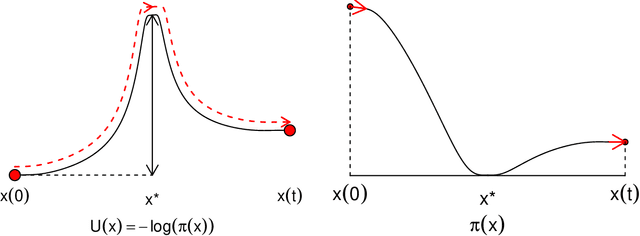
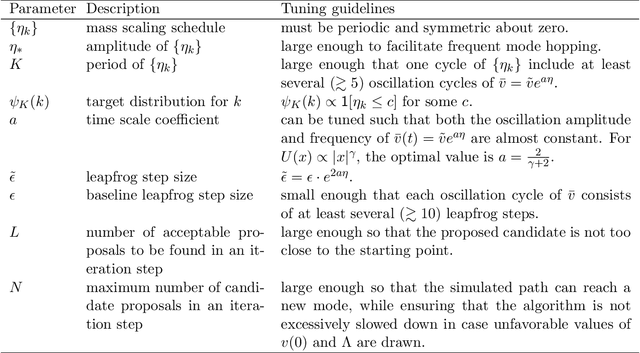
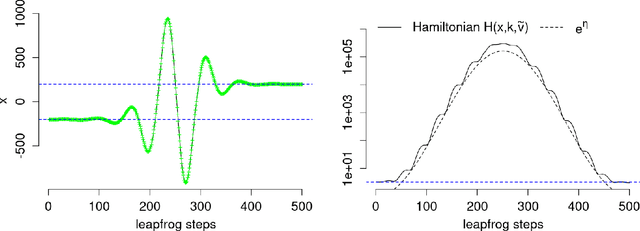

Hamiltonian Monte Carlo (HMC) methods are widely used to draw samples from unnormalized target densities due to high efficiency and favorable scalability with respect to increasing space dimensions. However, HMC struggles when the target distribution is multimodal, because the maximum increase in the potential energy function (i.e., the negative log density function) along the simulated path is bounded by the initial kinetic energy, which follows a half of the $\chi_d^2$ distribution, where d is the space dimension. In this paper, we develop a Hamiltonian Monte Carlo method where the constructed paths can travel across high potential energy barriers. This method does not require the modes of the target distribution to be known in advance. Our approach enables frequent jumps between the isolated modes of the target density by continuously varying the mass of the simulated particle while the Hamiltonian path is constructed. Thus, this method can be considered as a combination of HMC and the tempered transitions method. Compared to other tempering methods, our method has a distinctive advantage in the Gibbs sampler settings, where the target distribution changes at each step. We develop a practical tuning strategy for our method and demonstrate that it can construct globally mixing Markov chains targeting high-dimensional, multimodal distributions, using mixtures of normals and a sensor network localization problem.
Markov chain Monte Carlo algorithms with sequential proposals
Aug 20, 2019


We explore a general framework in Markov chain Monte Carlo (MCMC) sampling where sequential proposals are tried as a candidate for the next state of the Markov chain. This sequential-proposal framework can be applied to various existing MCMC methods, including Metropolis-Hastings algorithms using random proposals and methods that use deterministic proposals such as Hamiltonian Monte Carlo (HMC) or the bouncy particle sampler. Sequential-proposal MCMC methods construct the same Markov chains as those constructed by the delayed rejection method under certain circumstances. In the context of HMC, the sequential-proposal approach has been proposed as extra chance generalized hybrid Monte Carlo (XCGHMC). We develop two novel methods in which the trajectories leading to proposals in HMC are automatically tuned to avoid doubling back, as in the No-U-Turn sampler (NUTS). The numerical efficiency of these new methods compare favorably to the NUTS. We additionally show that the sequential-proposal bouncy particle sampler enables the constructed Markov chain to pass through regions of low target density and thus facilitates better mixing of the chain when the target density is multimodal.