 Add to Chrome
 Add to Firefox
 Add to Edge
Long-Term Outlier Prediction Through Outlier Score Modeling
Mar 22, 2026
This study addresses an important gap in time series outlier detection by proposing a novel problem setting: long-term outlier prediction. Conventional methods primarily focus on immediate detection by identifying deviations from normal patterns. As a result, their applicability is limited when forecasting outlier events far into the future. To overcome this limitation, we propose a simple and unsupervised two-layer method that is independent of specific models. The first layer performs standard outlier detection, and the second layer predicts future outlier scores based on the temporal structure of previously observed outliers. This framework enables not only pointwise detection but also long-term forecasting of outlier likelihoods. Experiments on synthetic datasets show that the proposed method performs well in both detection and prediction tasks. These findings suggest that the method can serve as a strong baseline for future work in outlier detection and forecasting.

Emulating Retrieval Augmented Generation via Prompt Engineering for Enhanced Long Context Comprehension in LLMs
Feb 18, 2025


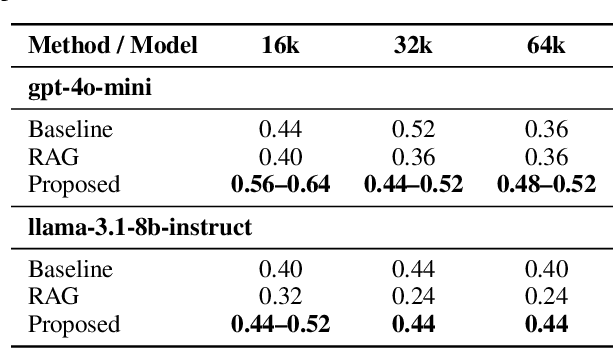
This paper addresses the challenge of comprehending very long contexts in Large Language Models (LLMs) by proposing a method that emulates Retrieval Augmented Generation (RAG) through specialized prompt engineering and chain-of-thought (CoT) reasoning. While recent LLMs support over 100,000 tokens in a single prompt, simply enlarging context windows has not guaranteed robust multi-hop reasoning when key details are scattered across massive input. Our approach treats the model as both the retriever and the reasoner: it first tags relevant segments within a long passage, then employs a stepwise CoT workflow to integrate these pieces of evidence. This single-pass method thereby reduces reliance on an external retriever, yet maintains focus on crucial segments. We evaluate our approach on selected tasks from BABILong, which interleaves standard bAbI QA problems with large amounts of distractor text. Compared to baseline (no retrieval) and naive RAG pipelines, our approach more accurately handles multi-fact questions such as object location tracking, counting, and indefinite knowledge. Furthermore, we analyze how prompt structure, including the order of question, relevant-text tags, and overall instructions, significantly affects performance. These findings underscore that optimized prompt engineering, combined with guided reasoning, can enhance LLMs' long-context comprehension and serve as a lightweight alternative to traditional retrieval pipelines.