 Add to Chrome
 Add to Firefox
 Add to Edge
Listening Between the Lines: Joint Learning of ASR Embeddings and LLM-Augmented Linguistics for Dementia Detection
Jun 26, 2026
Early detection of dementia through speech analysis offers a non-invasive screening alternative, but capturing both acoustic and linguistic biomarkers remains challenging. We propose a multimodal framework leveraging Whisper for dual-purpose extraction: acoustic representations from encoder outputs and transcripts via automatic speech recognition (ASR). For the acoustic pathway, temporal networks with attention pooling aggregate variable-length sequences into fixed-dimensional embeddings. For the linguistic pathway, we prompt a large language model (LLM) to extract interpretable features spanning lexical diversity, syntactic complexity, semantic coherence, and discourse patterns. A gated fusion network integrates both modalities. On ADReSS and ADReSSo, our method achieves F1-scores of 89.47% and 90.14%, demonstrating effective integration of acoustic and LLM-augmented linguistic features. Ablation shows that multimodal fusion consistently outperforms either modality alone.

LoRA-Tuned Large Language Models for Dementia Detection via Multi-View Speech-Derived Features
Jun 26, 2026Early detection of dementia enables timely intervention, and reflecting cognitive impairment, spontaneous speech offers a non-invasive screening modality. Conventional approaches often focus on a single representational dimension -- such as acoustic descriptors, pause modeling, automatic speech recognition (ASR) transcripts, or multimodal fusion -- limiting integrative reasoning across heterogeneous cognitive symptoms. We propose a low-rank adaptation (LoRA)-tuned large language model (LLM) that performs structured multi-view reasoning over four complementary speech-derived signals: ASR transcripts with pause markers, discourse-level topic cues, temporal fluency statistics, and phonological sequences. These cues are encoded within a unified prompt, enabling a single LLM to learn a coherent decision function without modality-specific encoders or late-stage fusion. On ADReSSo, our best model achieves an F1-score of 90.14%, and ablation confirms the complementary contribution of each view.
Efficient Obstacle Rearrangement for Object Manipulation Tasks in Cluttered Environments
Feb 19, 2019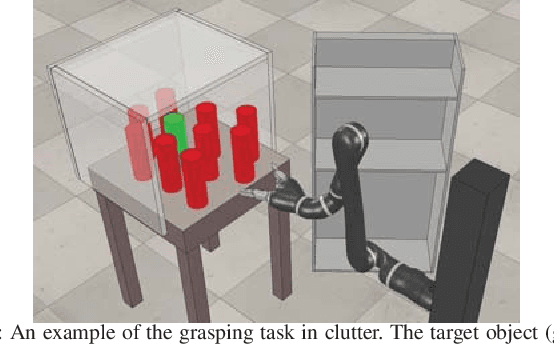
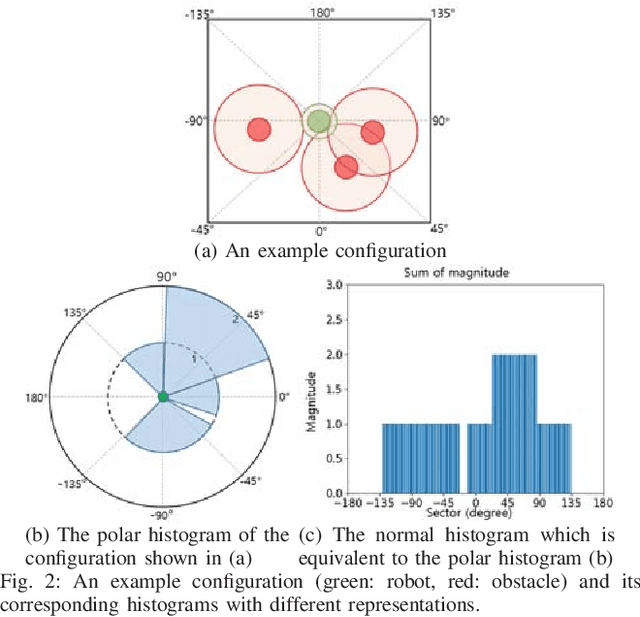
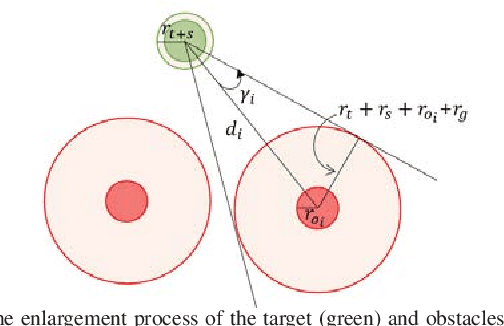
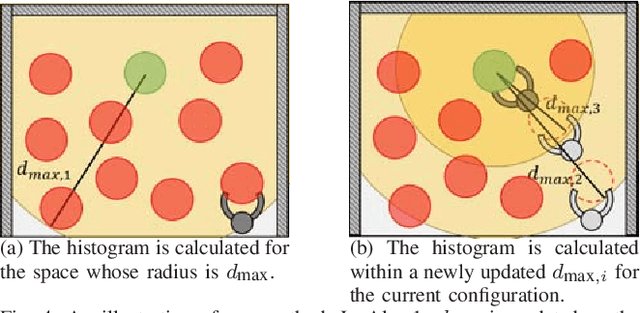
We present an algorithm that produces a plan for relocating obstacles in order to grasp a target in clutter by a robotic manipulator without collisions. We consider configurations where objects are densely populated in a constrained and confined space. Thus, there exists no collision-free path for the manipulator without relocating obstacles. Since the problem of planning for object rearrangement has shown to be NP-hard, it is difficult to perform manipulation tasks efficiently which could frequently happen in service domains (e.g., taking out a target from a shelf or a fridge). Our proposed planner employs a collision avoidance scheme which has been widely used in mobile robot navigation. The planner determines an obstacle to be removed quickly in real time. It also can deal with dynamic changes in the configuration (e.g., changes in object poses). Our method is shown to be complete and runs in polynomial time. Experimental results in a realistic simulated environment show that our method improves up to 31% of the execution time compared to other competitors.