 Add to Chrome
 Add to Firefox
 Add to Edge
Generative Adversarial Regression (GAR): Learning Conditional Risk Scenarios
Mar 09, 2026
We propose Generative Adversarial Regression (GAR), a framework for learning conditional risk scenarios through generators aligned with downstream risk objectives. GAR builds on a regression characterization of conditional risk for elicitable functionals, including quantiles, expectiles, and jointly elicitable pairs. We extend this principle from point prediction to generative modeling by training generators whose policy-induced risk matches that of real data under the same context. To ensure robustness across all policies, GAR adopts a minimax formulation in which an adversarial policy identifies worst-case discrepancies in risk evaluation while the generator adapts to eliminate them. This structure preserves alignment with the risk functional across a broad class of policies rather than a fixed, pre-specified set. We illustrate GAR through a tail-risk instantiation based on jointly elicitable $(\mathrm{VaR}, \mathrm{ES})$ objectives. Experiments on S\&P 500 data show that GAR produces scenarios that better preserve downstream risk than unconditional, econometric, and direct predictive baselines while remaining stable under adversarially selected policies.

On Generalization and Regularization via Wasserstein Distributionally Robust Optimization
Dec 12, 2022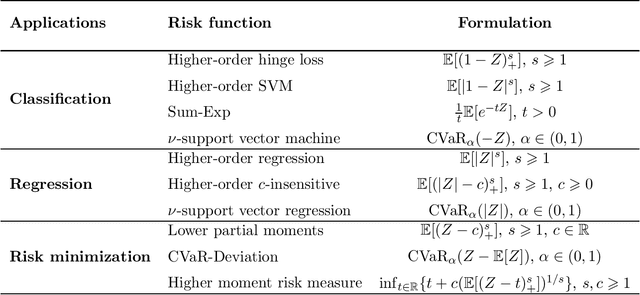
Wasserstein distributionally robust optimization (DRO) has found success in operations research and machine learning applications as a powerful means to obtain solutions with favourable out-of-sample performances. Two compelling explanations for the success are the generalization bounds derived from Wasserstein DRO and the equivalency between Wasserstein DRO and the regularization scheme commonly applied in machine learning. Existing results on generalization bounds and the equivalency to regularization are largely limited to the setting where the Wasserstein ball is of a certain type and the decision criterion takes certain forms of an expected function. In this paper, we show that by focusing on Wasserstein DRO problems with affine decision rules, it is possible to obtain generalization bounds and the equivalency to regularization in a significantly broader setting where the Wasserstein ball can be of a general type and the decision criterion can be a general measure of risk, i.e., nonlinear in distributions. This allows for accommodating many important classification, regression, and risk minimization applications that have not been addressed to date using Wasserstein DRO. Our results are strong in that the generalization bounds do not suffer from the curse of dimensionality and the equivalency to regularization is exact. As a byproduct, our regularization results broaden considerably the class of Wasserstein DRO models that can be solved efficiently via regularization formulations.