 Add to Chrome
 Add to Firefox
 Add to Edge
Accelerating Stroke MRI with Diffusion Probabilistic Models through Large-Scale Pre-training and Target-Specific Fine-Tuning
Mar 13, 2026
Purpose: To develop a data-efficient strategy for accelerated MRI reconstruction with Diffusion Probabilistic Generative Models (DPMs) that enables faster scan times in clinical stroke MRI when only limited fully-sampled data samples are available. Methods: Our simple training strategy, inspired by the foundation model paradigm, first trains a DPM on a large, diverse collection of publicly available brain MRI data in fastMRI and then fine-tunes on a small dataset from the target application using carefully selected learning rates and fine-tuning durations. The approach is evaluated on controlled fastMRI experiments and on clinical stroke MRI data with a blinded clinical reader study. Results: DPMs pre-trained on approximately 4000 subjects with non-FLAIR contrasts and fine-tuned on FLAIR data from only 20 target subjects achieve reconstruction performance comparable to models trained with substantially more target-domain FLAIR data across multiple acceleration factors. Experiments reveal that moderate fine-tuning with a reduced learning rate yields improved performance, while insufficient or excessive fine-tuning degrades reconstruction quality. When applied to clinical stroke MRI, a blinded reader study involving two neuroradiologists indicates that images reconstructed using the proposed approach from $2 \times$ accelerated data are non-inferior to standard-of-care in terms of image quality and structural delineation. Conclusion: Large-scale pre-training combined with targeted fine-tuning enables DPM-based MRI reconstruction in data-constrained, accelerated clinical stroke MRI. The proposed approach substantially reduces the need for large application-specific datasets while maintaining clinically acceptable image quality, supporting the use of foundation-inspired diffusion models for accelerated MRI in targeted applications.

INFusion: Diffusion Regularized Implicit Neural Representations for 2D and 3D accelerated MRI reconstruction
Jun 19, 2024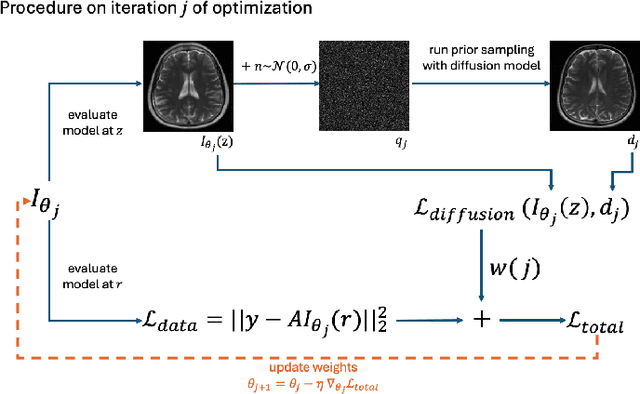
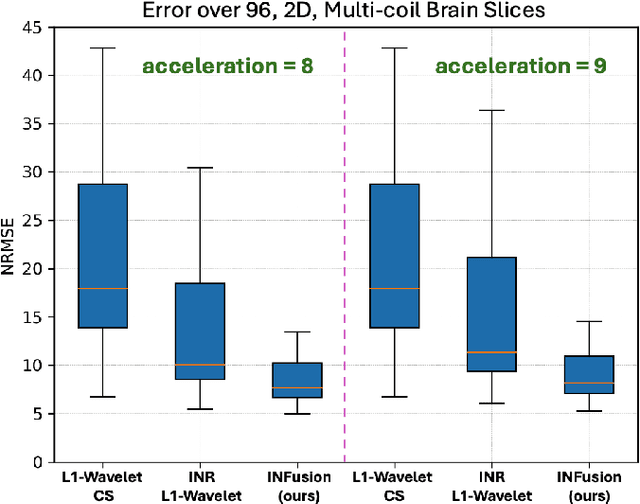
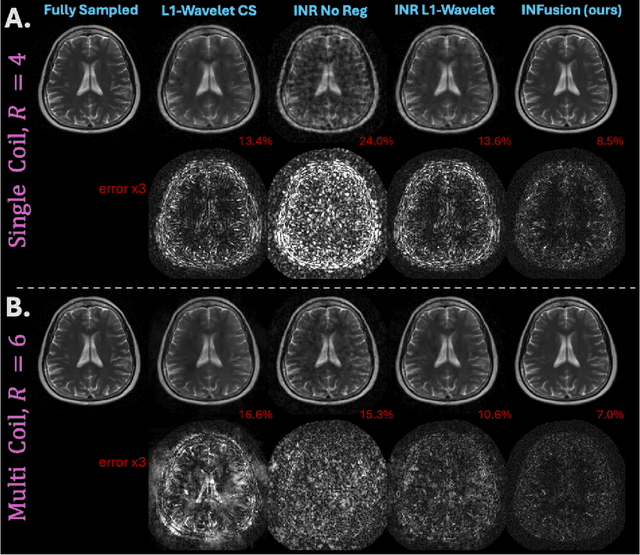
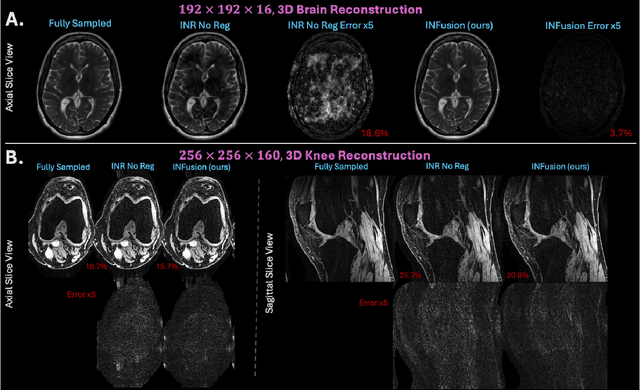
Implicit Neural Representations (INRs) are a learning-based approach to accelerate Magnetic Resonance Imaging (MRI) acquisitions, particularly in scan-specific settings when only data from the under-sampled scan itself are available. Previous work demonstrates that INRs improve rapid MRI through inherent regularization imposed by neural network architectures. Typically parameterized by fully-connected neural networks, INRs support continuous image representations by taking a physical coordinate location as input and outputting the intensity at that coordinate. Previous work has applied unlearned regularization priors during INR training and have been limited to 2D or low-resolution 3D acquisitions. Meanwhile, diffusion based generative models have received recent attention as they learn powerful image priors decoupled from the measurement model. This work proposes INFusion, a technique that regularizes the optimization of INRs from under-sampled MR measurements with pre-trained diffusion models for improved image reconstruction. In addition, we propose a hybrid 3D approach with our diffusion regularization that enables INR application on large-scale 3D MR datasets. 2D experiments demonstrate improved INR training with our proposed diffusion regularization, and 3D experiments demonstrate feasibility of INR training with diffusion regularization on 3D matrix sizes of 256 by 256 by 80.
Differentiable Rendering for Synthetic Aperture Radar Imagery
Apr 04, 2022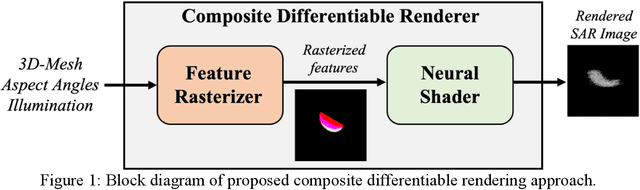
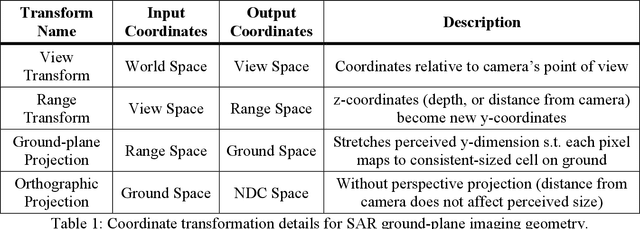

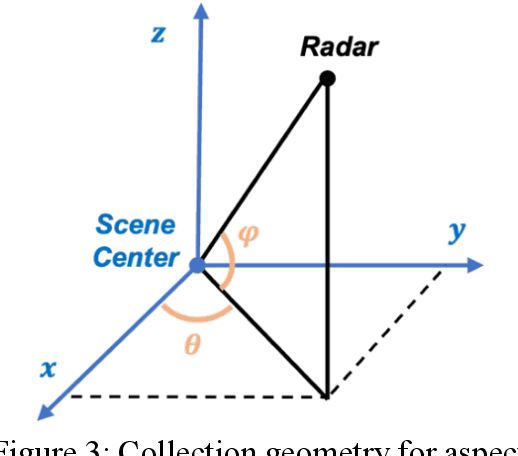
There is rising interest in integrating signal and image processing pipelines into deep learning training to incorporate more domain knowledge. This can lead to deep neural networks that are trained more robustly and with limited data, as well as the capability to solve ill-posed inverse problems. In particular, there is rising interest in differentiable rendering, which allows explicitly modeling geometric priors and constraints in the optimization pipeline using first-order methods such as backpropagation. Existing efforts in differentiable rendering have focused on imagery from electro-optical sensors, particularly conventional RGB-imagery. In this work, we propose an approach for differentiable rendering of Synthetic Aperture Radar (SAR) imagery, which combines methods from 3D computer graphics with neural rendering. We demonstrate the approach on the inverse graphics problem of 3D Object Reconstruction from limited SAR imagery using high-fidelity simulated SAR data.