 Add to Chrome
 Add to Firefox
 Add to Edge
Learning to Trace Seiberg Dualities
Jul 30, 2026
Dualities play an important role in establishing both microscopic and emergent phenomena in a wide range of physical systems. In practice, though, it can often be computationally challenging to establish when two systems are dual, even when all of the "rules of the game" are well-known. Said differently, when confronted with two systems, how can one efficiently establish that they are in fact dual? In this paper we use machine learning methods to address this question for Seiberg dualities of supersymmetric quiver gauge theories. Mathematically, this involves establishing mutations of quivers, which is in turn a variation on the theme of "learning to unknot". On the one hand, this leads us to a practical tool for establishing the computational complexity of different dualities. On the other hand, it also allows us to study how different network architectures learn how to trace Seiberg dualities. We find that for quivers with a modest number of quiver nodes (of order $10$), different network architectures consisting of transformers and multi-layer perceptrons tend to outperform deterministic algorithms. Supplementing the network by well-established pathfinder algorithms (essentially "Google Maps for quivers") leads to an additional improvement in the efficiency and accuracy of the search strategy. We anticipate that this class of questions can serve as a useful benchmark for frontier AI models applied to theoretical physics.

On the Dynamics of Inference and Learning
Apr 19, 2022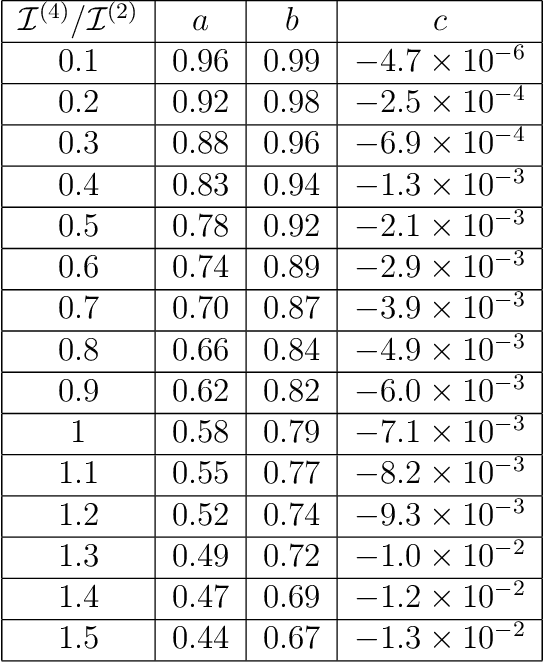
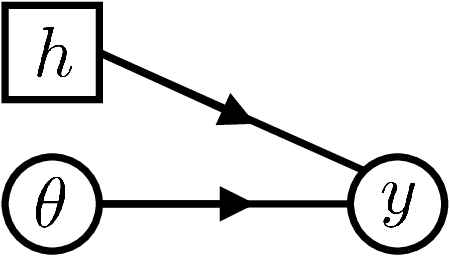
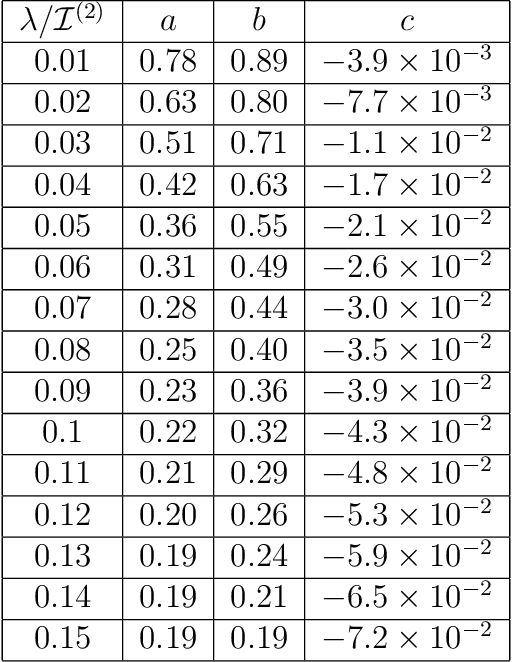
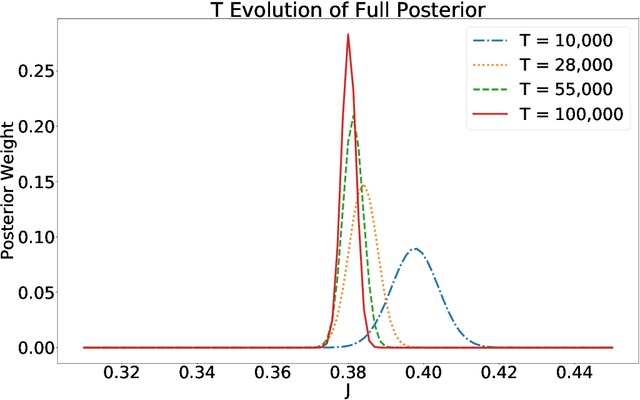
Statistical Inference is the process of determining a probability distribution over the space of parameters of a model given a data set. As more data becomes available this probability distribution becomes updated via the application of Bayes' theorem. We present a treatment of this Bayesian updating process as a continuous dynamical system. Statistical inference is then governed by a first order differential equation describing a trajectory or flow in the information geometry determined by a parametric family of models. We solve this equation for some simple models and show that when the Cram\'{e}r-Rao bound is saturated the learning rate is governed by a simple $1/T$ power-law, with $T$ a time-like variable denoting the quantity of data. The presence of hidden variables can be incorporated in this setting, leading to an additional driving term in the resulting flow equation. We illustrate this with both analytic and numerical examples based on Gaussians and Gaussian Random Processes and inference of the coupling constant in the 1D Ising model. Finally we compare the qualitative behaviour exhibited by Bayesian flows to the training of various neural networks on benchmarked data sets such as MNIST and CIFAR10 and show how that for networks exhibiting small final losses the simple power-law is also satisfied.