 Add to Chrome
 Add to Firefox
 Add to Edge
Next-Token Prediction Learns Generalisable Representations of Sleep Physiology
Jun 08, 2026
Foundation models offer a promising route to compress multi-modal physiological signals into compact representations of human health, with broad applications across sleep medicine, cardiology, neurology and other healthcare domains. Existing models have typically been trained with masked-reconstruction or contrastive objectives. However, masked reconstruction may be poorly suited to the stochastic nature of these signals, while contrastive approaches rely on positive-pair definitions despite the semantic invariances of physiological signals being poorly understood. In this work, we show that next-token prediction is a simple and scalable alternative. We develop Hypnos, a multi-modal sleep foundation model trained using eight different sensing modalities (e.g. EEG, ECG, respiratory signals) drawn from over 20,000 overnight polysomnography recordings. We tokenize each modality into streams of discrete tokens using residual vector quantization, then train a large auto-regressive RQ-Transformer to jointly predict the next token across all modalities in parallel. After training, Hypnos can be applied to continuous streams of sensor data from any subset of supported modalities, generating embeddings for downstream tasks. Across a range of benchmarks, Hypnos significantly outperforms existing foundation models. In sleep stage classification, we match the performance of strong supervised baselines on held-out test sets whilst using \(100\times\) less labelled data. Hypnos even generalises to daytime physiology, surpassing a dedicated ECG foundation model at detecting atrial fibrillation. Our results demonstrate that next-token prediction is a strong self-supervised objective for representation learning from multi-modal physiological signals.

wav2sleep: A Unified Multi-Modal Approach to Sleep Stage Classification from Physiological Signals
Nov 07, 2024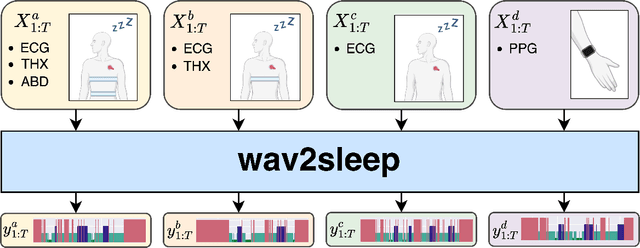
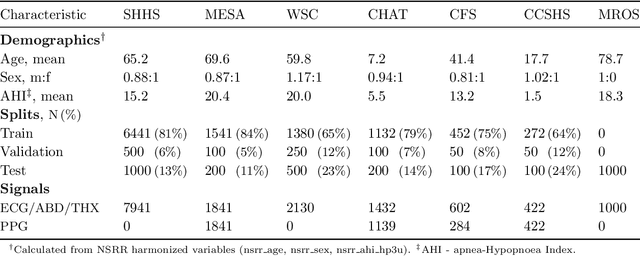
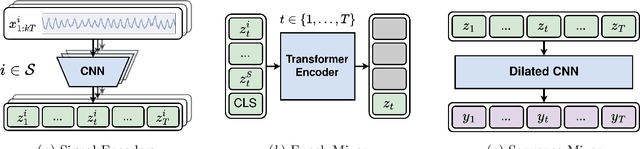
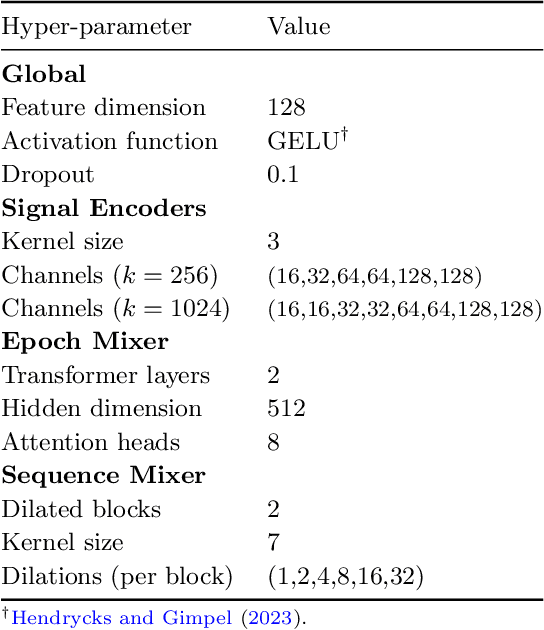
Accurate classification of sleep stages from less obtrusive sensor measurements such as the electrocardiogram (ECG) or photoplethysmogram (PPG) could enable important applications in sleep medicine. Existing approaches to this problem have typically used deep learning models designed and trained to operate on one or more specific input signals. However, the datasets used to develop these models often do not contain the same sets of input signals. Some signals, particularly PPG, are much less prevalent than others, and this has previously been addressed with techniques such as transfer learning. Additionally, only training on one or more fixed modalities precludes cross-modal information transfer from other sources, which has proved valuable in other problem domains. To address this, we introduce wav2sleep, a unified model designed to operate on variable sets of input signals during training and inference. After jointly training on over 10,000 overnight recordings from six publicly available polysomnography datasets, including SHHS and MESA, wav2sleep outperforms existing sleep stage classification models across test-time input combinations including ECG, PPG, and respiratory signals.
SleepVST: Sleep Staging from Near-Infrared Video Signals using Pre-Trained Transformers
Apr 04, 2024Advances in camera-based physiological monitoring have enabled the robust, non-contact measurement of respiration and the cardiac pulse, which are known to be indicative of the sleep stage. This has led to research into camera-based sleep monitoring as a promising alternative to "gold-standard" polysomnography, which is cumbersome, expensive to administer, and hence unsuitable for longer-term clinical studies. In this paper, we introduce SleepVST, a transformer model which enables state-of-the-art performance in camera-based sleep stage classification (sleep staging). After pre-training on contact sensor data, SleepVST outperforms existing methods for cardio-respiratory sleep staging on the SHHS and MESA datasets, achieving total Cohen's kappa scores of 0.75 and 0.77 respectively. We then show that SleepVST can be successfully transferred to cardio-respiratory waveforms extracted from video, enabling fully contact-free sleep staging. Using a video dataset of 50 nights, we achieve a total accuracy of 78.8\% and a Cohen's $\kappa$ of 0.71 in four-class video-based sleep staging, setting a new state-of-the-art in the domain.