 Add to Chrome
 Add to Firefox
 Add to Edge
Accurate Planar Tracking With Robust Re-Detection
Feb 23, 2026
We present SAM-H and WOFTSAM, novel planar trackers that combine robust long-term segmentation tracking provided by SAM 2 with 8 degrees-of-freedom homography pose estimation. SAM-H estimates homographies from segmentation mask contours and is thus highly robust to target appearance changes. WOFTSAM significantly improves the current state-of-the-art planar tracker WOFT by exploiting lost target re-detection provided by SAM-H. The proposed methods are evaluated on POT-210 and PlanarTrack tracking benchmarks, setting the new state-of-the-art performance on both. On the latter, they outperform the second best by a large margin, +12.4 and +15.2pp on the p@15 metric. We also present improved ground-truth annotations of initial PlanarTrack poses, enabling more accurate benchmarking in the high-precision p@5 metric. The code and the re-annotations are available at https://github.com/serycjon/WOFTSAM

MFTIQ: Multi-Flow Tracker with Independent Matching Quality Estimation
Nov 14, 2024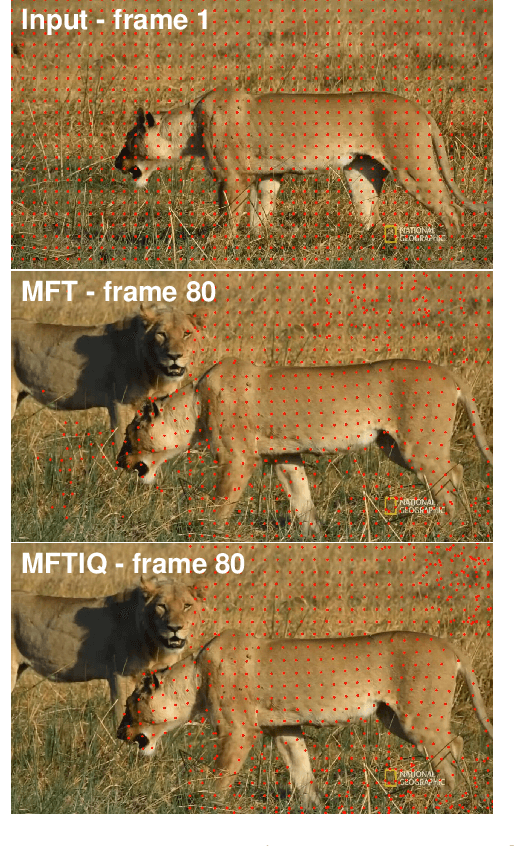
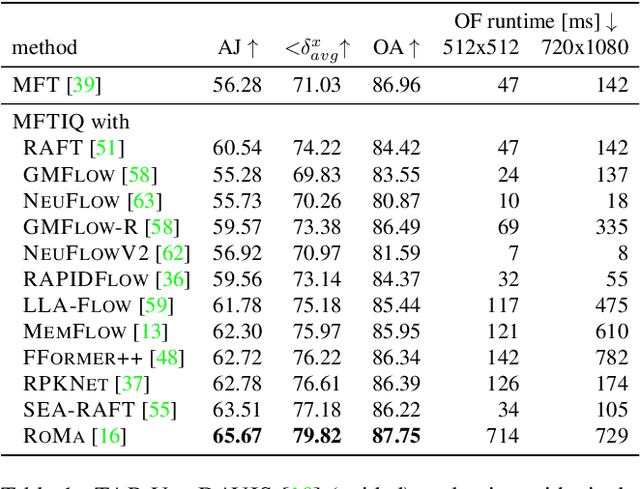
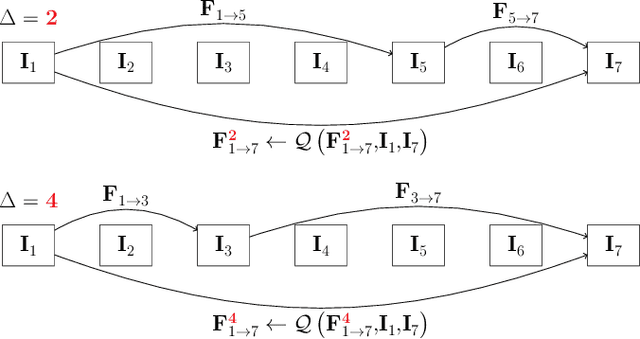
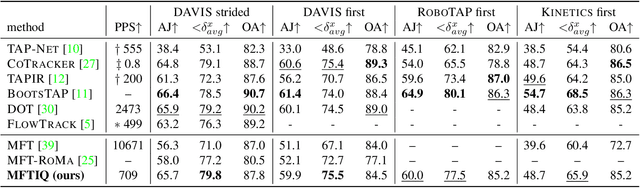
In this work, we present MFTIQ, a novel dense long-term tracking model that advances the Multi-Flow Tracker (MFT) framework to address challenges in point-level visual tracking in video sequences. MFTIQ builds upon the flow-chaining concepts of MFT, integrating an Independent Quality (IQ) module that separates correspondence quality estimation from optical flow computations. This decoupling significantly enhances the accuracy and flexibility of the tracking process, allowing MFTIQ to maintain reliable trajectory predictions even in scenarios of prolonged occlusions and complex dynamics. Designed to be "plug-and-play", MFTIQ can be employed with any off-the-shelf optical flow method without the need for fine-tuning or architectural modifications. Experimental validations on the TAP-Vid Davis dataset show that MFTIQ with RoMa optical flow not only surpasses MFT but also performs comparably to state-of-the-art trackers while having substantially faster processing speed. Code and models available at https://github.com/serycjon/MFTIQ .
Planar Object Tracking via Weighted Optical Flow
Jan 24, 2023We propose WOFT -- a novel method for planar object tracking that estimates a full 8 degrees-of-freedom pose, i.e. the homography w.r.t. a reference view. The method uses a novel module that leverages dense optical flow and assigns a weight to each optical flow correspondence, estimating a homography by weighted least squares in a fully differentiable manner. The trained module assigns zero weights to incorrect correspondences (outliers) in most cases, making the method robust and eliminating the need of the typically used non-differentiable robust estimators like RANSAC. The proposed weighted optical flow tracker (WOFT) achieves state-of-the-art performance on two benchmarks, POT-210 and POIC, tracking consistently well across a wide range of scenarios.