 Add to Chrome
 Add to Firefox
 Add to Edge
Reference-Guided Machine Unlearning
Mar 11, 2026
Machine unlearning aims to remove the influence of specific data from trained models while preserving general utility. Existing approximate unlearning methods often rely on performance-degradation heuristics, such as loss maximization or random labeling. However, these signals can be poorly conditioned, leading to unstable optimization and harming the model's generalization. We argue that unlearning should instead prioritize distributional indistinguishability, aligning the model's behavior on forget data with its behavior on truly unseen data. Motivated by this, we propose Reference-Guided Unlearning (ReGUn), a framework that leverages a disjoint held-out dataset to provide a principled, class-conditioned reference for distillation. We demonstrate across various model architectures, natural image datasets, and varying forget fractions that ReGUn consistently outperforms standard approximate baselines, achieving a superior forgetting-utility trade-off.

R-LiViT: A LiDAR-Visual-Thermal Dataset Enabling Vulnerable Road User Focused Roadside Perception
Mar 21, 2025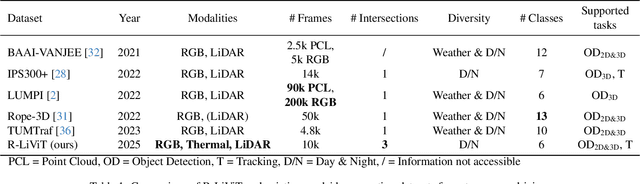
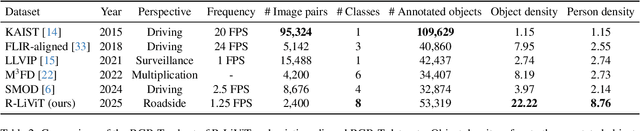
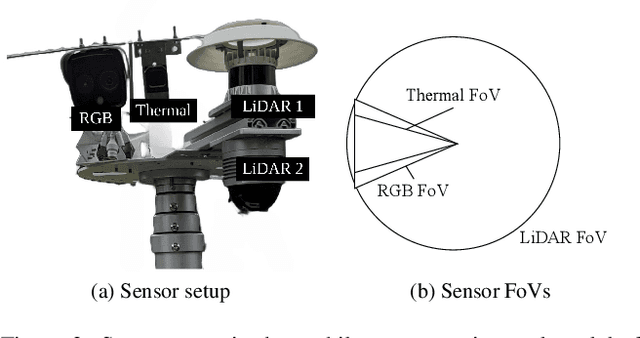

In autonomous driving, the integration of roadside perception systems is essential for overcoming occlusion challenges and enhancing the safety of Vulnerable Road Users (VRUs). While LiDAR and visual (RGB) sensors are commonly used, thermal imaging remains underrepresented in datasets, despite its acknowledged advantages for VRU detection in extreme lighting conditions. In this paper, we present R-LiViT, the first dataset to combine LiDAR, RGB, and thermal imaging from a roadside perspective, with a strong focus on VRUs. R-LiViT captures three intersections during both day and night, ensuring a diverse dataset. It includes 10,000 LiDAR frames and 2,400 temporally and spatially aligned RGB and thermal images across over 150 traffic scenarios, with 6 and 8 annotated classes respectively, providing a comprehensive resource for tasks such as object detection and tracking. The dataset1 and the code for reproducing our evaluation results2 are made publicly available.