 Add to Chrome
 Add to Firefox
 Add to Edge
Domain-Filtered Knowledge Graphs from Sparse Autoencoder Features
Apr 28, 2026
Sparse autoencoders (SAEs) extract millions of interpretable features from a language model, but flat feature inventories aren't very useful on their own. Domain concepts get mixed with generic and weakly grounded features, while related ideas are scattered across many units, and there's no way to understand relationships between features. We address this by first constructing a strict domain-specific concept universe from a large SAE inventory using contrastive activations and a multi-stage filtering process. Next, we build two aligned graph views on the filtered set: a co-occurrence graph for corpus-level conceptual structure, organized at multiple levels of granularity, and a transcoder-based mechanism graph that links source-layer and target-layer features through sparse latent pathways. Automated edge labeling then turns these graph views into readable knowledge graphs rather than unlabeled layouts. In a case study on a biology textbook, these graphs recover coherent chapter and subchapter-level structure, reveal concepts that bridge neighboring topics, and transform messy sentence-level activity containing thousands of features into compact, readable views that illustrate the model's local activity. Taken together, this reframes a flat SAE inventory as an internal knowledge graph that converts feature-level interpretability into a global map of model knowledge and enables audits of reasoning faithfulness.

Flash-SD-KDE: Accelerating SD-KDE with Tensor Cores
Feb 10, 2026Score-debiased kernel density estimation (SD-KDE) achieves improved asymptotic convergence rates over classical KDE, but its use of an empirical score has made it significantly slower in practice. We show that by re-ordering the SD-KDE computation to expose matrix-multiplication structure, Tensor Cores can be used to accelerate the GPU implementation. On a 32k-sample 16-dimensional problem, our approach runs up to $47\times$ faster than a strong SD-KDE GPU baseline and $3{,}300\times$ faster than scikit-learn's KDE. On a larger 1M-sample 16-dimensional task evaluated on 131k queries, Flash-SD-KDE completes in $2.3$ s on a single GPU, making score-debiased density estimation practical at previously infeasible scales.
Allocate Marginal Reviews to Borderline Papers Using LLM Comparative Ranking
Feb 04, 2026This paper argues that large ML conferences should allocate marginal review capacity primarily to papers near the acceptance boundary, rather than spreading extra reviews via random or affinity-driven heuristics. We propose using LLM-based comparative ranking (via pairwise comparisons and a Bradley--Terry model) to identify a borderline band \emph{before} human reviewing and to allocate \emph{marginal} reviewer capacity at assignment time. Concretely, given a venue-specific minimum review target (e.g., 3 or 4), we use this signal to decide which papers receive one additional review (e.g., a 4th or 5th), without conditioning on any human reviews and without using LLM outputs for accept/reject. We provide a simple expected-impact calculation in terms of (i) the overlap between the predicted and true borderline sets ($ρ$) and (ii) the incremental value of an extra review near the boundary ($Δ$), and we provide retrospective proxies to estimate these quantities.
LLMs are Overconfident: Evaluating Confidence Interval Calibration with FermiEval
Oct 30, 2025Large language models (LLMs) excel at numerical estimation but struggle to correctly quantify uncertainty. We study how well LLMs construct confidence intervals around their own answers and find that they are systematically overconfident. To evaluate this behavior, we introduce FermiEval, a benchmark of Fermi-style estimation questions with a rigorous scoring rule for confidence interval coverage and sharpness. Across several modern models, nominal 99\% intervals cover the true answer only 65\% of the time on average. With a conformal prediction based approach that adjusts the intervals, we obtain accurate 99\% observed coverage, and the Winkler interval score decreases by 54\%. We also propose direct log-probability elicitation and quantile adjustment methods, which further reduce overconfidence at high confidence levels. Finally, we develop a perception-tunnel theory explaining why LLMs exhibit overconfidence: when reasoning under uncertainty, they act as if sampling from a truncated region of their inferred distribution, neglecting its tails.
Score-Debiased Kernel Density Estimation
Apr 27, 2025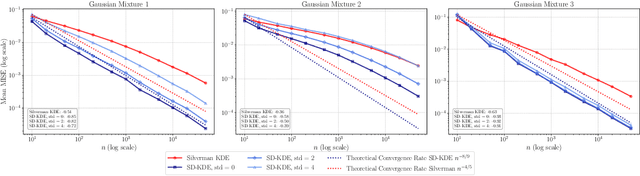
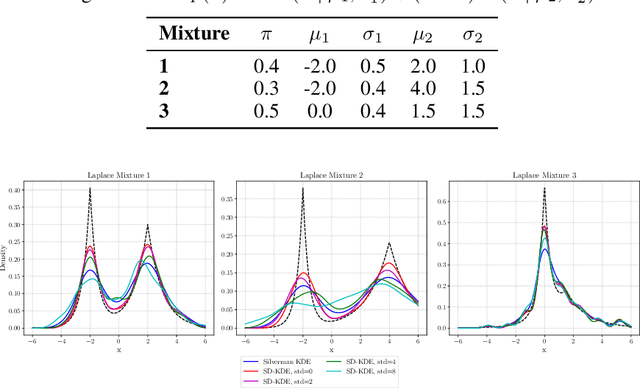
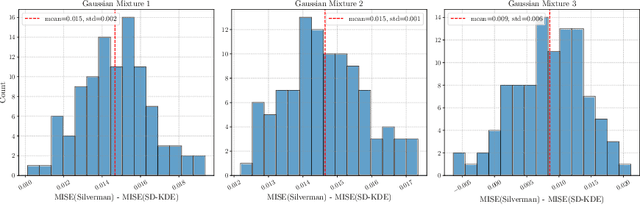
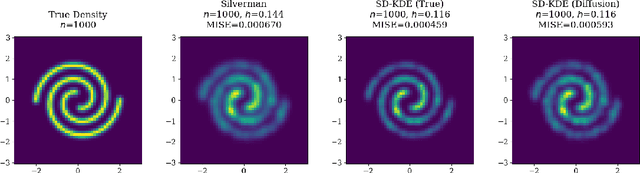
We propose a novel method for density estimation that leverages an estimated score function to debias kernel density estimation (SD-KDE). In our approach, each data point is adjusted by taking a single step along the score function with a specific choice of step size, followed by standard KDE with a modified bandwidth. The step size and modified bandwidth are chosen to remove the leading order bias in the KDE. Our experiments on synthetic tasks in 1D, 2D and on MNIST, demonstrate that our proposed SD-KDE method significantly reduces the mean integrated squared error compared to the standard Silverman KDE, even with noisy estimates in the score function. These results underscore the potential of integrating score-based corrections into nonparametric density estimation.